
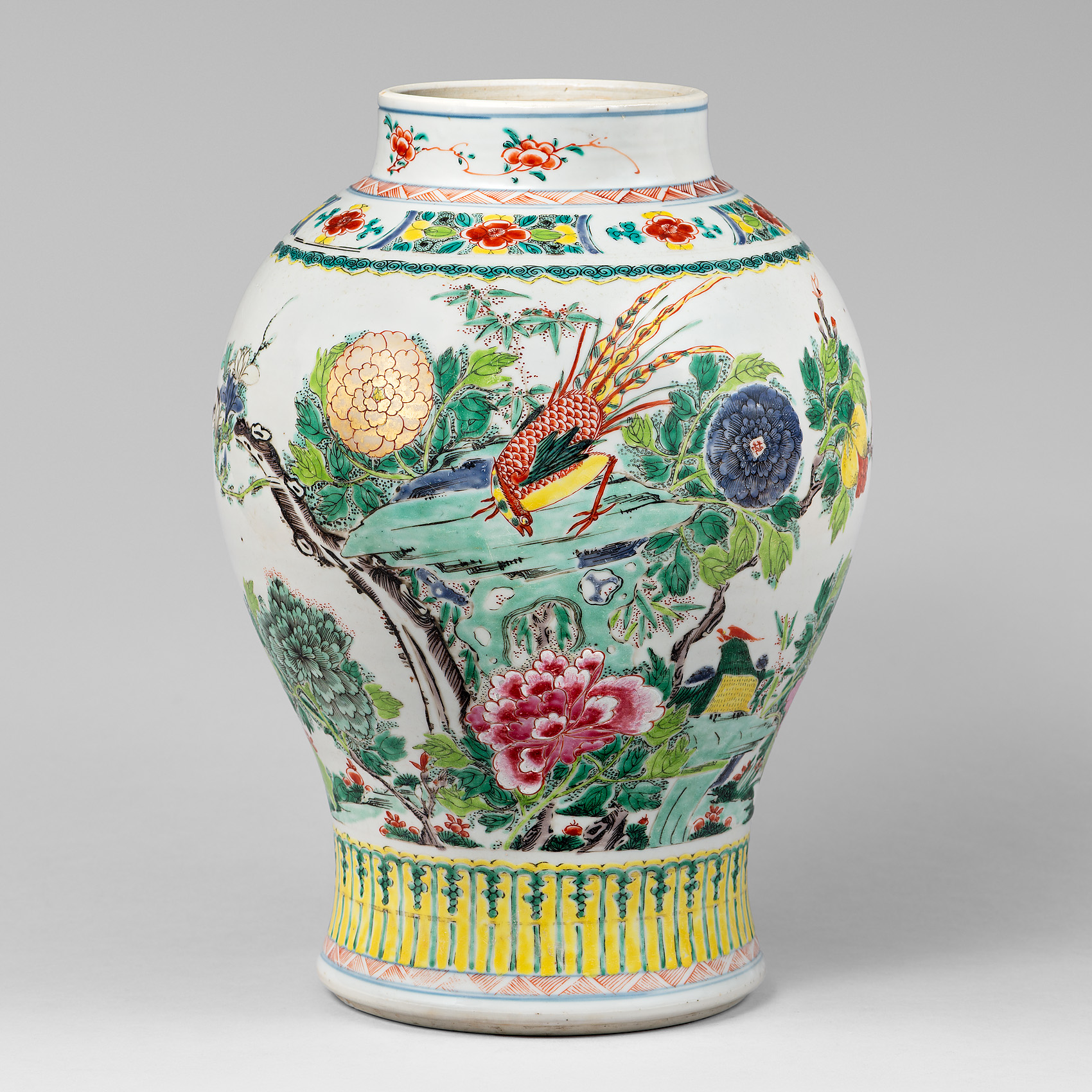
A baluster jar decorated in the famille rose-verte palette. China, early Yongzheng

The baluster vase, with its slightly flared cylindrical neck, is decorated in the famille rose-verte palette, employing yellow, aubergine, green, blue and iron-red enamels. It stands on a short spreading foot and features a generously rounded body, whose fullness contrasts elegantly with the restrained form of the neck.

The principal decoration unfolds across the body as a luxuriant flowering garden scene. At the centre of the composition are two pheasants, one of which is perched upon a pierced garden rock. Around them flourishes an abundance of vegetation, including peonies, chrysanthemums and other garden flowers rendered in a rich polychrome palette. The shoulder is encircled by a decorative band punctuated with cartouches enclosing floral compositions, while the neck is adorned with delicate flowering branches painted in iron red. A narrow band of pale red diaper pattern marks the transition between the neck and the shoulder. The lower part of the body is framed by a substantial architectural border composed of vertical reserves. The iconography combines several themes particularly favoured under the Qing dynasty: floral abundance, auspicious birds, and pierced rocks, the latter serving as emblems of longevity and scholarly cultivation.

COUNTRY : China
TIME: Early Yongzheng (1723-1735)
MATERIAL : Porcelain
SIZE : 36 cm
REFERENCE : E963
PROVENANCE : Acquired by the previous owner in London, circa 1960–1980
STATUS : vendu
Additional information.

Decorated in the transitional famille rose-verte palette, this vase exemplifies one of the most innovative periods in the history of Chinese porcelain. Developed at the end of the Kangxi reign (1662–1722) and during the early years of the Yongzheng period (1723–1735), this palette combines a distinctly Kangxi-style decorative vocabulary and iconography—such as that seen here—with the green, yellow and aubergine enamels inherited from the famille verte tradition, enriched by the newly introduced opaque pink enamels that appeared in China at the beginning of the eighteenth century. Unlike later famille rose porcelains, characterised by subtle modelling and delicate tonal gradations, famille rose-verte wares retain the decorative vigour, bold outlines and graphic strength that define the finest Kangxi productions.

For many specialists, porcelains decorated in the famille rose-verte palette represent one of the high points of Qing ceramic production. They preserve the remarkable graphic energy of the Kangxi period while benefiting from the technical innovations that would ultimately give rise to the fully developed famille rose palette. Often executed on porcelain of hight quality, they are also considerably rarer than the more widely encountered famille rose wares of the Qianlong period, further enhancing their appeal among collectors and connoisseurs.

Question about condition report

Question about condition report