
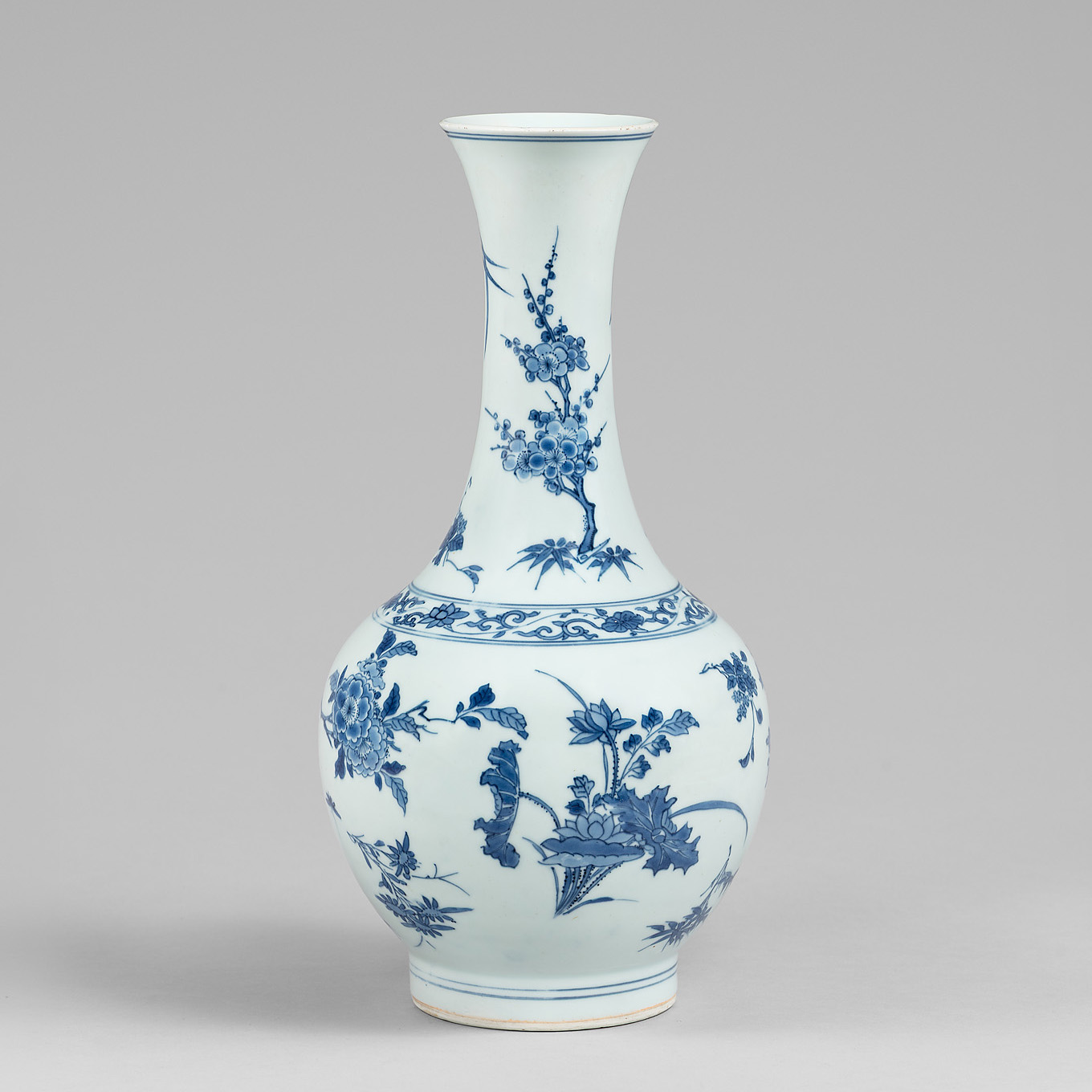
A blue and white bottle vase decorated with flowers. China, Transitional period, circa 1630-1650

The vase has a globular rounded body and is surmounted by a tall cylindrical flaring neck. It is supported on a short foot and finely painted in underglaze cobalt blue with a continuous composition of flowers. The body is painted with luxuriant peonies in full bloom, flowering branches of prunus laden with blossoms and buds, lotus rising above broad aquatic leaves, clumps of bamboo, complemented by a variety of secondary flowering plants like orchids. The shoulder is encircled by an elegant frieze of alternating lotus blossoms and scrolling foliage, while the neck is further embellished with flowering branches of prunus and peonies. The decoration is enclosed between two continuous lines, one at the rim and the other above the foot.


COUNTRY : China
TIME: Ming dynasty, Transitional period, circa 1630-1650
MATERIAL : Porcelain
SIZE : 36 cm
REFERENCE : F024
PROVENANCE : From a private collection of the bourbonnais
STATUS : vendu
Related works .

A bottle vase of similar form painted with four figures is illustrated by Sir Michael Butler in Seventeenth Century Chinese Porcelain from the Butler Family Collection, no. 40, p. 81.

Additional information.

Beyond its decorative appeal, the composition embodies a sophisticated symbolic programme deeply rooted in Chinese literati culture. The combination of prunus, bamboo, lotus and peony brings together some of the most emblematic plants of the Chinese decorative repertoire. The prunus (梅), which blossoms in winter, symbolises resilience and renewal; the bamboo (竹), one of the Three Friends of Winter, represents integrity, steadfastness and moral strength; the lotus (莲), closely associated with Buddhism, embodies purity and spiritual perfection; while the peony (牡丹), often referred to as the “King of Flowers”, remains the emblem of wealth, honour and prosperity. Rather than illustrating a strictly codified iconographic programme, the decoration combines several of the most auspicious plants in the Chinese tradition to create a particularly harmonious and elegant composition.

The painting exemplifies the finest achievements of the Jingdezhen kilns during the Transitional period. Executed with a fluid, confident brush and subtle gradations of cobalt blue, ranging from deep sapphire tones to delicate washes, the decoration recalls the spontaneity of contemporary ink painting. This freedom of execution, combined with a balanced and naturalistic composition, is one of the finest Transitional blue and white porcelains of the end of the first half of the seventeenth century.


Question about condition report

Question about condition report