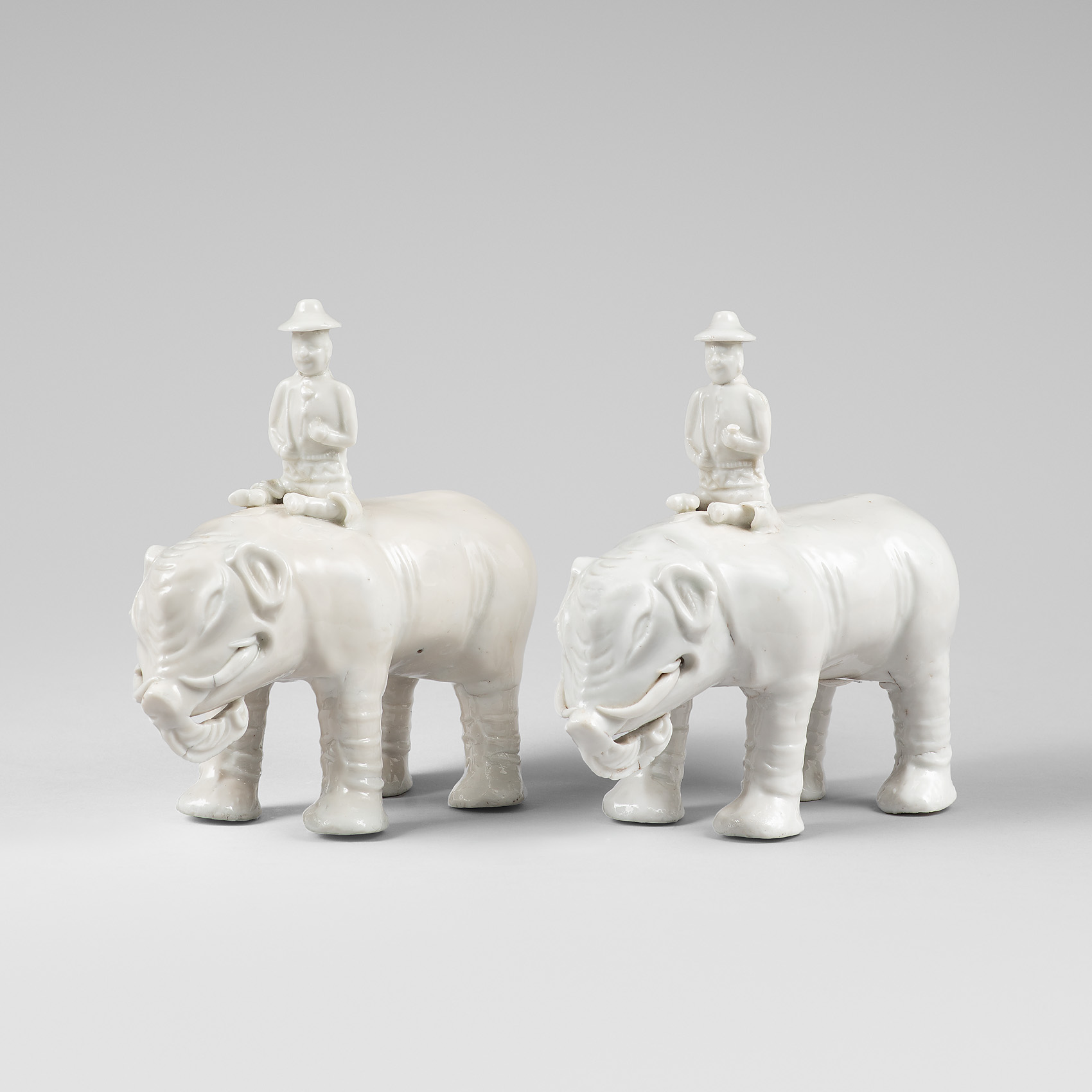
A pair of Blanc de Chine figures of foreigners riding elephants. China, Kangxi

Each figure is finely moulded as a foreigner seated atop an elephant standing foursquare. The rider wears a conical hat, a buttoned jacket with an elaborate waistband, and boots, and holds an ankus (elephant goad). The animal is rendered with almond-shaped eyes beneath lotus-like ears, a long curling trunk between sharp tusks, and a wrinkled body, all covered with a creamy white glaze.
COUNTRY : China
TIME: Kangxi (1662-1722)
MATERIAL : Porcelain
SIZE : 19 cm
REFERENCE : E930
PROVENANCE : From a European Collection
STATUS : disponible
Related works.

A pair of very similar examples were published by Marchant in their Exhibition of Blanc de Chine, 2014[1]. A similar group is illustrated by Patrick J. Donnelly in Blanc de Chine[2]. A model of an elephant without a rider was in the royal collections of Augustus the Strong[3].

[1] no. 49

[2] pl. 110, no. 341

[3] Porzellansammlung, inv. number PO 8508

Additional information.

As elephants had become extinct in China centuries earlier, they were not directly known to local craftsmen. The animal nonetheless retained a prominent status, particularly within Buddhism, as a symbol of wisdom and spiritual strength.

Elephants were also a subject of fascination in Europe. During the festivities held in Dresden in June 1709 for the visit of Frederick IV of Denmark, Augustus the Strong—Elector of Saxony and King of Poland—led the ‘African Quadrille’ in the Carousel of the Four Continents, which boasted elephant-shaped machines. The elephant motif was integrated into the decoration of the Zwinger Palace, built in 1711, and served as a major source of inspiration for Meissen modellers, most notably Gottlieb Kirchner.

In 1668, the King of Portugal presented an elephant to Louis XIV for the Royal Menagerie at Versailles. The Manufacture of Chantilly was similarly inspired by the animal, producing models of elephants” in white soft-paste porcelain[1]. Other models also crafted  in Japan with a Kakiemon decor.

[1] Gardiner Museum of Toronto

See other items

Question about condition report