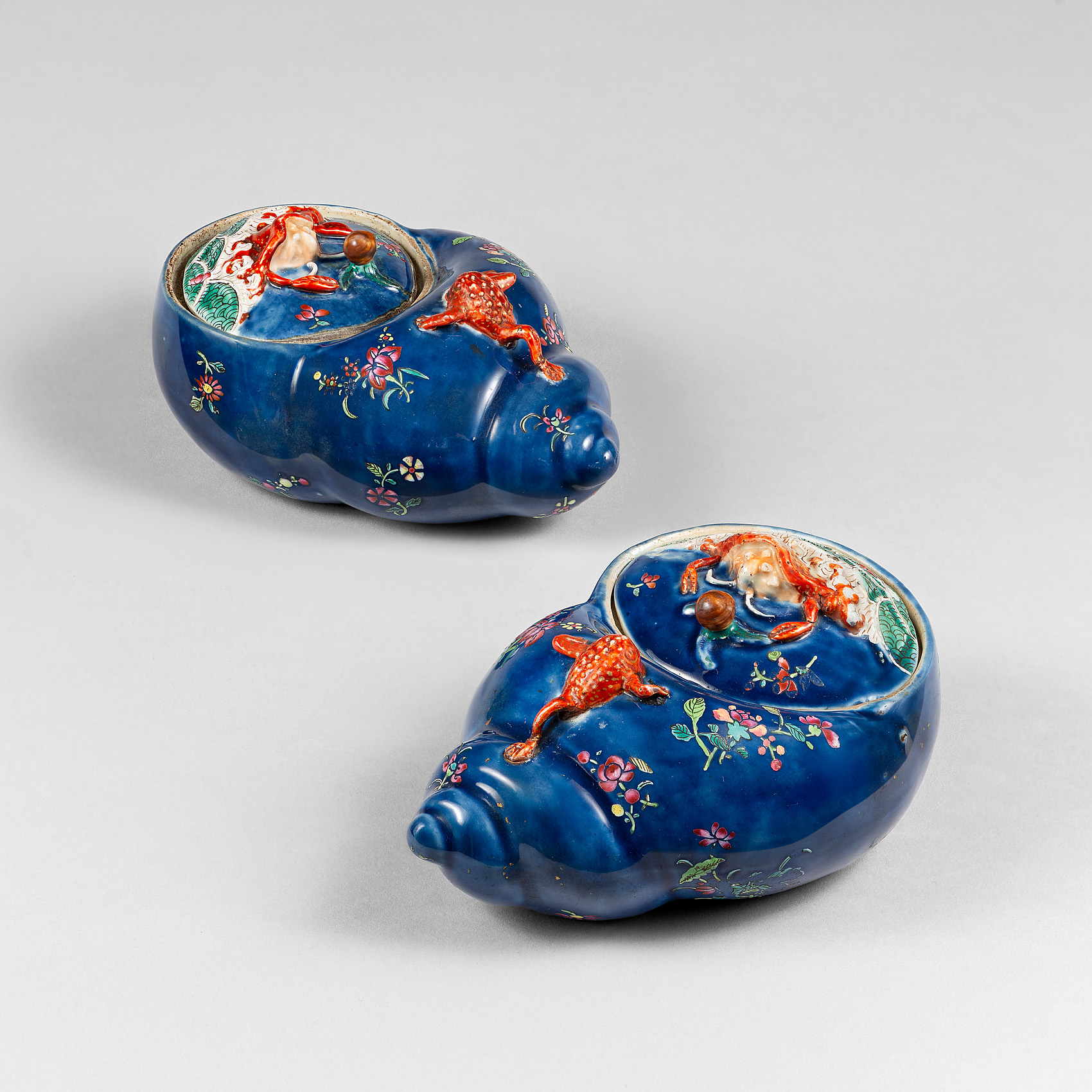
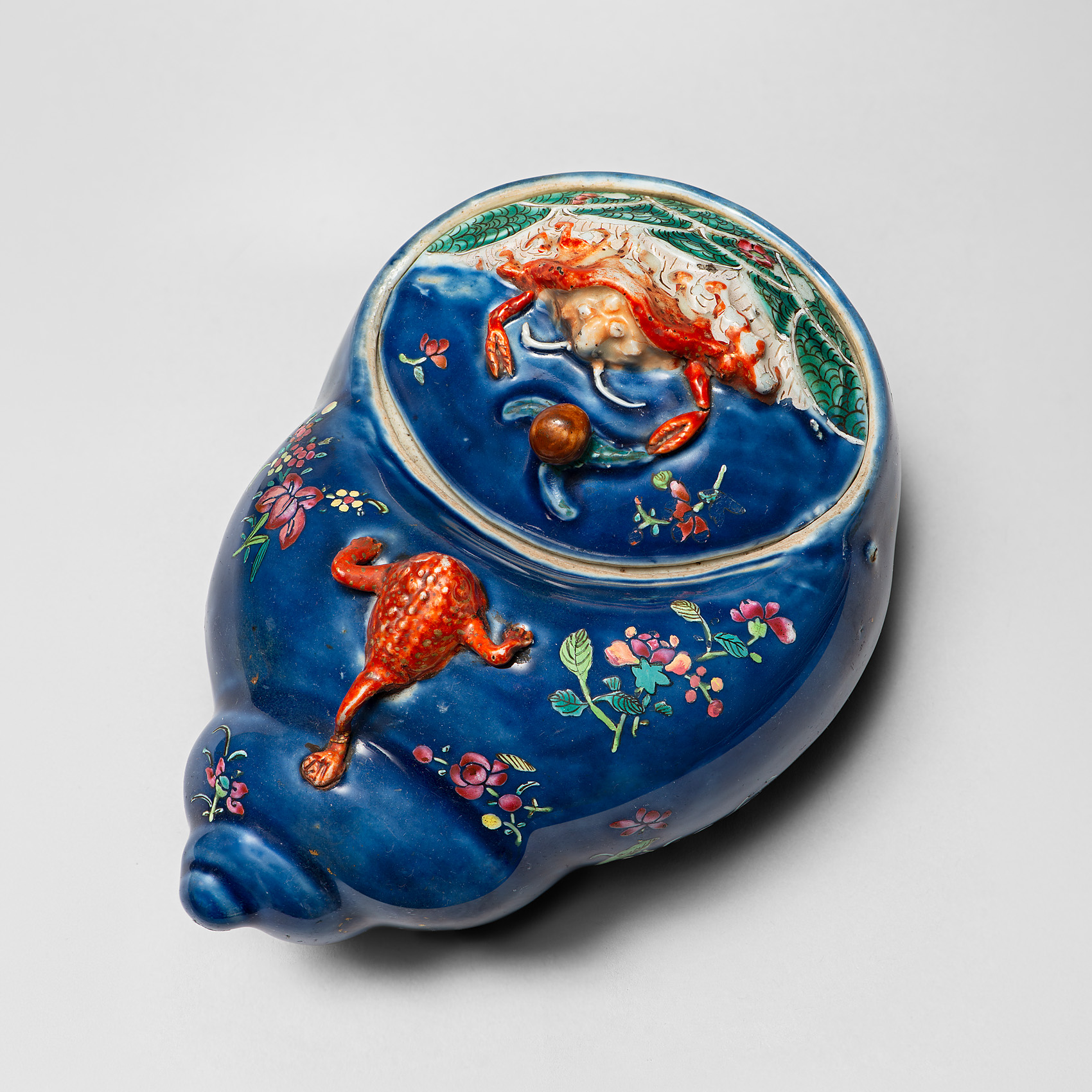
Additional information.The presence of the three-legged toad (Sanzuchan) elevates these tureens from mere table service to a charming tableau of Chinese folklore. In the Chinese imagination, this mythical creature—more commonly known as Jin Chan (the ‘Golden Toad’)—is believed to attract and generate abundance. It is the inseparable companion of Liu Hai, a Daoist immortal closely associated with wealth and prosperity. According to legend, the toad lived in a deep well and could only be lured out by Liu Hai’s golden coins. In the most whimsical expressions of Chinese popular iconography, Liu Hai is often depicted in a state of joyful exuberance, brandishing a long string of cash (copper coins) which he uses like a skipping rope to play with his elusive friend.
With its hard shell and powerful claws, the crab serves as a dynamic counterpoint. It embodies defence and combativeness, at times suggesting confrontation or rivalry. Beyond its martial appearance, the crab (xie蟹) offers a pun on the word harmony (xie 谐), while serving as a potent symbol of social advancement through the imperial examinations. This explains its frequent appearance on the scholar’s desk, most notably in the form of porcelain water-droppers used for the preparation of ink. Its association here with the whelk shell creates a ‘double shell’, reinforcing the promise of social advancement: the word for shell (jia 甲) also denotes ‘Number One’ in classical enumerations, serving as a shorthand for the highest rank in the imperial examinations. The pearl, placed between the toad and the crustacean, functions as a symbolic treasure, creating a visual tension suggestive of a contest for wealth or auspicious power.
Beyond this symbolic battle, the crab carries a sophisticated cultural resonance linked to the culinary arts. In China, the consumption of crab is an autumnal ritual. Eating crab was a test of dexterity and breeding. A refined guest would approach the dish using the Xie Ba Jian, a specialized set of eight silver tools, extracting every morsel with surgical precision without ever losing their composure or staining their silks. In a Chinese context, tureens shaped like sea-shells and adorned with a crab celebrate both the bounty of the sea and the sophisticated etiquette of the ruling elite.
During the eighteenth century, Conchophilia—the collecting and study of shells—flourished at the intersection of science and luxury. Rare exotic specimens were the pride of the Central European Schatzkammern (treasure chambers), where they were often heightened by sumptuous silver-gilt or ormolu mounts, transforming a natural “curiosity” into a princely objet de vertu. The shell, stylized with endlessly jagged and convoluted contours, became the quintessential motif for rococo ornamentists.
This fascination with shells is intertwined with the taste for Chinese wares in the celebrated trade card of the marchand-mercier Edme-François Gersaint, engraved after François Boucher (1740) for his gallery ‘À la Pagode’. The composition illustrates a blend of lacquer cabinets, fine porcelains, and natural-history specimens like corals and shells. An accomplished extant expression of this taste is the pair of shell-shaped pot-pourri[1] vases in the J. Paul Getty Museum, where sea-green celadon shells are encased in ormolu mounts. While the Getty vases were designed to diffuse fragrance, the present tureens shift the sensory pleasure from scent to the delights of the palate.
These vessels were probably intended for the service of sauces—a culinary genre that saw unprecedented development during the eighteenth century. This period marked the rise of culinary refinement the intimate setting of the Petits Appartements at Versailles. In an atmosphere of sophisticated leisure, the art of the saucier flourished, creating a lasting impact on Western gastronomy by establishing sauces as the foundation of French culinary prestige. On such tables, the meal was fully embedded in a culture of display and staging. Sculptural forms, illusionistic decoration, and precious materials were designed to evoke surprise and delight, engaging the eye as much as the palate. The table thus became a space of aesthetic experimentation, where the decorative arts and the new science of cookery interacted closely with evolving social customs. The intimate dining culture of the Petits Appartements is famously captured in the memoirs of the Duc de Croÿ (1718–1784). On a singular evening in January 1754, Louis XV invited his guests to help him unpack a new delivery of porcelain from the royal manufactory. Far from being mutually exclusive, these prestigious home-grown productions shared the stage with imported Far Eastern wares.
[1] 77.DI.90