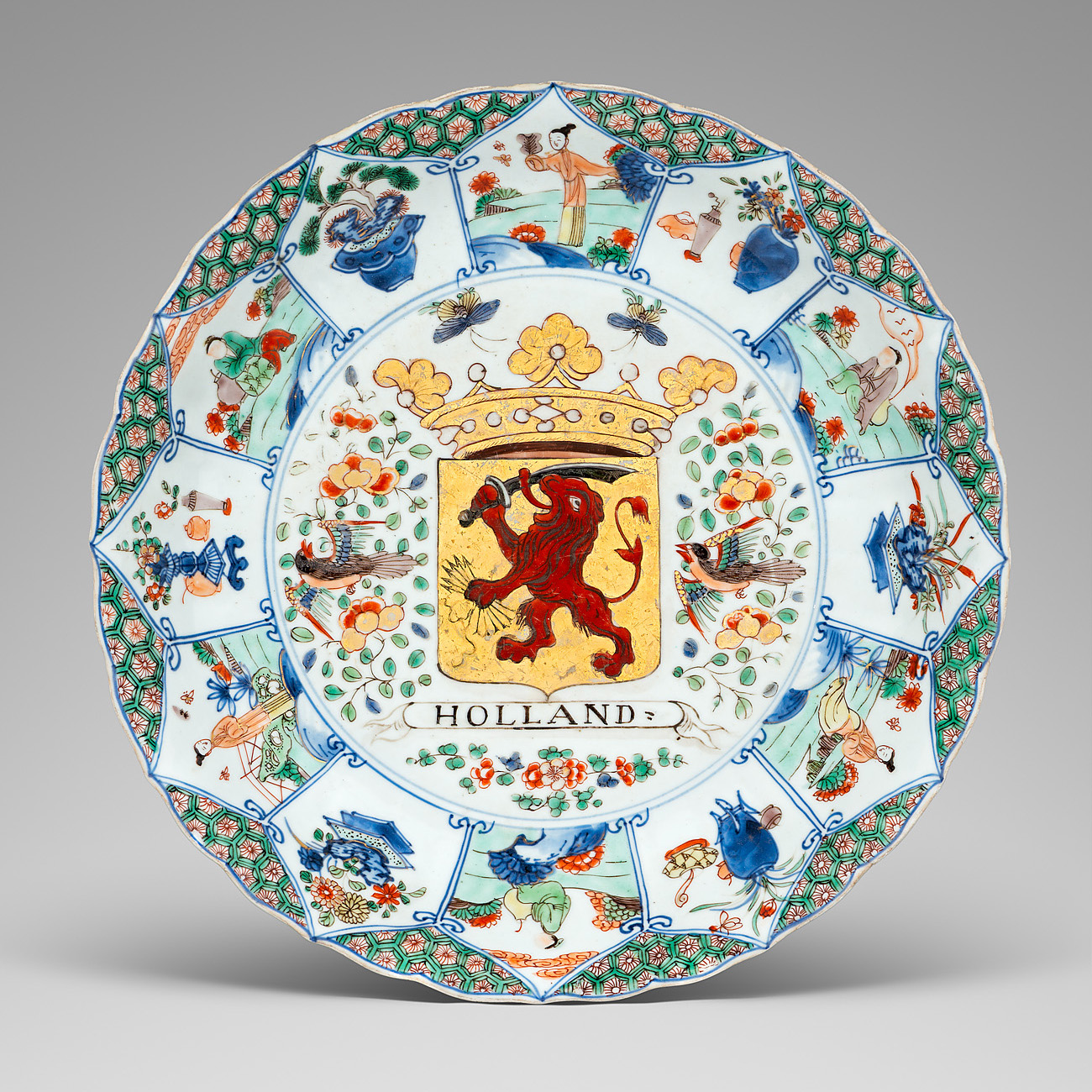
Additional information.For a discussion on these series, see Christiaan Jörg in Famille Verte: Chinese Porcelain in Green Enamels, BAI-Schoten – Belgium, Groninger Museum, 2011, p. 172.
This discussion examines the remarkable series of Chinese famille verte porcelain dishes, chargers and shaving bowls decorated with the coats of arms of Dutch provinces, counties and cities, as well as those of England and France. Such decoration is highly unusual on famille verte porcelain, which was rarely adorned with Western subjects or heraldic devices. The series comprises the arms of 21 different territories, cities and countries, including Holland, Zeeland, Friesland, Utrecht, Groningen, Amsterdam, Rotterdam, Antwerp, Brabant, Flanders and Luxembourg. Christiaan Jörg suggests that these porcelains were manufactured in relatively substantial quantities over several years, reflecting a sustained demand for this particular type of armorial decoration.
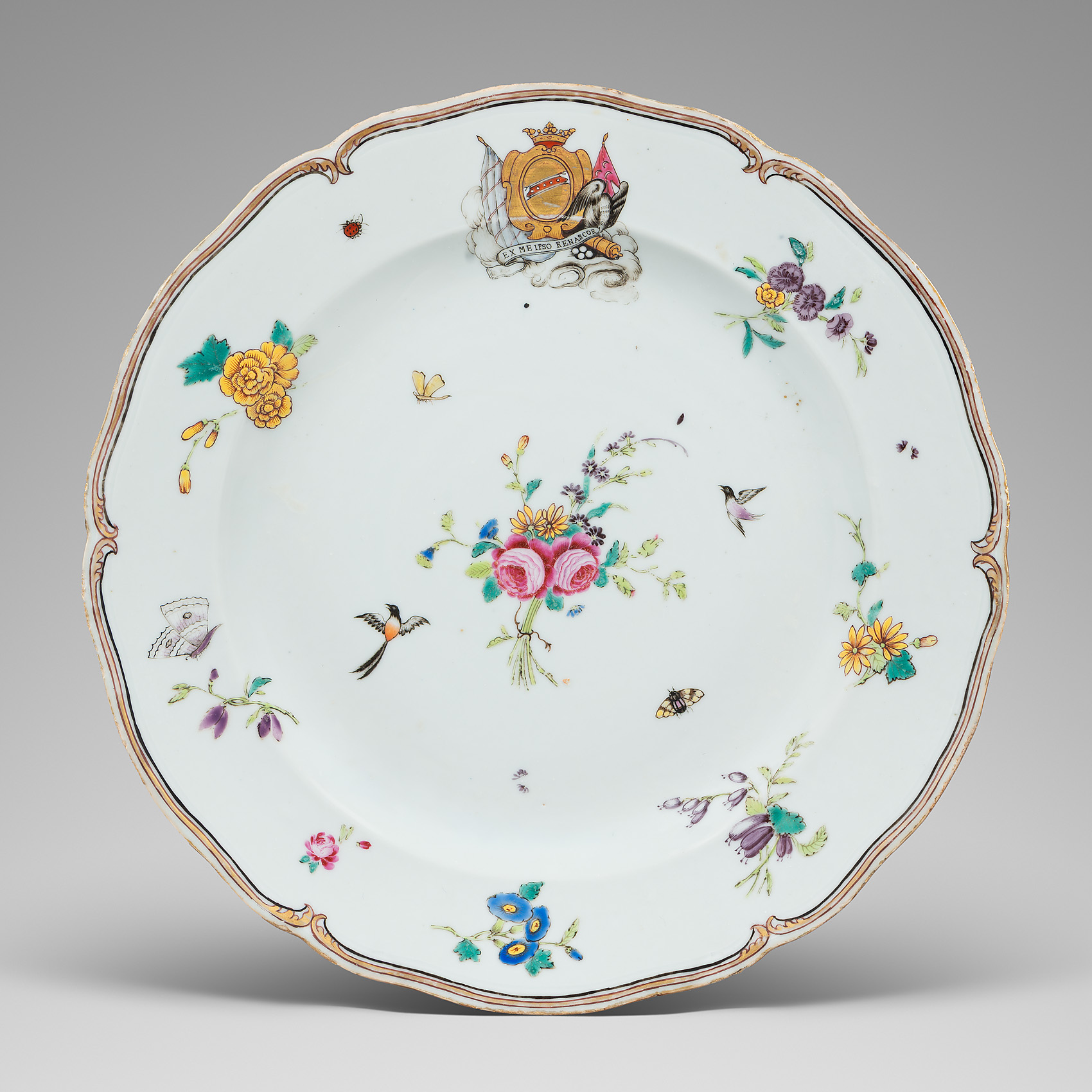
The central questions concern their date and place of manufacture, the identity of their patrons, their intended function and the significance of the heraldic designs. The author identifies five groups, distinguished by their shapes, dimensions, border patterns and enamel decoration. Groups 1 and 2 display the traditional famille verte palette, whereas groups 3 and 5 incorporate early pink enamels, providing valuable evidence for their chronology. He proposes a general date of 1710–1725, while suggesting that the different groups were commissioned over a period of approximately fifteen to twenty years. The author considers it unlikely that these porcelains resulted from an official commission by the Dutch East India Company (VOC). Instead, he favours private commissions arranged through merchants or intermediaries operating in Batavia. At the beginning of the eighteenth century, European merchants and private individuals were already able to commission Chinese porcelain decorated according to drawings or models supplied from Europe. The author cites an illuminating document dated 1706, concerning a German soldier in Batavia who ordered a large five-piece garniture bearing the arms of Frederick I of Prussia. The soldier supplied a drawing of the arms, which was attached to the contract. This document demonstrates that Chinese workshops were willing to execute highly specific heraldic commissions for individual European customers. The author therefore suggests that the Dutch armorial dishes and shaving bowls were probably commissioned privately, rather than as part of an official VOC programme.
The selection of the coats of arms remains one of the most intriguing aspects of the series. Christiaan Jörg explores the possibility that these porcelains reflect the political transformations affecting the Low Countries during and after the War of the Spanish Succession (1701–1714). Following the Treaties of Utrecht (1713) and Rastatt (1714), the Southern Netherlands passed from Spanish to Austrian Habsburg control. These developments may have encouraged renewed interest in the historical unity of the Seventeen Provinces, which had once formed part of the Habsburg Netherlands. The author suggests that the series may reflect a nostalgic or political interest in this earlier territorial configuration. The inclusion of the arms of England and France might also relate to the shifting diplomatic alliances and political relationships of the period. However, he remains cautious. No documentary evidence establishes that these porcelains were commissioned to commemorate a particular political event. Their heraldic programme may have carried a broader historical or symbolic meaning, but its precise significance remains uncertain.
Christiaan Jörg argues that these porcelains were primarily intended for decorative display rather than practical use at the table. Their large dimensions, elaborate decoration and, in the case of the shaving bowls, suspension holes suggest that they were designed to be exhibited in European interiors. An important documentary reference supports this interpretation. The inventory of Abraham van Gerwen, dated 14 December 1727, records: “18 large, medium-sized and small dishes with the coat of arms of different provinces and cities.” Abraham van Gerwen (1663–1727) was a lawyer at the Court of Holland, burgomaster of Leiden and one of the directors of the VOC. This inventory provides valuable contemporary evidence that such armorial dishes were already present in distinguished Dutch collections by 1727. The reference to three different sizes strongly suggests that these dishes belonged to group 1. It also establishes that these porcelains were appreciated as decorative objects within the homes of wealthy and influential Dutch patrons.