Additional information.Blanc de Chine refers to the white porcelain produced primarily at Dehua, in Fujian province, from the late Ming dynasty throughout the Qing period. Renowned for the purity of its body, its warm, ivory-toned hue, and the soft, satin-like quality of its glaze, this porcelain is distinct from the production of Jingdezhen. Initially intended for religious and domestic use—particularly for Buddhist and Daoist figures, incense burners, and ritual objects—the Dehua kilns developed an exceptional mastery of modelling, favouring sculptural form and the subtle play of light over painted decoration.
Although its predecessor, qingbai ware (literally ‘green-white’), appeared as early as the Northern Song dynasty (960–1127), true Blanc de Chine was not produced until the mid-Ming dynasty (1368–1644). The technique reached its peak in the seventeenth century, when it became highly prized on both domestic and European markets for its refined restraint.
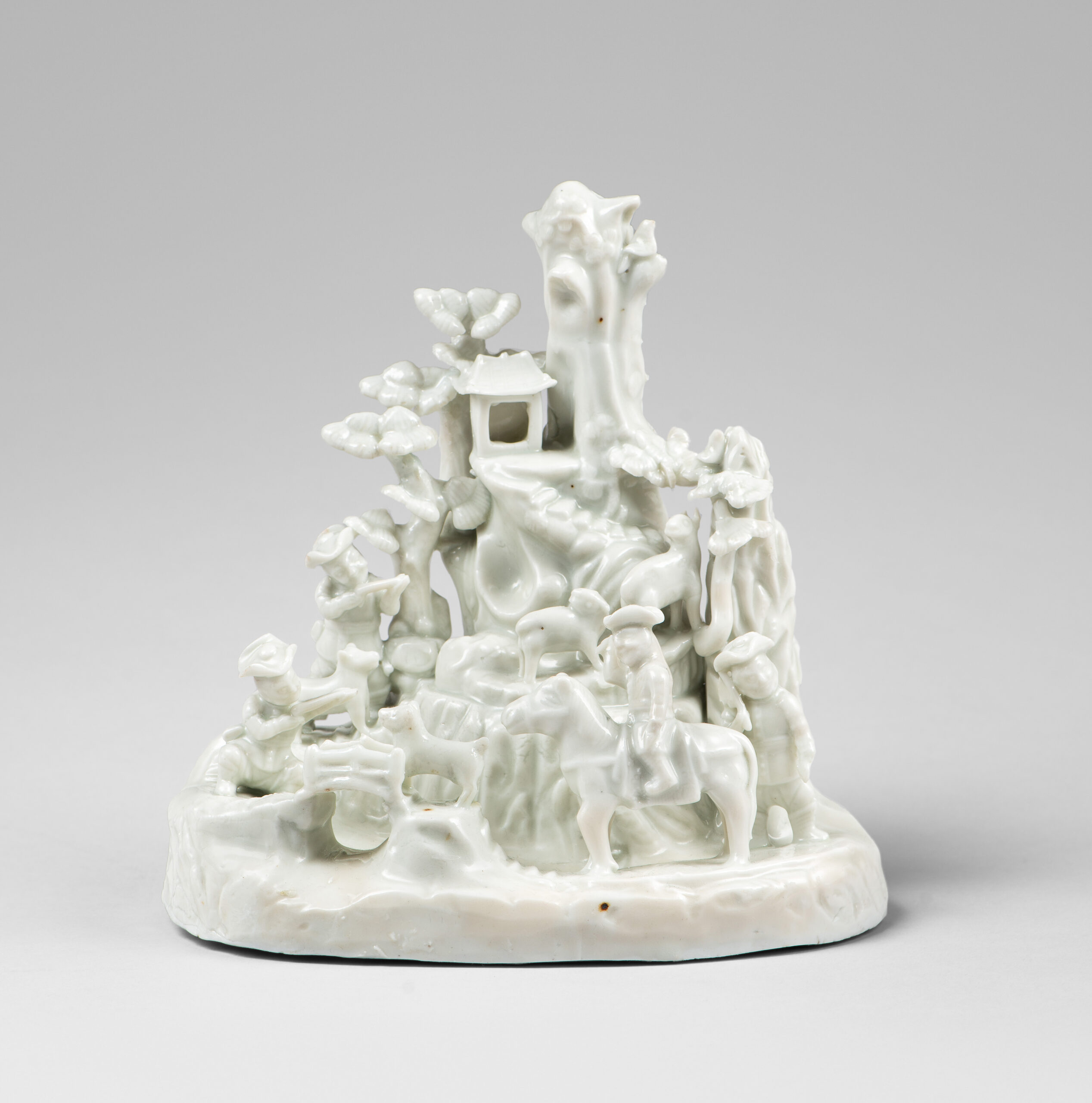
Depictions of hunting in Blanc de Chine appealed to both Chinese and European clients. During the early Qing dynasty (1644–1911), hunting emerged as a vital political and leisure activity, serving the Kangxi Emperor both as a form of recreation and a means to inspect his empire. This renewed imperial interest led to the creation of numerous hunting parks, conceived as miniature representations of the empire. These vast enclosures incorporated regional flora and fauna, functioning as both symbolic landscapes and preserved nature reserves.
Although this figural group draws inspiration from Kangxi-period hunting imagery, it is remarkable for its depiction of Western figures, strongly suggesting that it was produced specifically for export to Europe.
A number of variations of the present scene are known, such as a piece[1] heldt at the British Museum (London) depicting a European in a Chinese landscape with a similar pavilion. A closely related figural group[2] is held in the Koger Collection at the Ringling Museum, Sarasota, Florida.
[1] Inv. NO. F.578 B
[2] Inv. no. SN11122.18