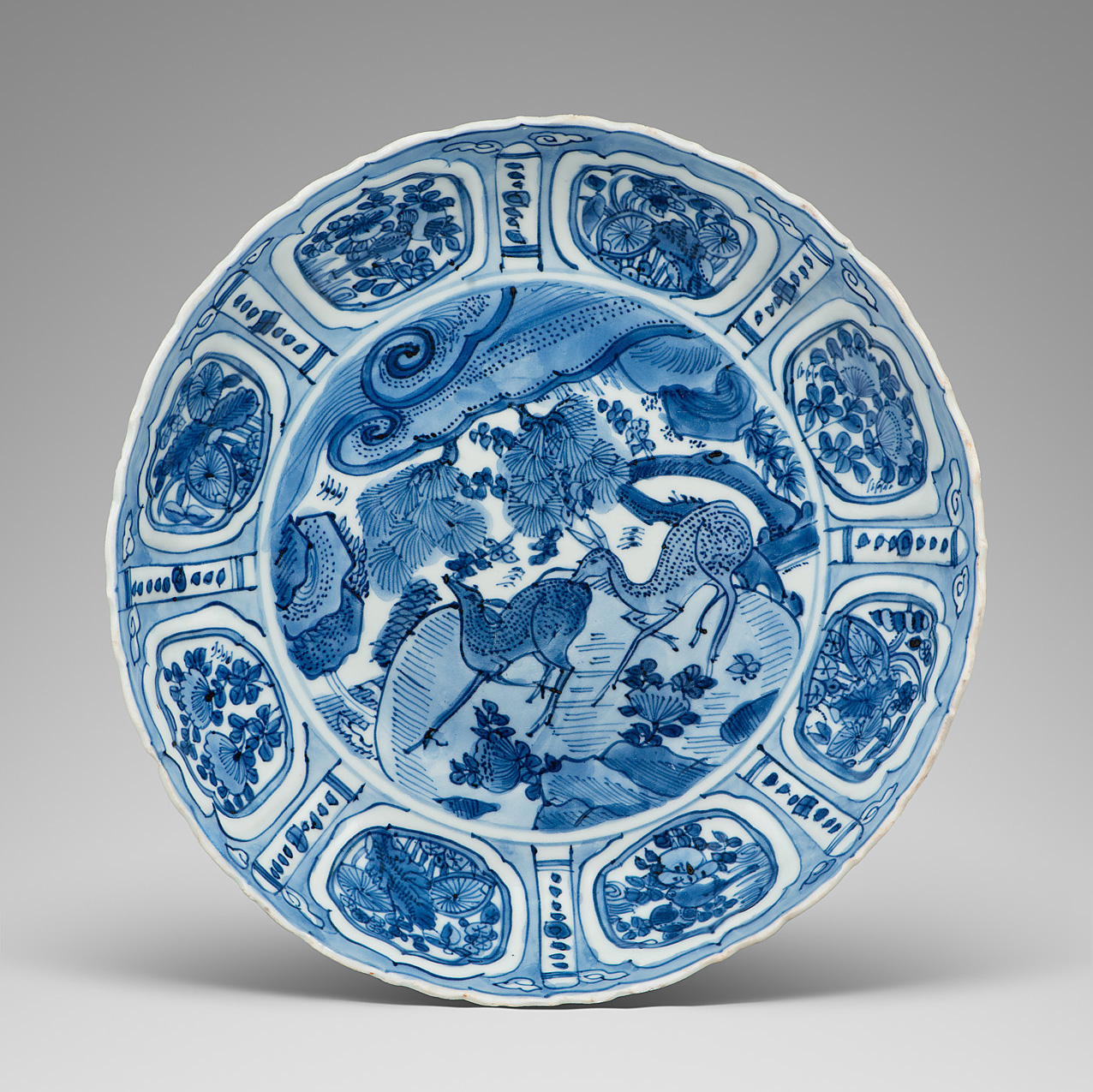
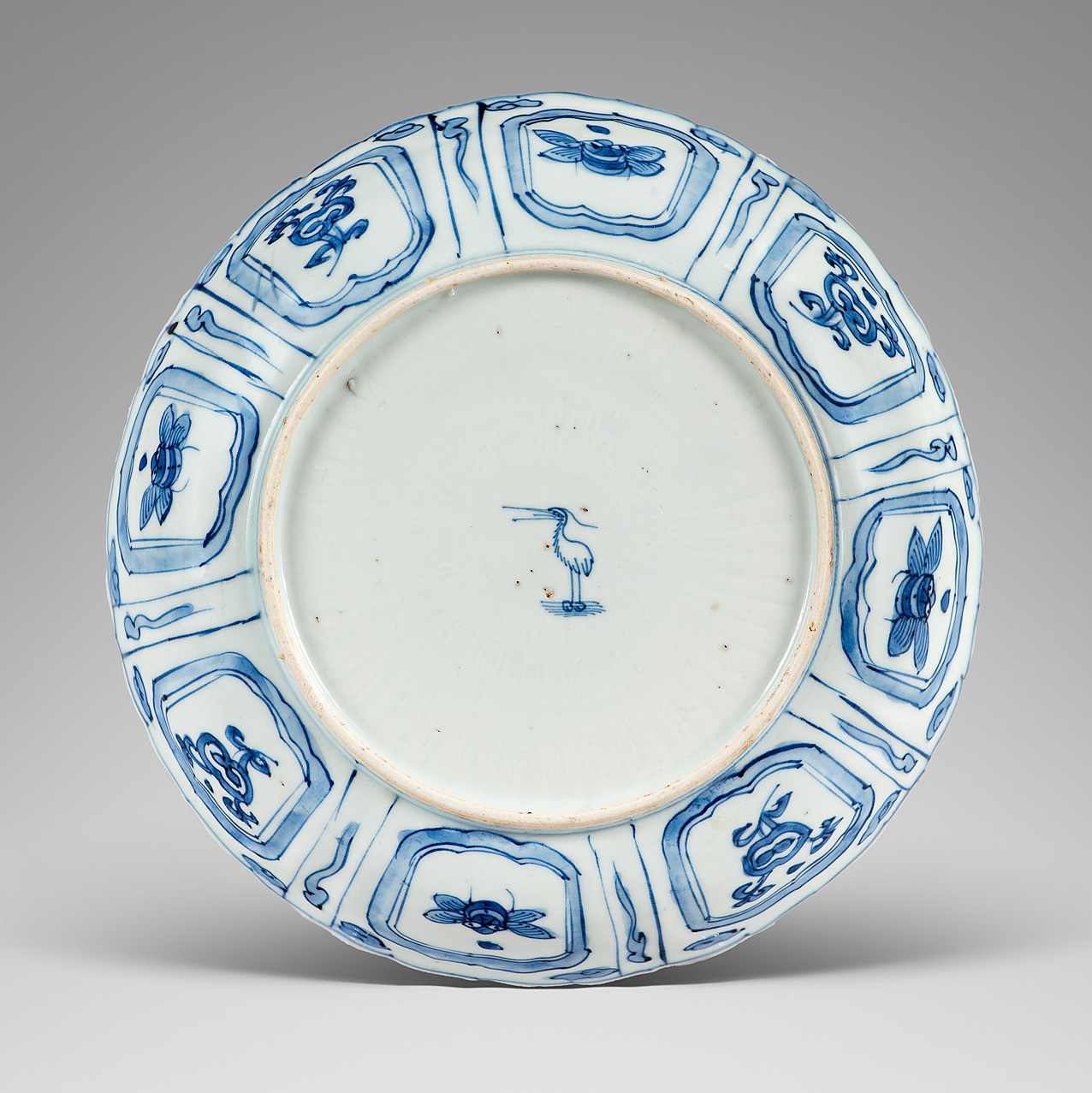
Related works .The consistently high quality of the potting and draughtsmanship across these variants suggests that such pieces originated from elite private kilns in Jingdezhen, notably those at Guanyinge. The rarity of this group is well-documented in ceramic scholarship. Maura Rinaldi first discussed forty-five recorded examples[2], a figure later updated by Eva Ströber, who noted approximately sixty identified pieces in 2013[3]. A significant portion of this group resides in prestigious historical collections; notably, sixteen such plates and one saucer-dish were recorded in the Santos Palace in Lisbon – now the French Embassy[ii].
Specific comparisons reinforce the importance of the present dish. A plate with nearly identical decoration depicting two deer, formerly in the collection of George Wingfield Digby, is now held in the Lurie Collection[4]. While the deer motif is highly prized, other naturalistic scenes appear within this ‘egret mark’ series. These include a dish with cranes in the Gemeentemuseum, The Hague, and the Princessehof Museum, Leeuwarden; a pheasant-decorated plate in the British Museum[5]; and another depicting a pair of pheasants beneath a pine tree from the former Roger and Jill Bichard collection. Even more exceptional are the rare saucer-dishes that combine underglaze blue with monochrome blue glaze, such as the examples in the Sir Michael Butler Collection discussed in Leaping the Dragon Gate. The Sir Michael Butler Collection of 17th-Century Chinese Porcelain[6]. These objects, fragments of which have been unearthed in excavations at Macao, confirm that Portuguese merchants were amongst the primary early patrons of this refined ‘egret mark’ porcelain[7]
[2] Maura Rinaldi, Kraak Porcelain: A Moment in the History of Trade, 1989, pp. 201-205, pl. 264a-n
[3] Eva Ströber, Ming Porcelain for a Globalised Trade, Stuttgart, 2013, p. 208
[4] Teresa Canepa, Jingdezhen to the World: The Lurie Collection of Chinese Export Porcelain from the Late Ming Dynasty, 2019, no. 17
[5] 1923,0611.1
[6] London, 2021, pp. 74–5, nos. III.1.20 and III.1.21.
[7] Christiaan Jörg, Oriental Porcelain in The Netherlands. Four museum collections, exhibition catalogue, Groninger Museum, Groningen, 2003, p. 22, no. 5