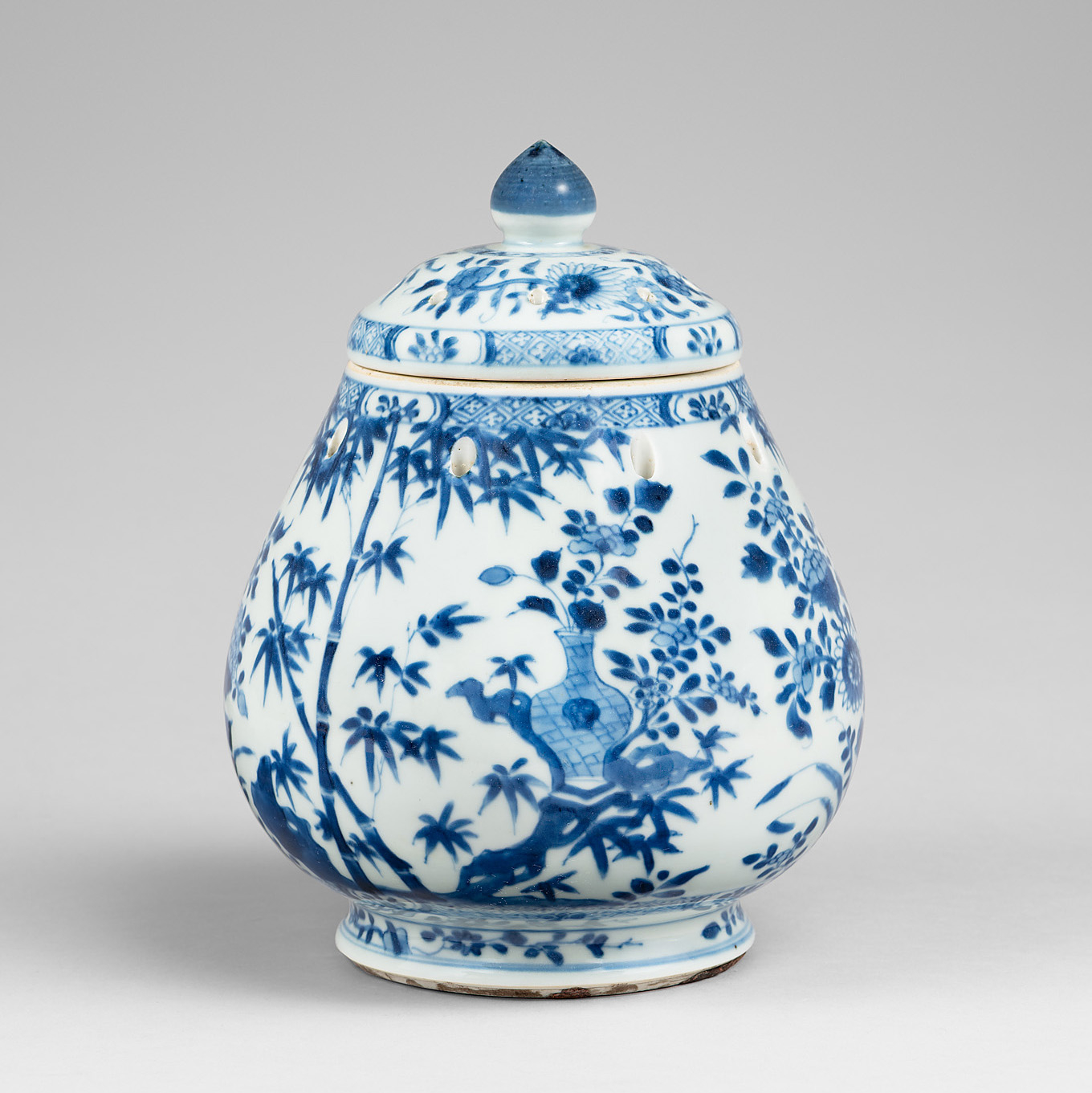
A blue and white pot-pourri vase and cover. China, Kangxi / Yongzheng

The covered blue and white pot-pourri vase is of baluster form, raised on a slightly splayed foot and surmounted by a domed cover with a lotus-bud finial. Oval perforations beneath the shoulder and in the cover allowed the fragrance of the pot-pourri to diffuse. The decoration depicts bamboo, peonies and chrysanthemums issuing from rockwork, arranged around two archaistic vases. A diaper border of interlocking lozenges, interrupted by floral reserves, encircles the neck and the rim of the cover, while the finial is surrounded by flowering sprays and foliage.

COUNTRY : China
TIME: Kangxi (1662-1722) / Yongzheng (1723-1735)
MATERIAL : Porcelain
SIZE : 23,8 cm
REFERENCE : F006
STATUS : disponible
Related works .

For the same form decorated in the Imari palette, see The Benjamin F. Edwards III Collection of Chinese Porcelain, 2002, lot 108.

Additional information.

The emergence of pot-pourri vases reflects a new culture of privacy, comfort and refinement that came to characterize European aristocratic interiors in the early eighteenth century. Descended from incense burners, yet stripped of any liturgical function, they were designed to diffuse fragrance continuously without combustion. Filled with dried flowers, rose petals, aromatic herbs, spices and precious scented substances such as ambergris or musk, their contents released their perfume through the pierced cover and shoulder. Displayed on mantelpieces, commodes or corner cabinets, they appealed not only to the sense of smell but also served as conspicuous expressions of wealth and taste, showcasing some of the finest porcelains imported from China. By adopting this distinctly Western form, the kilns of Jingdezhen demonstrated their remarkable ability to create objects for functions unknown in China, yet perfectly suited to the tastes and fashions of Europe’s elite.

The decoration combines three plants of great symbolic significance in Chinese culture. Bamboo represents integrity, resilience and the virtues of the scholar-gentleman, its evergreen nature symbolising constancy and moral strength. Peonies, celebrated as the “King of Flowers”, are emblems of wealth, honour, prosperity and high rank. Chrysanthemums, one of the Four Gentlemen of Chinese painting, symbolize longevity, endurance and the cultivated life of the recluse. Together, these auspicious motifs convey wishes for a prosperous, virtuous and long life.

Question about condition report

Question about condition report