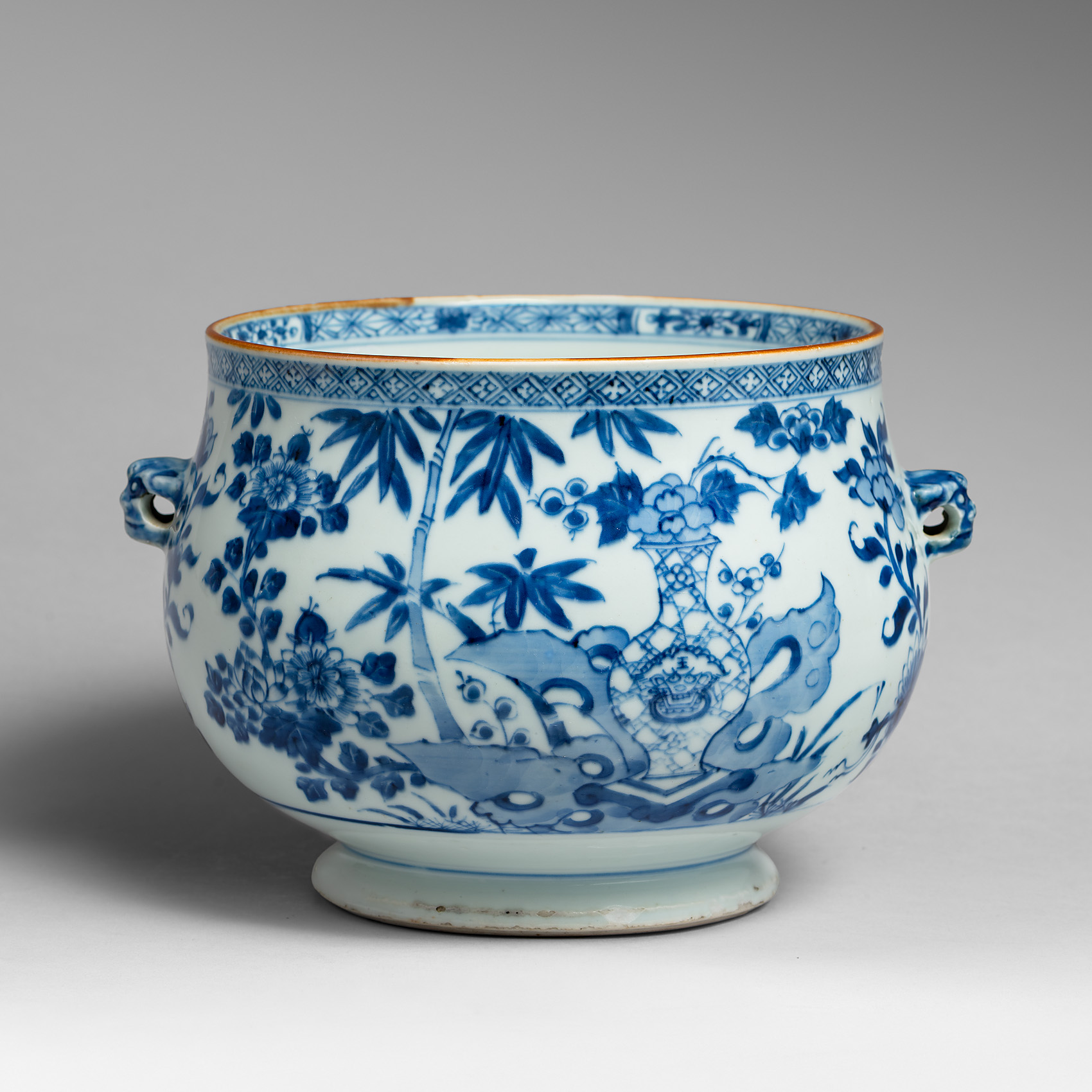
Additional information.The decoration combines three plants of great symbolic significance in Chinese culture. Bamboo represents integrity, resilience and the virtues of the scholar-gentleman, its evergreen nature symbolising constancy and moral strength. Peonies, celebrated as the “King of Flowers”, are emblems of wealth, honour, prosperity and high rank. Chrysanthemums, one of the Four Gentlemen of Chinese painting, symbolize longevity, endurance and the cultivated life of the recluse. Together, these auspicious motifs convey wishes for a prosperous, virtuous and long life.
The decoration brings together three plants imbued with rich symbolism. Bamboo (竹, zhu) is an emblem of uprightness, resilience and moral integrity; as an evergreen, it also symbolizes constancy and the virtues of the scholar. The peony (牡丹, mudan), known as the “king of flowers”, evokes wealth, honour, prosperity and high social rank. The chrysanthemum (菊, ju), one of the “Four Noble Plants” together with bamboo, orchid and prunus, is associated with longevity, serenity and detachment from worldly concerns; it is also a symbol of autumn and the scholar’s retreat from public life.
The bottle cooler emerged in European tableware in the late seventeenth and, above all, the early eighteenth century, alongside the development of an increasingly codified manner of serving wine. Designed to keep a bottle cool in cold water, sometimes with the addition of ice, it was distinct from the glass cooler. Its deep, wide-mouthed form, fitted with two lateral handles, was probably derived from European metalwork or silver prototypes.
Chinese potters adopted this Western form at an early date in response to commissions for the export market. Examples are known from as early as the Kangxi reign (1662–1722). A pair of Chinese porcelain bottle coolers decorated in the Imari palette, dating to circa 1720 and formerly in the collection of Augustus the Strong, is notably recorded in the inventory of the Japanese Palace in Dresden as early as 1723 (« Japanese Porcelain », chapitre IV, « Table Services and Accessories).
Such pieces testify to the remarkable ability of Chinese porcelain workshops to adapt their production to new European dining practices: a specifically Western form and function were combined with decoration firmly rooted in the Chinese artistic repertoire. The bottle cooler thus provides a particularly evocative illustration of the interaction between European dining customs and Chinese export porcelain production in the early eighteenth century.