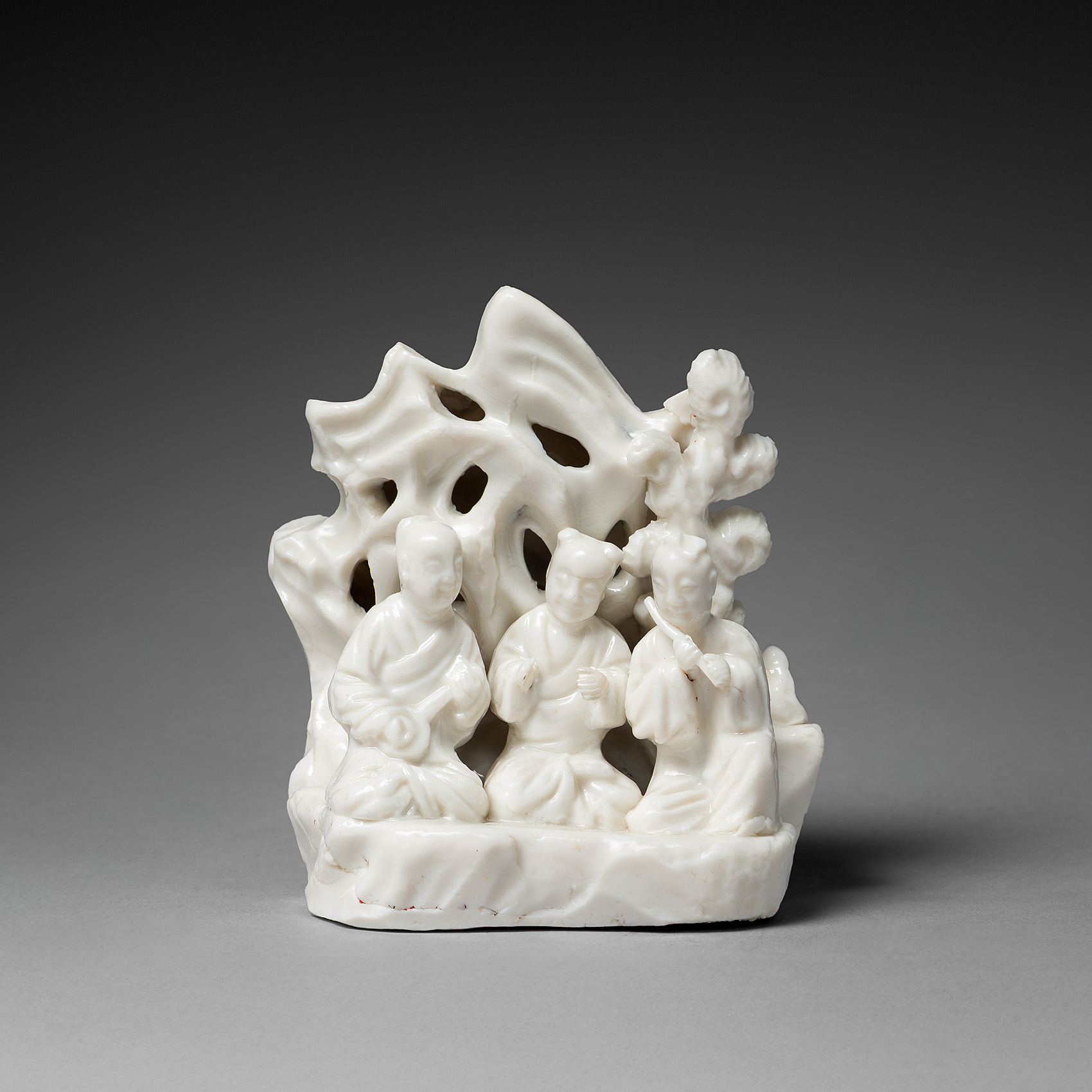
A Chinese Blanc-de-Chine “musicians-literati” group. Kangxi

This finely modelled blanc-de-Chine group depicts three seated figures arranged before a large pierced rock and a small gnarled pine. Set upon a naturalistic rocky base, the figures form a small musical ensemble: the figure on the left plays the yueqin (月琴), the central figure keeps time by clapping his hands, while the figure on the right plays a slender flute held obliquely before the face. The drapery of their robes falls in soft, rounded folds characteristic of Dehua modelling, and their faces are rendered with gentle, serene expressions. The rock rising behind them, pierced with irregular openings, provides a striking backdrop that contrasts with the smooth, lustrous white glaze. The pine, with its compact clusters of needles, completes this miniature landscape and enhances the impression of an intimate scene.
COUNTRY : China (Dehua)
PERIOD : Kangxi (166-1722), circa 1690
MATERIAL : Porcelain
SIZE : 11,5 cm
REFERENCE : E597
PROVENANCE : From a private French collection
STATUT : sold
Related works :

A similar group is illustrated by Marchant in their catalogue, Blanc de Chine, 2014, p. 85, no. 55 : another group was illustrated my Marchant in their exhibition of Blanc de Chine, 1985, p. 10, no. 9.

Another group, from the Hickey Collection, Singapore, is illustrated by Rose Kerr & John Ayers, Blanc de Chine Porcelain from Dehua, no. 34.

Additonal informations :

This group depicts musicians-literati. Music—particularly the playing of the qin zither—was traditionally counted among the Four Accomplishments cultivated by scholars, together with weiqi, calligraphy, and painting. Allusions to these refined pursuits appear frequently in Kangxi-period porcelain. In the aftermath of the late Ming and early Qing upheavals, the values embodied by the ancient scholars—cultural continuity, moral integrity, and a sense of stable tradition—offered a reassuring link to an idealised past. Encouraged by the Emperor’s own dedication to literati culture, collectors of the Kangxi era favoured works that expressed this scholarly aesthetic.

The presence of the pine and the pierced scholar’s rock further reinforces the atmosphere of poetic retreat and quiet cultivation. Comparable blanc-de-Chine groups depicting weiqi players are known, notably the example in the Museum Volkenkunde, Leiden (RV-5492-1).

Demande de condition report

Question about condition report