
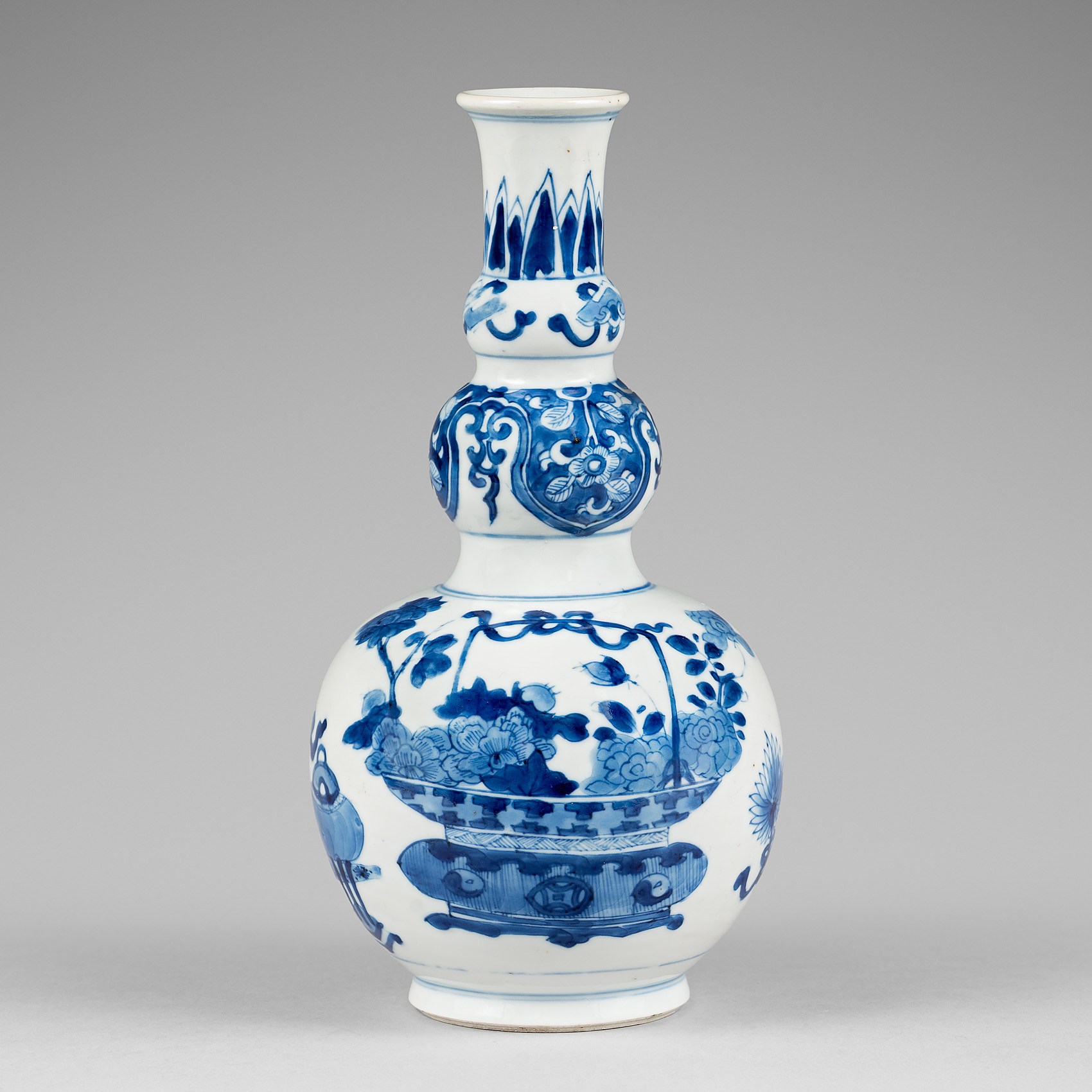
A blue and white triple-gourd vase. China, Kangxi

The vase is of elegant triple-gourd (san hulu) form, composed of three superimposed globular bulbs of diminishing size, surmounted by a slightly flaring cylindrical neck. It stands on a short circular foot and is finely painted in underglaze cobalt blue. The largest bulb is decorated with flower baskets filled with peonies, each resting on an ornate pedestal embellished with yin-yang symbols and coin motifs. This bulb is also decorated with motifs from the Hundred Antiques (Bogu), including an incense burner, an archaistic vase, scrolls, a fan, a qin (zither), and a qing (musical stone).

The middle bulb is decorated with an alternating pattern of ruyi-shaped cartouches enclosing stylised peonies reserved against a blue ground, and white panels painted with scrolling foliage. The upper bulb is decorated with motifs including the Lozenge, one of the Eight Precious Symbols, symbol of Victory and success and the sacred pearl. The neck is encircled by a band of tall upright lappets. The decoration of the vase is enclosed between fine double lines beneath the rim and above the foot and the base is decorated with a double circle around the footring.

COUNTRY : China
TIME: kangxi (1662-1722)
MATERIAL : Porcelain
SIZE : 26 cm
REFERENCE : E921
STATUS : vendu
Related works .

A similar vase is in the Dresden Collection (PO 2199).

Additional information.

The triple-gourd vase is one of the most iconic forms in Chinese porcelain, inspired by the natural gourd (hulu 葫芦), an ancient symbol of prosperity, fertility, good fortune, and longevity. Although the motif first appeared during the Ming dynasty, the form reached its greatest refinement under the Kangxi, Yongzheng, and especially Qianlong emperors (1662–1795), when the imperial kilns at Jingdezhen excelled in producing increasingly sophisticated and technically demanding shapes. The triple-gourd form also alludes to the attributes of Daoist immortals, who are often depicted carrying a gourd containing the elixir of immortality. Highly prized at the imperial court, these vases were produced in a wide variety of monochrome glazes and finely enamelled decorations. Their elegant profile represented a remarkable technical achievement, requiring exceptional mastery in throwing, assembling, and firing the different sections. Although produced in smaller numbers for export to Europe during the eighteenth century, they were admired by Western collectors for both their sculptural elegance and rich symbolic meaning. Today, triple-gourd vases remain among the most desirable forms of Qing dynasty porcelain, celebrated for their aesthetic refinement, technical virtuosity, and auspicious symbolism.

The Hundred Antiques is a miscellaneous or general collection of emblematic forms comprising the Eight Treasures, the Four Treasures, the symbols of Four Fine Arts (music, chess, calligraphy, and painting) together with numerous conventional representations of sacrificial vessels, flowers, animals etc.

Question about condition report

Question about condition report