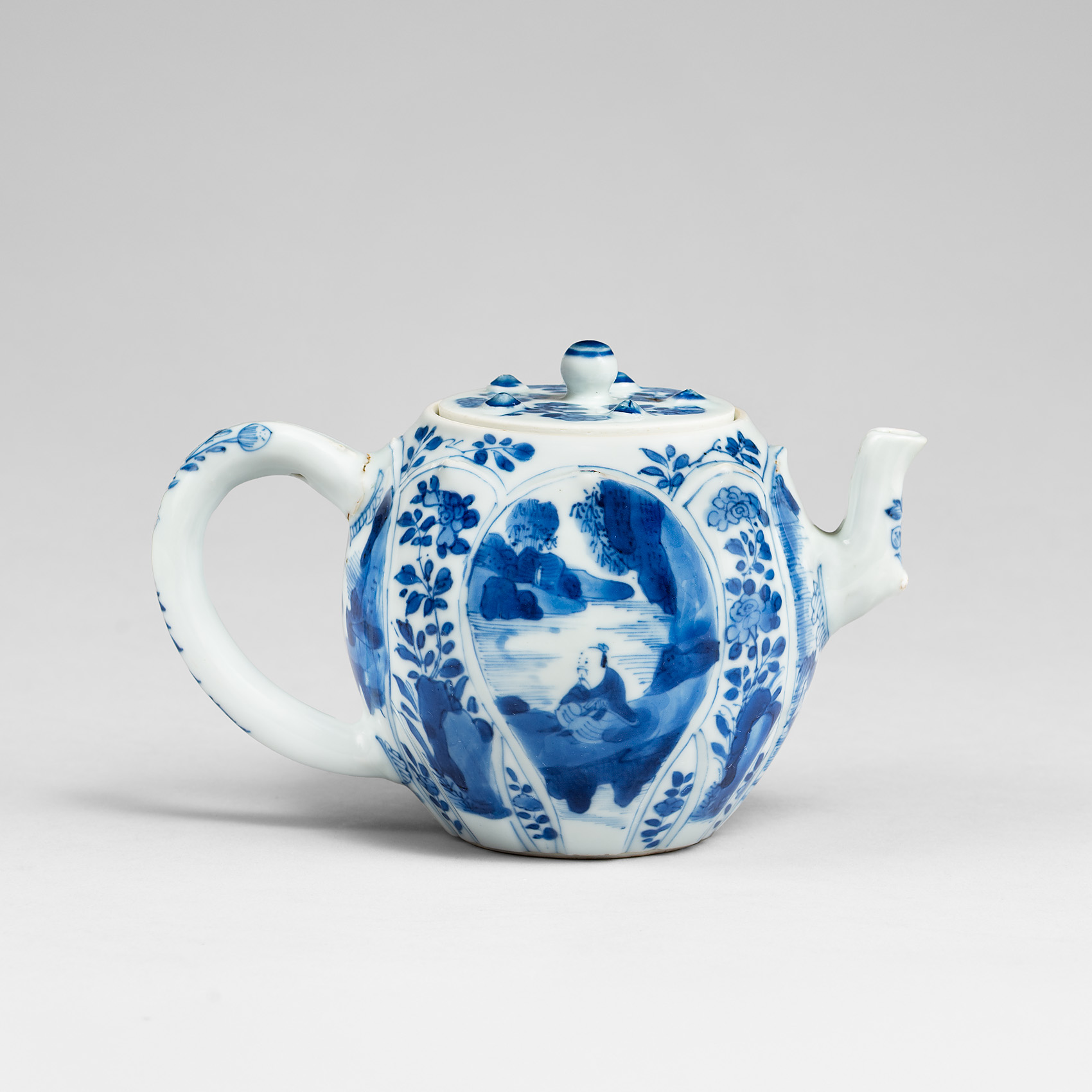
A Chinese blue and white lotus teapot. Kangxi

The teapot is of rounded form, resting on a footring, its body moulded in low relief with overlapping leaf-shaped panels. It is fitted with a short curved spout and a C-shaped handle, while the almost flat, recessed cover is modelled in the form of a lotus seed pod, with the seeds rendered in relief. The decoration is painted in underglaze blue, each panel alternately enclosing a figure in a landscape or flowering plants. Delicate floral sprays further embellish the spout, handle and cover.
COUNTRY : China
TIME: Kangxi (1662-1722)
MATERIAL : Porcelaine
SIZE : 15.5 cm x 10 cm
REFERENCE : F054
STATUS : disponible
Related works.

An identical teapot is in the collection of the Dresden Collection (inventory PO 2679).

Another example is in the collection of the Groningen Museum (2019.0390).

Additional information.

Kangxi blue-and-white teapots (1662–1722) form a particularly distinctive group, bringing together the long-established Chinese tradition of tea drinking, the inventiveness of the Jingdezhen potters and, in many cases, a growing responsiveness to European taste. Their remarkable variety of shapes reflects this spirit of experimentation: alongside globular and pear-shaped forms are ribbed and petal-moulded examples, miniature and double-spouted teapots, as well as more naturalistic designs inspired by bamboo and the lotus.

The body of the teapot is modelled as a succession of overlapping lotus petals, while the cover evokes the lotus seed pod, transforming the vessel as a whole into a stylised representation of the plant. In Chinese symbolism, the lotus (蓮, lian / 荷, he) is above all associated with purity: although it grows from the mud, its flower emerges pristine and unsullied. This idea, particularly important in Buddhist thought, made the lotus an emblem of spiritual purity, elevation and moral integrity. The presence of the seeds adds a further layer of meaning. As the lotus produces an abundance of seeds, it became associated with fertility and numerous offspring. Lotus seeds (lianzi, 蓮子) also lend themselves to auspicious wordplay evoking the succession of sons and, more broadly, the continuity and prosperity of the family line.

See other items

Question about condition report

Question about condition report