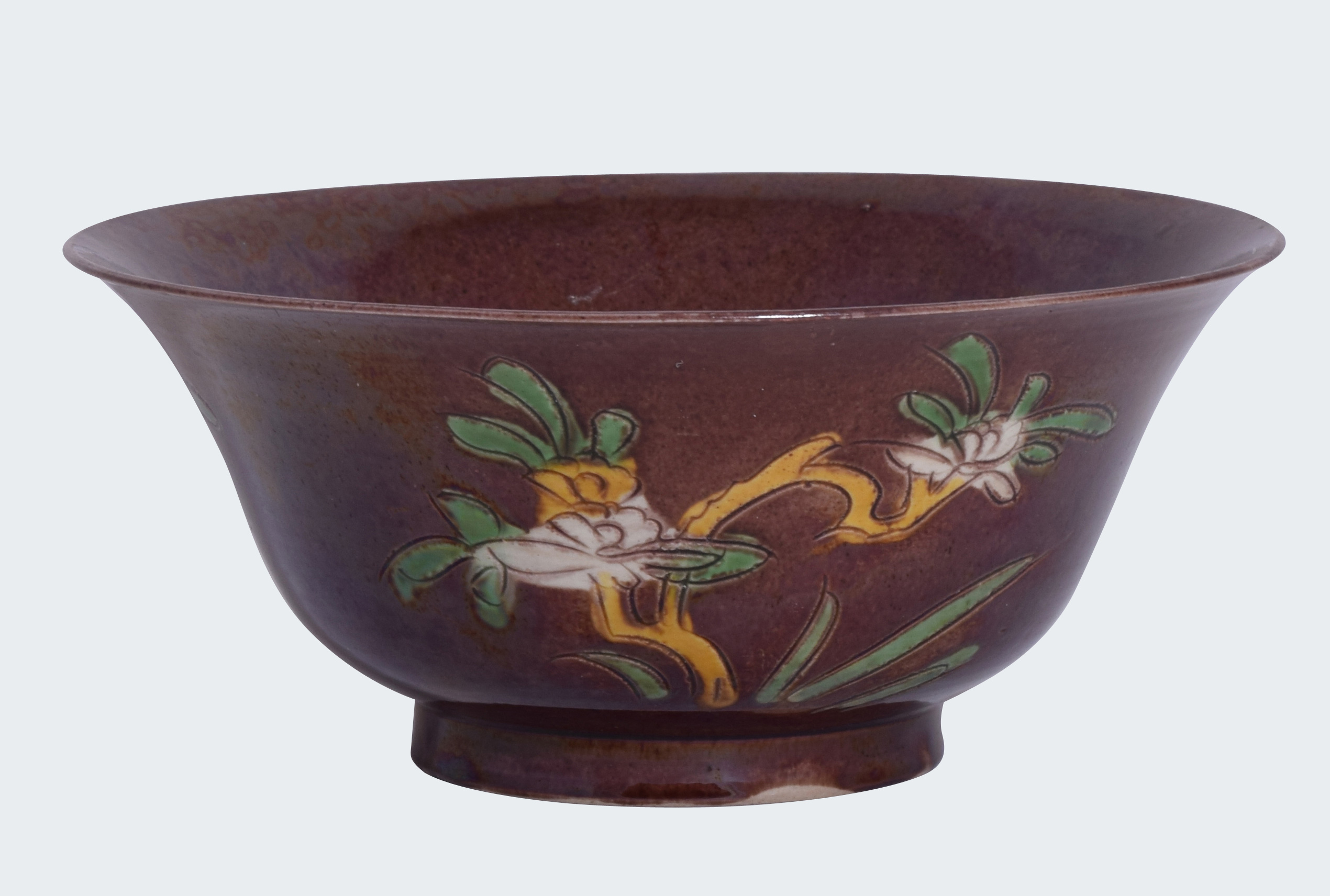
A Chinese “brinjal” bowl decorated with famille verte enamels on the biscuit. Kangxi period

Bowl with rounded sides and a wide flaring rim, standing on a short, straight foot ring. The exterior incised with a repeating pattern of flowering branches painted in green and yellow enamels and a clear glaze, on an aubergine-brown enamel ground. A small lingzhi fungus is incised in the centre of the interior. The recessed base has a mark in the centren surrounded by a double circle in underglaze cobalt blue.
COUNTRY : China
TIME: Kangxi (1662-1722)
MATERIAL : Porcelain
SIZE : 7.48 in. (19 cm)
REFERENCE : C092
STATUS : vendu
Related works.

A very similar bowl is illustrated by Luisa Vinhais and Jorge Welsh in Biscuit: Refined Chinese Famille Verte Wares, Jorge Welsh Books, London and Lisbon, October, 2012, pp. 76/77, no. 7.

Another boxl is illustrated by He Li in Chinese Ceramics. The New Standard Guide, London, 1996, p. 297, pl. 619.

Additional information.

The present bowl belongs to a group of bowls with several different shapes, usually generically describes as “Brinjal” bowls. Most of these bowls have a shop or maker’s mark in underglaze blue on the base, with appears frequently on export wares from the late Ming Dynasty (1368-1644) onwards. By reference to a single yellow-ground example with a Tianqi reign mark (1621-1627) in the Avery Brundage Collection, historian Stephen Little asserts that the whole group might be dated to the earlier Transitional period.

See other items

Question about condition report

Question about condition report