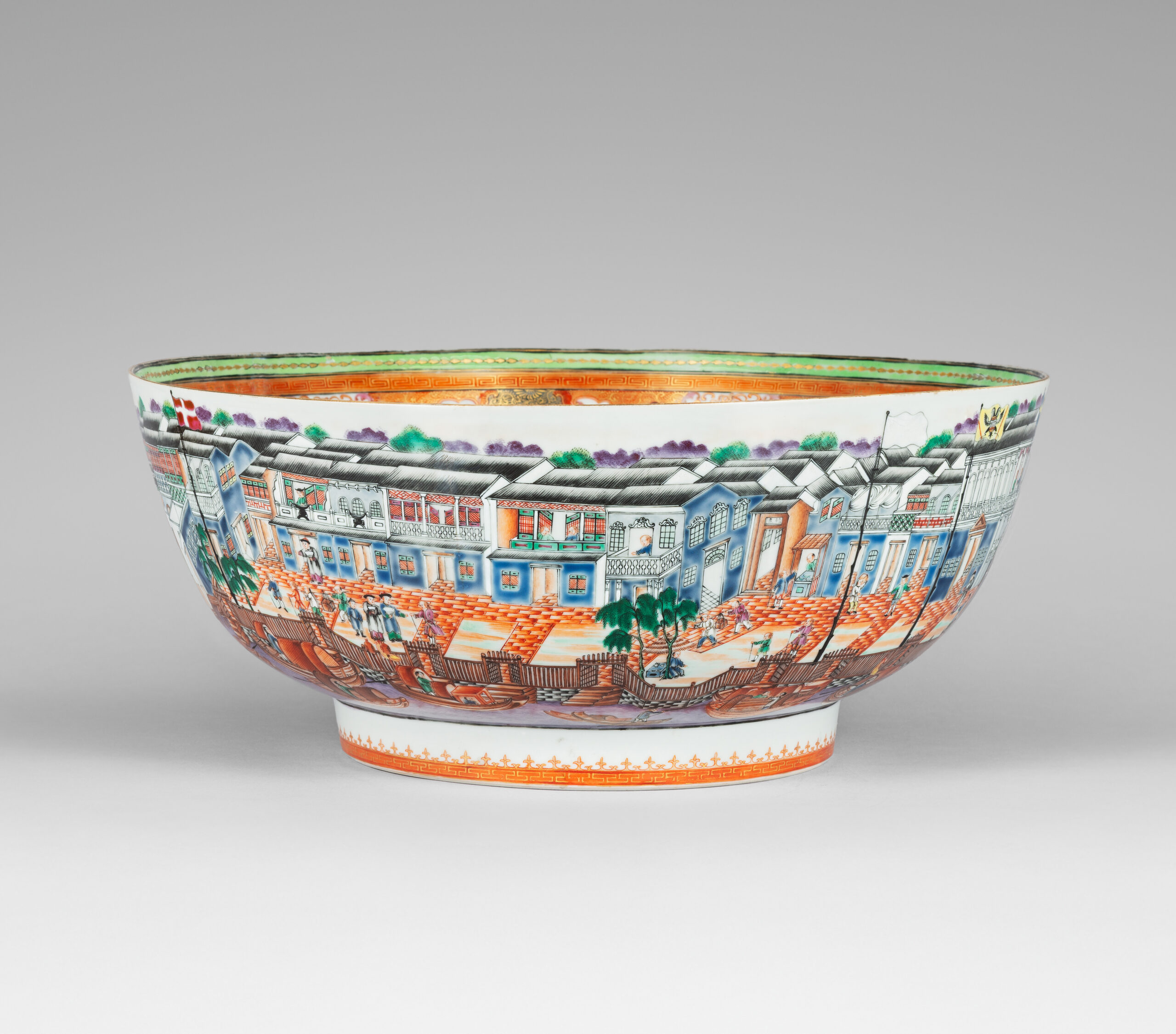
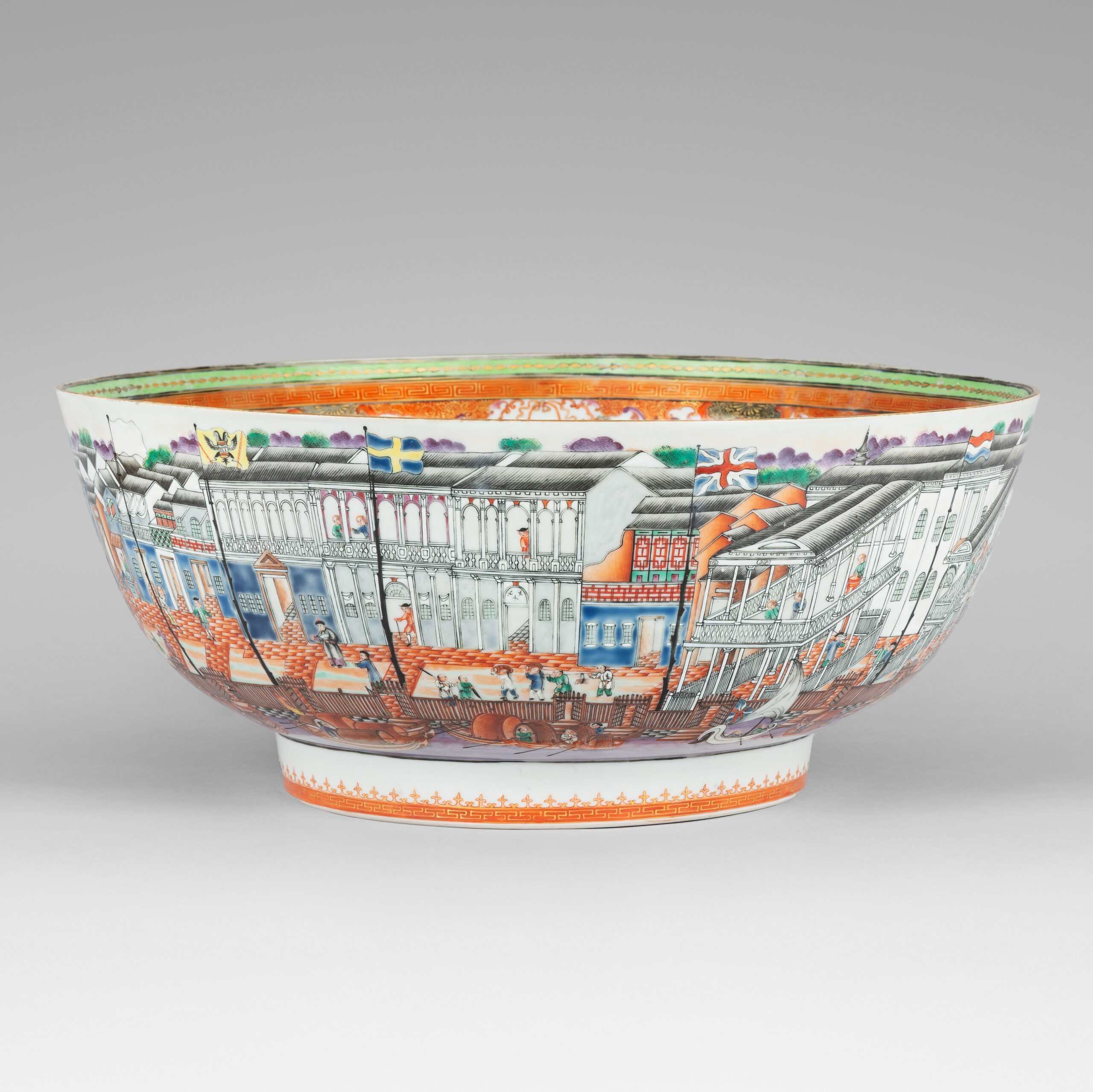
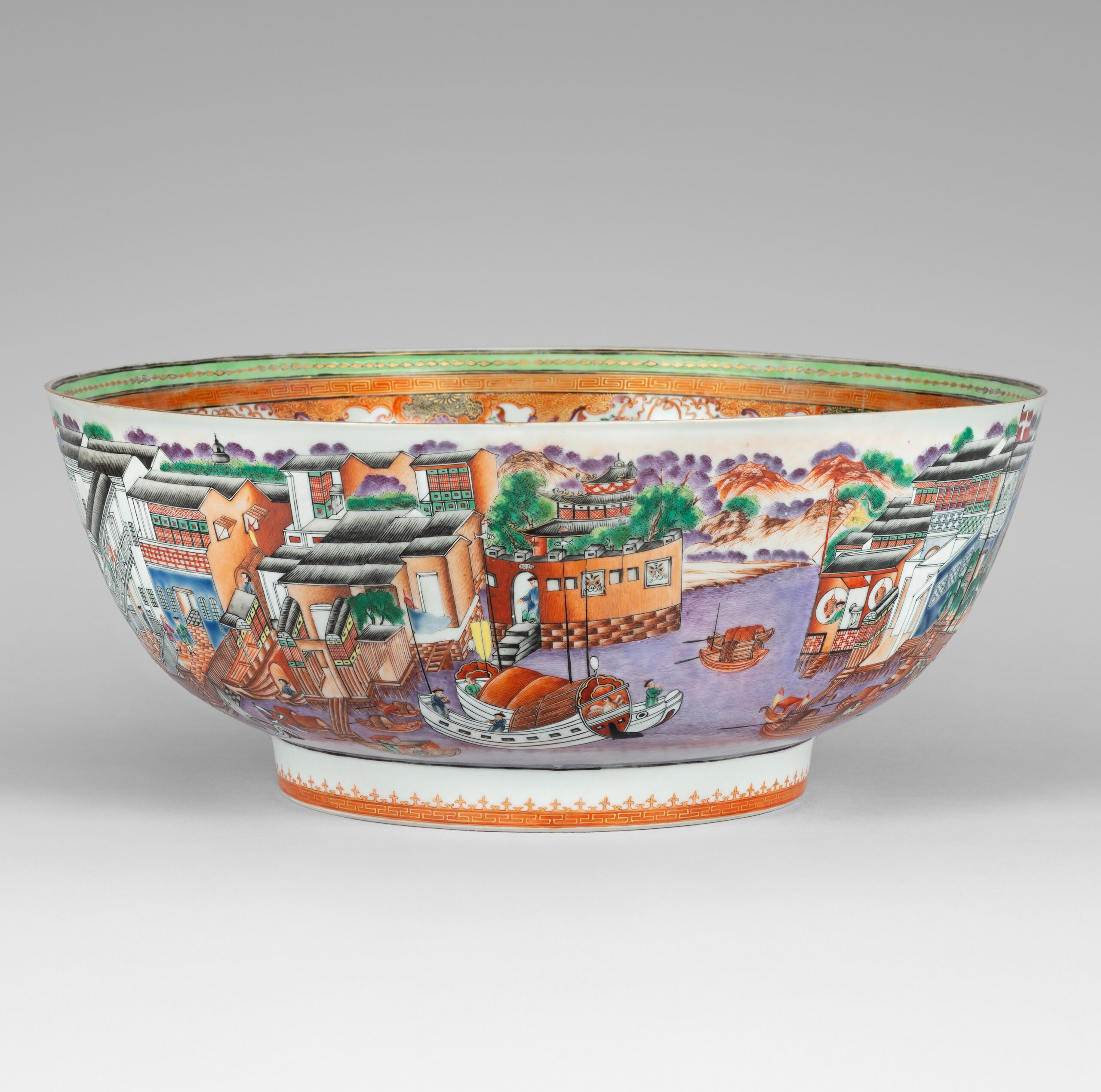
Additional information.As David Howard[1] observes, the decoration “is painted with considerable perspective and realism, with the shoreline crowded with Chinese chop boats and many Europeans in the courtyards before the factories, on balconies, in doorways, and at windows.” In contrast to the historical realism of the exterior, the interior is centered on a flower basket within a light green medallion, surrounded by a lush arrangement of pomegranates, grapes, butterflies, and bamboo. The rim is finished with an intricate floral composition beneath green and orange bands, all highlighted in gold.
This large Hong bowl belongs to a celebrated group of Chinese export porcelain produced for the Western market during the second half of the eighteenth century. Such pieces were specifically commissioned for a clientele deeply involved in the China trade—captains, merchants, and officers of the various European and American trading companies stationed at Canton. At the time, these bowls were highly prized and costly acquisitions, serving as prestigious souvenirs for supercargoes seeking a lasting memento of their maritime ventures to the Far East.
The exterior depicts the Thirteen Factories of Canton, the exclusive foreign enclave along the Pearl River. This panoramic view, teeming with merchant ships and river traffic, serves as a meticulous topographical record of the China Trade at its zenith. National flags—including those of Great Britain, Holland, Denmark, France, and Sweden—fly from tall flagpoles lining the quay. The presence of the French white ensign (predating the 1789 Revolution) and the Imperial Austrian flag is of particular diagnostic importance. These details, combined with the absence of the American Stars and Stripes, allow for a precise dating of the piece: it must have been commissioned after the Austrian arrival in Canton in 1779, but before the establishment of a permanent American factory. The composition also features the Folly Forts, though they are rendered with a certain artistic license, appearing much closer to the Hongs than their actual geographical position.
According to Ronald W. Fuchs II and David S. Howard in their discussion of a related example in the Hodroff Collection, Winterthur Museum[2], these bowls combine the continuous horizontal format of Chinese handscrolls with the principles of Western one-point perspective.
The evolution of these panoramic views offers a chronological map of the China Trade. The earliest and rarest known example, dating to circa 1765, painted in camaïeu rose, is in the collection of the Maritime Museum of Denmark. It depicts the Hongs on one side and the Stock Exchange in Copenhagen on the other. While panelled versions of Hong bowls began to appear around 1775, the late 1780s marked a significant iconographic shift. Following the arrival of the Empress of China in Canton in 1784 and the subsequent establishment of an American base, the United States flag began to appear on these pieces. Similarly, the flag of the Royal Philippine Company (Real Compañía de Filipinas), founded in 1785 under the patronage of Charles III of Spain, is occasionally found on bowls produced after 1787. These elements, along with the continuous views painted solely en grisaille—often featuring the Danish, French, ‘Imperialist’ (referring to the Austrian Empire), Swedish, British, American, and Dutch flags—allow for a precise placement of the present bowl within this celebrated artistic lineage
The Hongs were destroyed in 1856, at the outbreak of the Second Opium War. Between approximately 1765 and the early nineteenth century, views of the Hongs appeared not only on porcelain but also across various media, including Chinese export paintings on canvas and copper. In their precise architectural rendering of factories and flags, Hong bowls share a closer aesthetic and documentary affinity with these export paintings than with patterns traditionally found on other types of Chinese export porcelain.
[1] Howard, China for the West, 1978, vol. I, 209, no. 207
[2] Made in China, Winterthur, 2005, pp. 138–139, cat. no. 88