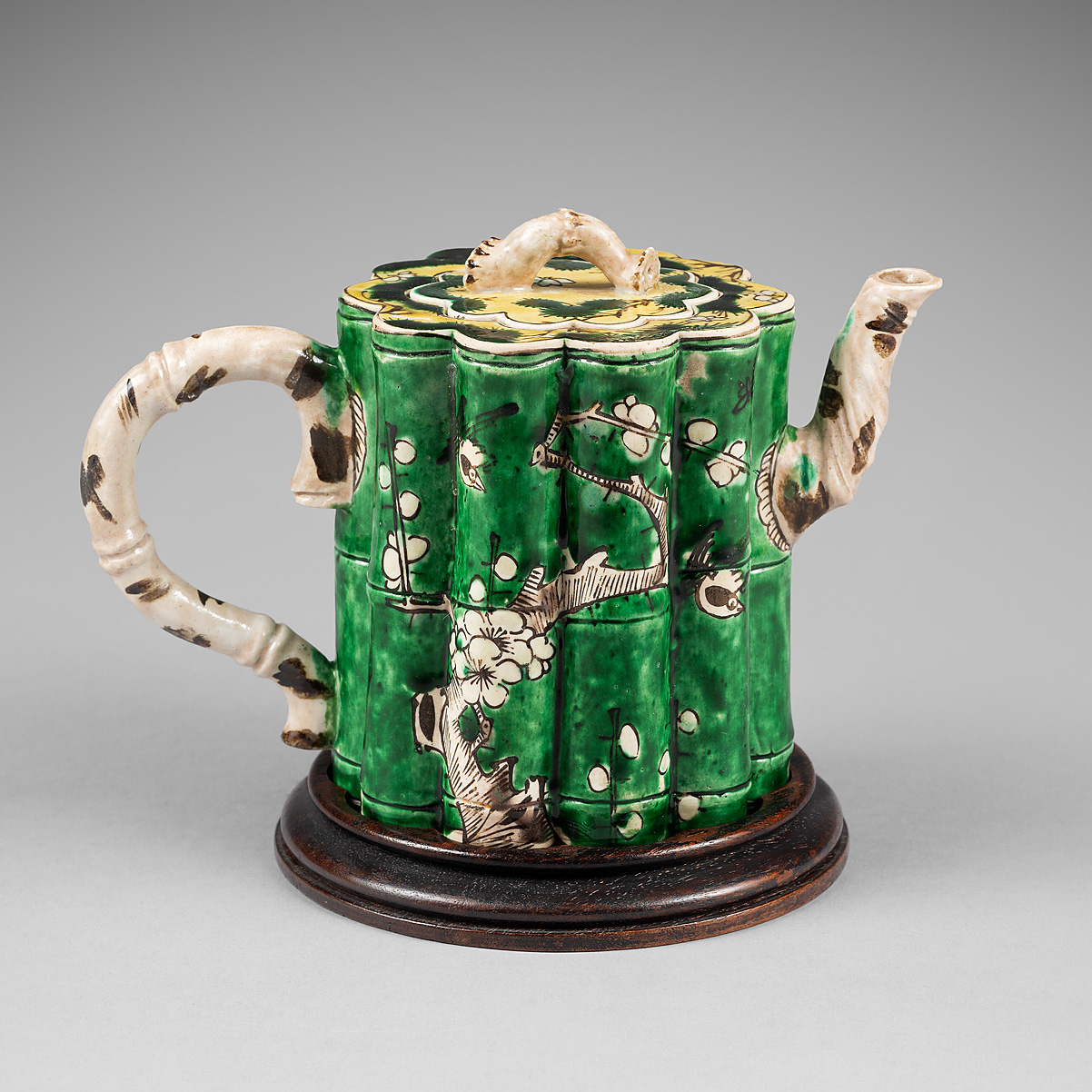
Additonal informations :This teapot’s body imitates a bundle of bamboo stalks, and the bamboo motif is carried through in the handle, spout, and finial as well. This form also was popular in Yixing ware, and in turn, versions influenced Wedgwood’s so-called “caneware.” A bamboo-form teapot illustrated in Sir William Chambers’s Designs of Chinese Buildings, Furniture, Dresses, Machines and Utensils (1757) may have been based on a Yixing piece.
The sculptural quality of this form necessitated that the body be molded in two pieces, with the seam running from spout side to handle side; handle, spout, and finial were all molded or sculpted. This pot was decorated in the range of available translucent enamels, including aubergine, green, yellow, and black, the last of which was obtained by covering the ink-colored enamel with a translucent glaze.
Although bamboo itself never was used to make teapots or wine pots, its versatility makes it useful for many other purposes: young shoots are eaten and wine is sometimes furnished with the leaves; bamboo pulp is used to make paper; its stems become pipes and furniture; raincoats, thatch, and packing materials are made from the leaves; and various parts of the plant have medicinal properties. Its beauty bestows upon bamboo a favored place in Chinese poetry and, as a result, it has come to carry much symbolism. When the wind blows, for instance, the bamboo bends “in laughter,” and zhu, the Chinese word for bamboo, is a homonym for other words that encompass meanings including to wish or pray and to herald, announce. Bamboo is an emblem of longevity because it is evergreen and long lived, and it flourishes throughout winter.
Florine Langweil (1861–1958), Asian art dealer in Paris
Florine Langweil took over her husband’s business and specialized in Chinese and Japanese art, managing from Paris the direct importation of objects from the Far East. Within a few years, she had built a solid reputation and came to be regarded as one of the leading specialists in East Asian art. As her enterprise expanded, she purchased a large aristocratic townhouse at 26 Place Saint-Georges, where she opened her gallery in January 1903.
From 9 to 13 January and again from 5 to 30 December 1911, she organized two exhibitions at Durand-Ruel, presenting the finest pieces from her collection of Chinese art. Among her clients and admirers were numerous artists, writers, and politicians. Through their connections, several works she initially donated to the Louvre are now housed in the Musée Guimet. Major museums such as those of Boston, Hamburg, Düsseldorf, and Saint Petersburg were also among her clients, and the Vatican consulted her to assess the papal collections.
In November 1913, she retired from business, donating parts of her collection to Parisian museums (the Louvre, the Musée des Arts Décoratifs) as well as to Alsatian institutions (in Strasbourg, Colmar, and Mulhouse). She settled in the Rue de Varenne, in the former Hôtel de Talleyrand, where she surrounded herself in three large salons with the finest pieces she had kept from her collection.
Under the name Madame Langlois, in order to conceal her Jewish origins, she took refuge first in Paris and later in Normandy near Verneuil, where she spent the last eight months of the war. Part of her collection had been placed in safety as early as 1939 in a vault at the Banque de France, but much of what remained at Rue de Varenne was seized on the orders of Hermann Göring.
In 1949, the French Commission for the Recovery of Works of Art located and restituted nearly all the confiscated pieces. From that time, Florine Langweil’s health declined. In accordance with her wishes, her remaining collection was sold at Hôtel Drouot in June 1959.