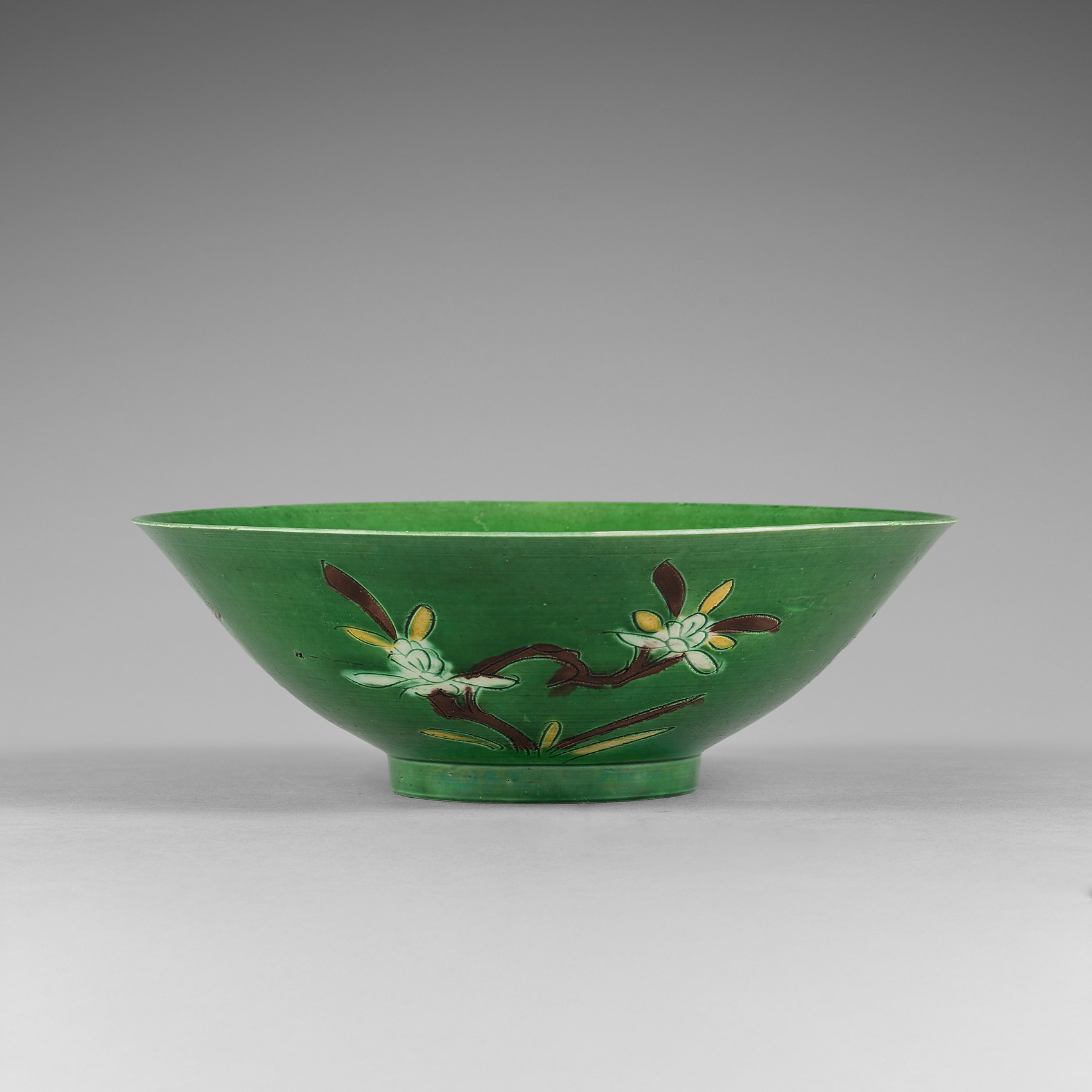
A Chinese green-ground biscuit bowl. Kangxi

The bowl has rounded and wide flaring sides, standing on a short and straight foot ring. The exterior is incised with a repeating pattern of flowering branches, very likely magnolia flowers, painted in yellow and aubergine-brown enamels, and a clear-glaze, on a green enamel ground. A small lingzhi fungus is incised in the centre of the interior, which is painted in aubergine-brown and yellow on a green ground. The recessed base has a mark in the centre, surrounded by a double circle in underglaze cobalt blue.
COUNTRY : China
PERIOD : Kangxi (1662-1722)
MATERIAL : Porcelain
SIZE : 21 cm x 7,2 cm
REFERENCE : E790
STATUT : sold
Related works :

For an identical bowl (form and decoration), see John Ayers, La Collection de porcelaines chinoises de Marie Vergottis, 2004, p. 105, no. 105.

For discussion about brinjal bowls, see Jorge Welsh, Biscuit: Refined Chinese Famille Verte Wares, 2012, pp. 69-73.

For another bowl of this form but decorated in “egg-and-spinach, see Metropolitan Museum of NYC, object number :79.2.128.

Additonal informations :

The present bowl belongs to a group of bowls with several different shapes, usually generically describes as “Brinjal” bowls. In shape, these bowls vary from a more rounded version with flaring sides, to a straighter, more conical version, such as the present example. They are known in yellow, green, brown, and white grounds. The decoration is typically incised with patterns of flowering branches outside and a lingzhi fungus inside.

The name “brinjal” derives from an old Anglo-Indian word for eggplant, and may have been adopted because of the aubergine colour often employed for the decoration. The date when these bowls were made, which was traditionally attributed to the Kangxi period, has been a matter of much academic debate in recent years. Stephen Little asserts that the whole group might dated to the earlier Transitional period. Michael Butler suggests that this production occurred later in the early-to-mid Kangxi period.

These bowls most likely represent the development of “on the biscuit” decoration from this earlier period. These bowls were, before being exported to Europe, probably used in a scholarly context — in the studio of a literati as part of his space for reading, writing, and contemplation — particularly for admiring their texture and form as objects of aesthetic inspiration.

Demande de condition report

Question about condition report