Additional information.The Kangxi period (1662–1722) is widely regarded as a golden age for enamelled porcelain. A remarkable diversity of forms and colours was achieved at Jingdezhen, the foremost porcelain centre in Jiangxi province.
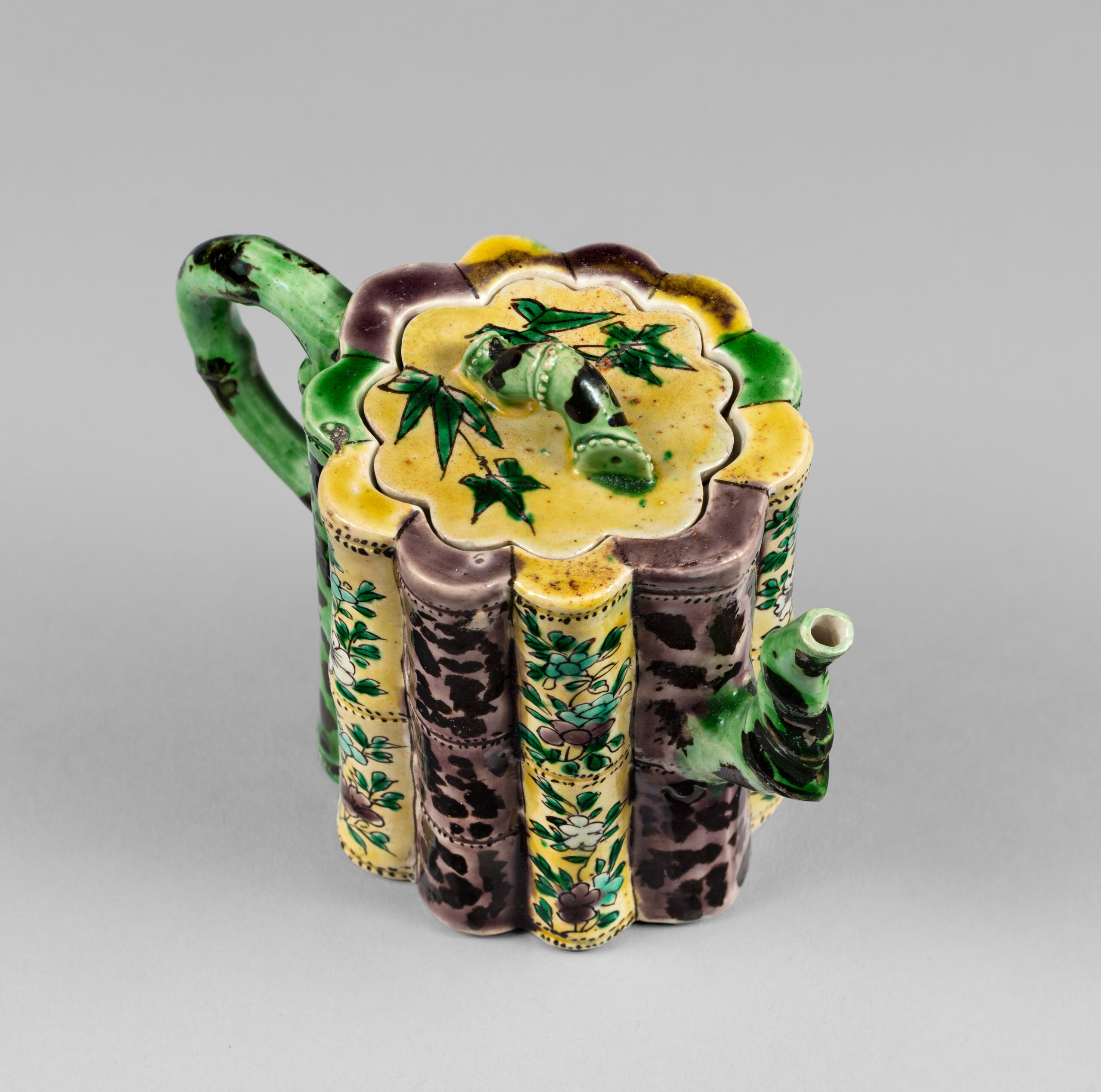
The French art historian Albert Jacquemart (1808–1875) coined the term famille verte to describe Chinese porcelains characterised by a predominance of green enamels. However, the yellow ground of this teapot makes the distinction between famille verte and famille jaune difficult.
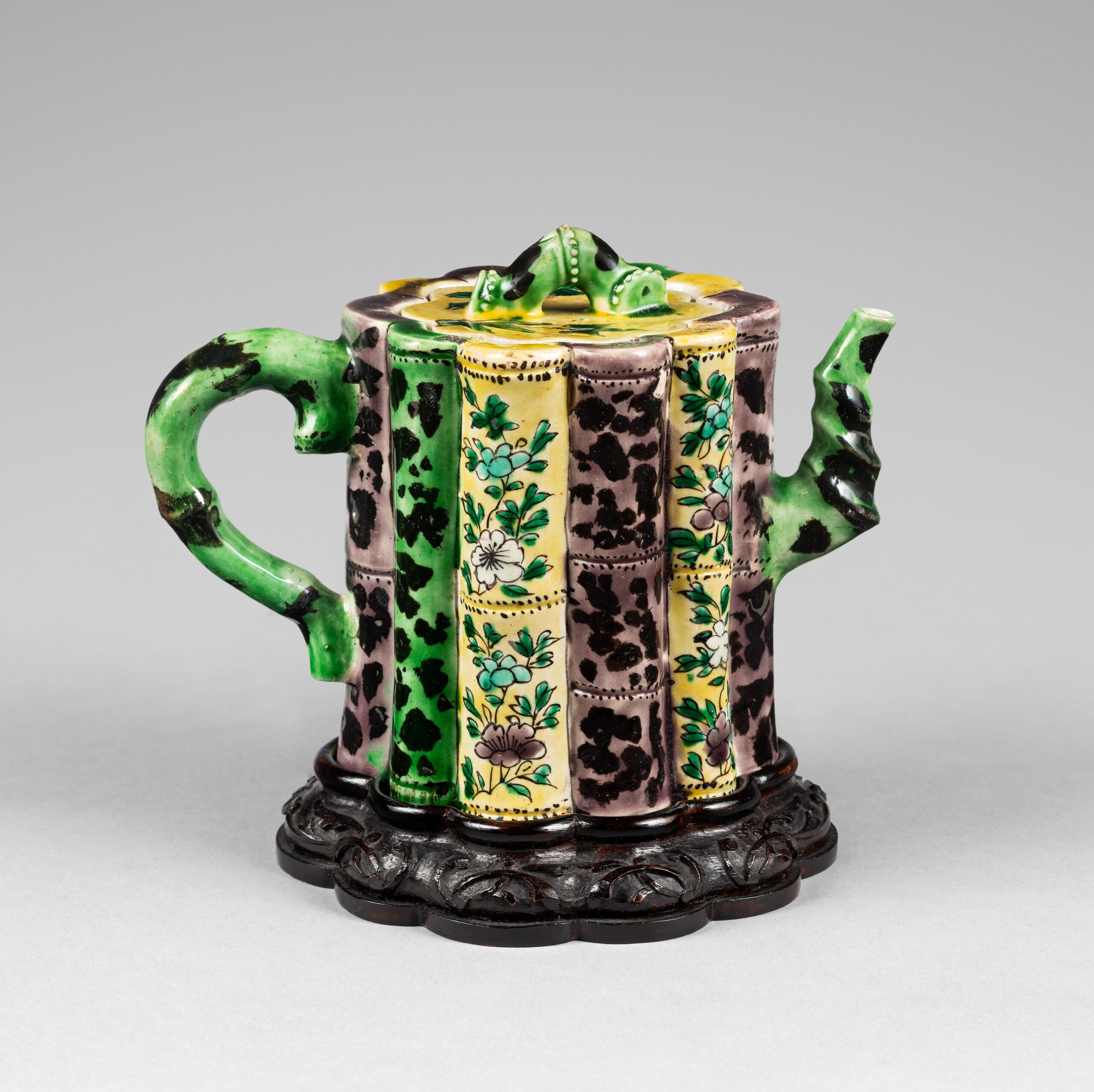
The body imitates a bundle of bamboo stalks, a motif continued in the handle, spout, and finial. This form, also popular in Yixing ware, inspired some versions of the “caneware” produced by Wedgwood. A bamboo-form teapot illustrated in the publication Designs of Chinese Buildings, Furniture, Dresses, Machines and Utensils (1757) by Sir William Chambers may have been based on a Yixing piece, as well as a Sèvres porcelain teapot very likely purchased by Madame du Barry[1].
The sculptural form required a two-part body mould, with the seam running from spout to handle. The handle, spout, and finial were moulded or sculpted separately. The piece features a full palette of translucent enamels: aubergine, green, yellow, and black (the latter achieved by covering ink-coloured enamel with a translucent glaze).
Forms inspired by nature flourished during the Kangxi period. The bamboo motif, long celebrated in Chinese painting and poetry, became a favoured subject in porcelain. Although bamboo was not used for teapots, it served many purposes. Young shoots were eaten, and leaves were used for wine, raincoats, thatch or packing material. Stems became pipes or furniture, while pulp was used for paper. Various parts of the plant also possessed medicinal properties. A cornerstone of Chinese poetry, bamboo embodies a profound range of symbolic meanings. Its swaying in the wind is described as “bending in laughter”. The word zhu (bamboo) is also a homonym for “to wish” or “to herald”. As it flourishes throughout winter, bamboo is an emblem of longevity. It is admired as one of the “Three Friends of Winter”—alongside pine and plum—for its ability to endure the cold.
This model of teapot also exists in versions fully enamelled in aubergine or green. The present example is remarkable for the exceptional quality of its painting, arguably among the finest recorded for this model. A very similar teapot[2], bequeathed by George Salting, Esq., is in the collection of the Victoria and Albert Museum. Comparable examples are in the collections of the National Gallery of Art, Washington[3], D.C. (from the J. Pierpont Morgan Collection), the Musée Guimet[4], Paris (Grandidier Collection), and the Musée Ariana, Geneva[5] (Clare van Beusekom-Hamburger Collection). The model is also illustrated by Walter Bondy (Kang-shi) [6] and R. L. Hobson (The Leonard Gow Collection of Chinese Porcelain)[7].
The history of this piece is linked to the celebrated Gorer firm. Solomon Lewis Gorer (1841–1907) was an antique dealer based in Brighton, Sussex. Upon his death, the business passed to his son Edgar Gorer who became recognised as one of the most important British dealers in Chinese porcelain of his time. In 1901, at age twenty-eight, he was recorded as an “antique dealer’s assistant”, residing at Greville Road, Hampstead, London. He later became one of the leading figures in the trade of antique Chinese porcelain. His firm, trading as Gorer of London, had galleries in New York, at No. 560 Fifth Avenue, and in London, at No. 170 New Bond Street.
Edgar Gorer acquired and dispersed some of the most significant collections in England. These included the Alfred Trapnell collection (1906), the Nightingale collection (1907), and the notable Sir William Bennett collection (1909). In 1911, Gorer acquired the Richard Bennett Collection, then considered the finest of its kind in the country. Many important pieces were sold to prominent American collectors, including P. A. B. Widener, Benjamin Altman, George Elkins, and John D. Rockefeller Jr. In 1913, Gorer acquired the George R. Davis collection, valued at $550,000, and in January of the following year purchased the Henry Sampson collection in New York City.
Edgar Gorer was also a scholar, co-authoring with J. F. Blacker the seminal work Chinese Porcelain and Hard Stones (1911). This early reference work was published during a period of widespread Western interest in Chinese art, but before the development of modern classification systems. Edgar Gorer died tragically in 1915 when RMS Lusitania sank during the First World War.
[1] Sèvres, Manufacture et musée nationaux, inv. MNC4670
[2]C.1095&A-1910
[3] 1942.9.561
[4] G 2318
[5] AR 2007-170
[6] 1923, Buchenau & Reichert Verlag, Munich, p. 166
[7] 1931, no. 272, pl. LXIX