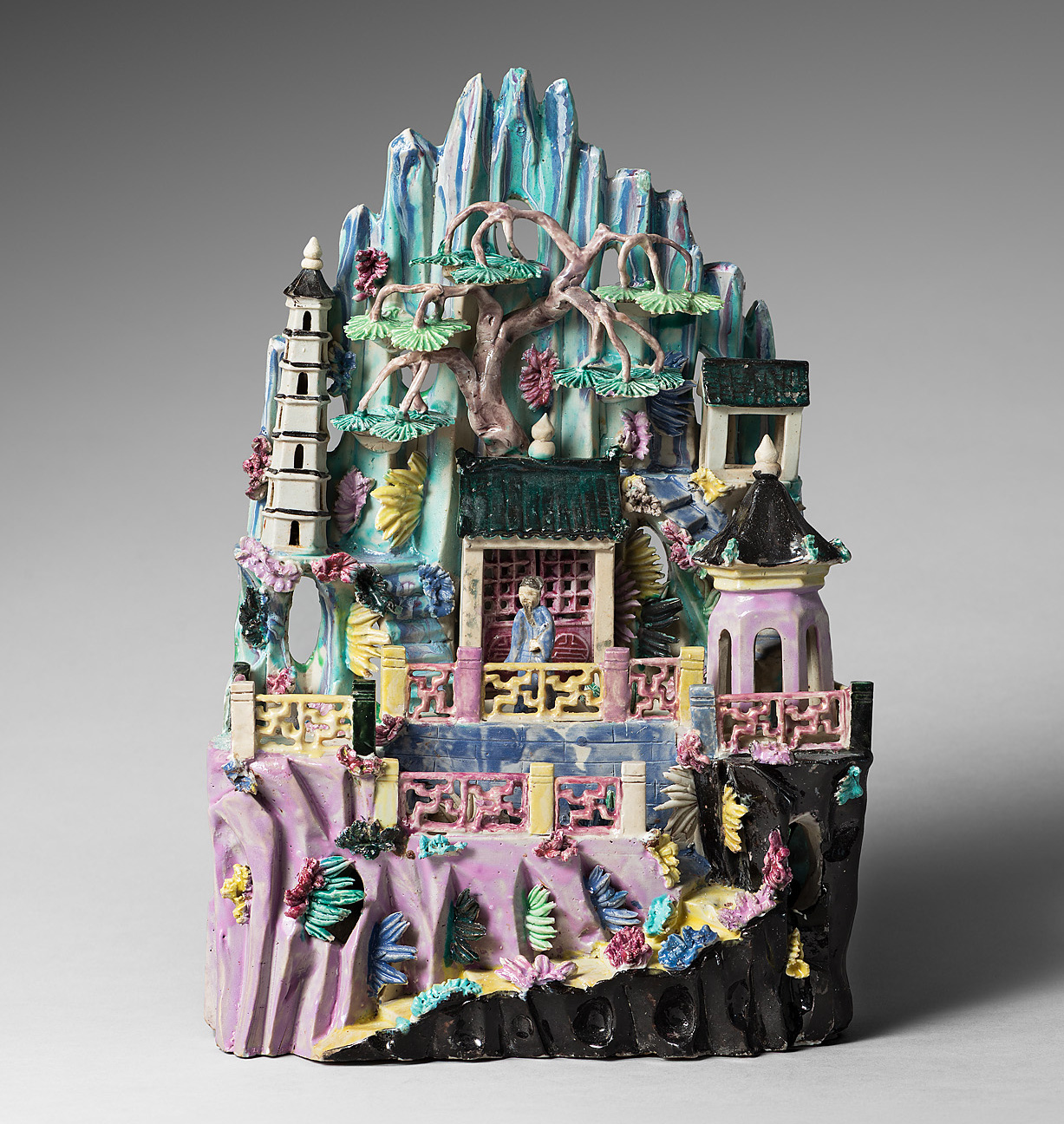
Additional information.This sculpture is inspired by the concept of shanshui, literally meaning “mountain and water”, a term used in China to describe both a literary and pictorial vision of landscape. Emerging during the Six Dynasties period (220–589 AD), shanshui became one of the fundamental themes of traditional Chinese painting. Shanshui compositions primarily depict natural landscapes, combining mountains, rivers, figures and architecture. The Ming and Qing dynasties marked important periods in the development of this artistic tradition, which gradually extended beyond painting to influence ceramics as well.
The rock is rendered using the cun (皴) technique, a method commonly employed in shanshui painting to emphasize the textured surfaces and layered formations of mountains and rocks.
Mountains held profound significance in Chinese culture. From the late Zhou dynasty onwards, the search for immortality became increasingly important, particularly among emperors who believed in the existence of a mythical place known as Penglai (蓬莱), a celestial mountain reserved for the immortals. Many sought this legendary site, convinced that it contained an elixir capable of granting eternal life.
Until the third century AD, mountains were widely regarded as the point of contact between the human world and the supernatural realm, inhabited by powerful deities, immortal sages and fearsome mythical creatures. These beliefs gave rise to numerous myths that were initially only loosely connected to organised religion, but which gradually contributed to the formation of Daoism, a religion in which nature—and mountains in particular—occupies a central place. Following its introduction into China, Buddhism soon became intertwined with these earlier beliefs.
During the transition from the Ming to the Qing dynasty, mountains also became places of refuge for many scholars and officials who remained loyal to the fallen dynasty. The death of the Chongzhen Emperor (1627–1644) marked the end of the Ming dynasty (1368–1644), and with the establishment of Qing rule, many scholars and painters who refused to serve the new regime chose to withdraw into the mountains or embrace Buddhist or Daoist monastic life, hoping to find a new purpose. Hermit painters sought to express an intimate relationship with nature and, in doing so, infused their works with the imagery of mountains and water, establishing shanshui as a central theme in Chinese artistic expression.
While landscape paintings primarily depict natural elements such as mountains and rivers, they also emphasise the harmonious relationship between man and nature. As human beings were regarded as an integral part of the natural world, architecture was expected to blend naturally into its surroundings. For this reason, figures and buildings frequently appear within landscapes of this period.
The pagoda represented on the mountain is known in China as a wenfeng (文峰) pagoda. The wenfeng pagoda belongs to an architectural type associated with fengshui (风水) and was regarded as an auspicious symbol. Widespread from the Ming dynasty onwards, it generally features a square, hexagonal or octagonal plan. Although derived from Buddhist pagodas, it is not directly associated with Buddhism. The purpose of a wenfeng pagoda was to bring prosperity and good fortune to the place where it was erected, particularly by encouraging success in the imperial examinations. Such pagodas could be constructed both on mountains and within urban centres.
During the Qing dynasty (1644–1911), the theme of shanshui inspired not only painted porcelain decoration but also sculptural compositions in porcelain. A Kangxi-period (1662–1722) porcelain model of Mount Penglai decorated in the famille verte palette, now preserved in the Shanxi Province Cultural Relics Exchange Centre, incorporates a bridge, pagoda, cottage, house and temple linked by a winding path ascending through the mountain. This composition reflects the imagined vision of the immortal mountain of Penglai and the contemporary aspiration to an existence beyond the earthly world.
Such a mountain was most likely originally intended for a Chinese scholar’s studio before being exported to Europe as a curiosity for a collector’s cabinet. The Chinese scholar’s studio was a place of retreat dedicated to study, calligraphy, painting and contemplation. Rooted in the ideals of the literati tradition, it reflected the intellectual refinement of its owner through a carefully chosen selection of objects, including porcelains, scholar’s rocks, incense burners, painted scrolls and writing implements. A cultivated microcosm, it sought to recreate a harmonious relationship between man and nature, often evoked through shanshui landscapes. The studio could also accommodate rare or exotic objects intended to stimulate contemplation and learned conversation. More than simply a place of work, it embodied an ideal of withdrawal from worldly affairs and spiritual cultivation.