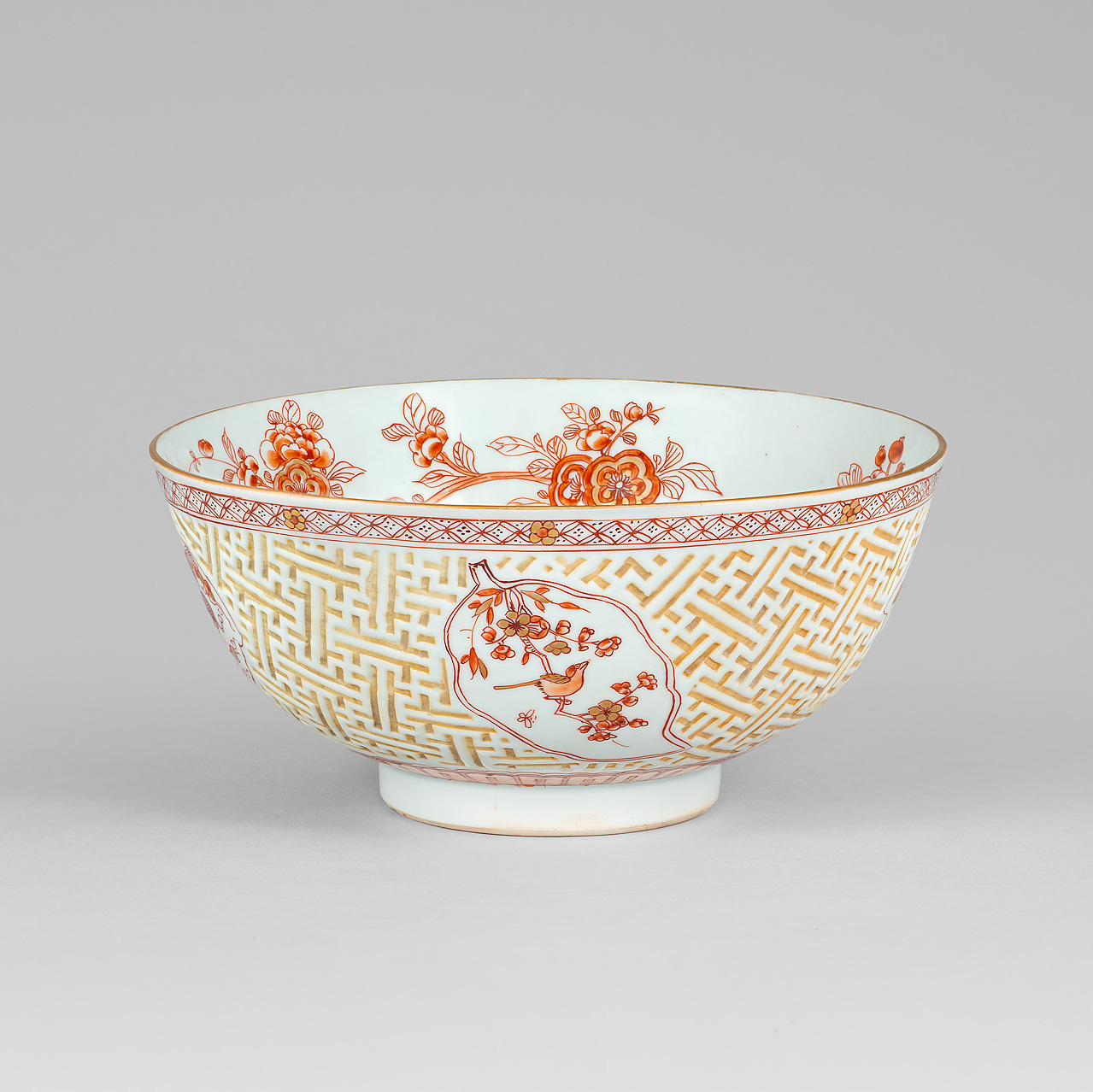
A gilt and iron-red-decorated bowl. China, Kangxi

The bowl, resting on a small circular foot, is decorated in iron-red enriched with gilt details. The exterior is entirely covered with a carved key-fret ground, interrupted by four leaf-shaped reserves outlined in iron-red. These enclose delicate scenes of birds perched on flowering prunus branches accompanied by butterflies, or squirrels among fruiting grapevines. Below the rim runs a narrow iron-red cross-hatched border, punctuated with small gilt flowerheads. A second geometric border encircles the lower part of the bowl above the plain white foot. The interior is decorated with large sprays of peonies, chrysanthemums and lotus painted in iron-red. The underside of the bowl bears a stamped lotus-flower mark.

COUNTRY : China
TIME: Kangxi (1662-1722)
MATERIAL : Porcelain
SIZE : 20.5 cm x 9.5 cm
REFERENCE : E940
STATUS : vendu
Related works .

For a famille verte brushpot from the Kangxi period with this type of ground, see S. Marsh, Brushpots: A Collector’s View, Hong Kong, 2020, pp. 252-253.

For a famille verte brushpot with a similar carved decoration, see Porcelains in Polychrome and Contrasting Colors: The Complete Collection of Treasures of the Palace Museum, Hong Kong, 2007, p. 161, no. 147.

Additional information.

Geometric key-fret grounds appear on Chinese porcelain as early as the Ming dynasty and became particularly popular during the seventeenth century. A pair of bowls from the Chongzhen period, dated to circa 1643 and formerly in the collection of Julia and John Curtis, is decorated on the exterior with a carved key-fret ground, which S. Marchant suggests was probably inspired by Chinese carved lacquer, where such geometric grounds had long been used (S. Marchant & Son, Exhibition of Chongzhen-Shunzhi Transitional Porcelain from a Private American Collection, London, 2007, p. 20, no. 9). This ornamental vocabulary belongs to a much older tradition, recalling the decoration of archaic bronzes of the Shang and Zhou dynasties, particularly leiwen (雷紋), or ‘thunder pattern’, composed of repeated angular spirals often used as a ground for the principal motifs. Transposed and reinterpreted across different materials over the centuries, this decorative vocabulary enjoyed renewed popularity on porcelain during the seventeenth and eighteenth centuries.

The subjects depicted within the reserves belong to the Chinese auspicious repertoire. A bird perched on a flowering prunus branch evokes spring and renewal, while the prunus itself also symbolises perseverance. The butterfly is associated with happiness and longevity, notably through a homophonic pun. In another reserve, a squirrel among bunches of grapes forms a traditional motif symbolising fertility, abundance and numerous offspring. Together, these motifs form an auspicious composition celebrating longevity, prosperity and the continuation of the family line.

Iron-red is a low-fired overglaze enamel whose colour is derived from iron oxide. Unlike underglaze copper-red, which is technically difficult to control, it produces, after a second firing, shades ranging from orange-red to deep brick-red. Iron-red was developed to remarkable effect in the Jingdezhen workshops during the Kangxi period. Used as one of the essential colours of the famille verte palette, it was also combined almost exclusively with gilding on a group of porcelains distinguished by the richness of their decoration.

Question about condition report

Question about condition report