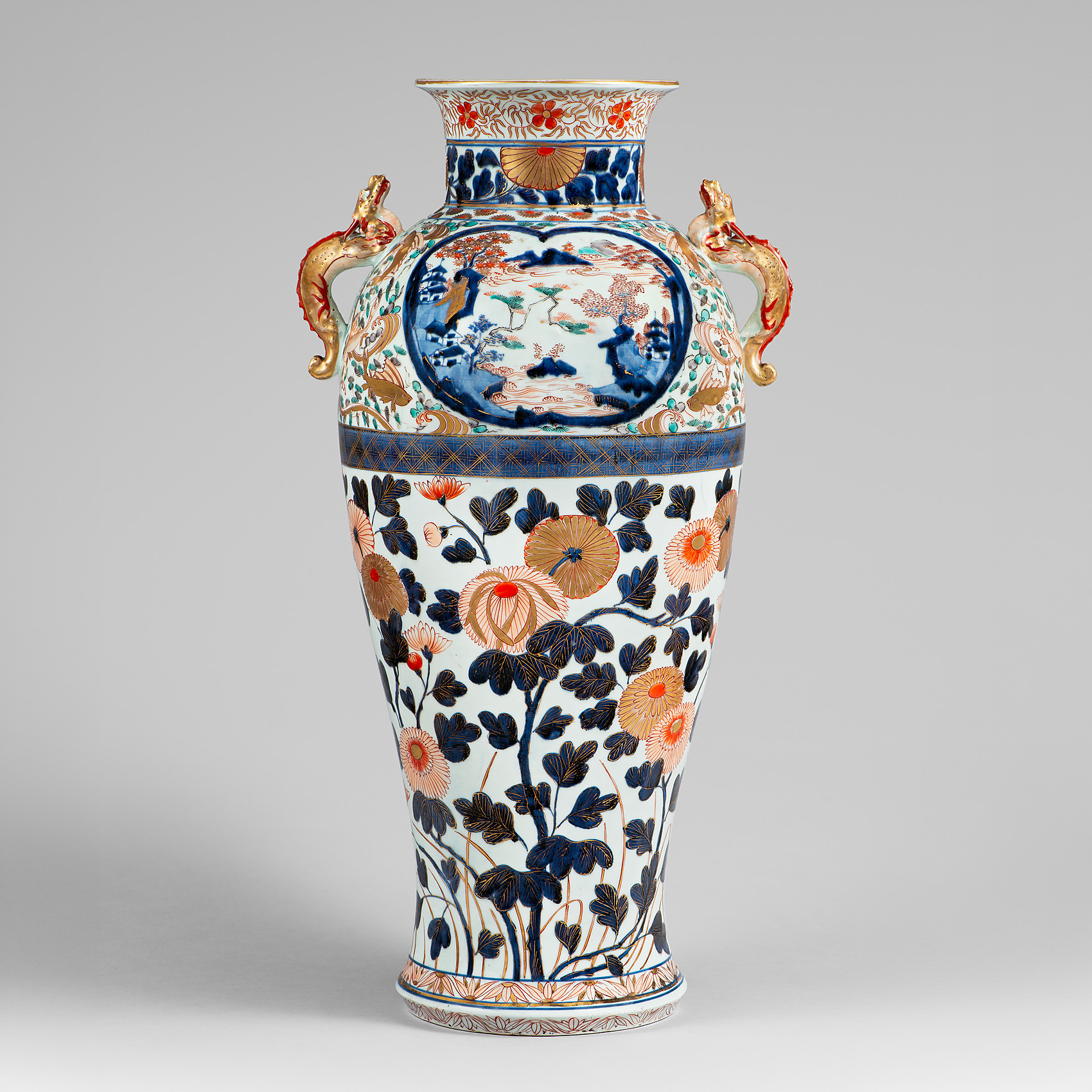
Additional information.The name Imari derives not from the site of production—as these wares were crafted in the kilns of Arita—but from the port in Saga Prefecture from which they were shipped to Nagasaki for global distribution. This nomenclature underscores the fact that these exuberant, densely decorated, and highly chromatic porcelains were primarily destined for the export market. In this regard, the Imari style stood in striking contrast to the more restrained and minimalist Kakiemon aesthetic, which was simultaneously developed by the Dutch East India Company (VOC) to cater to a different segment of the international elite.
The decorative programme of this imposing vase functions as a sophisticated microcosm, perhaps mirroring the geopolitical reality of Edo-period Japan. The upper lobed panels appear as isolated islands of serenity amidst a turbulent ocean—a poetic metaphor for the Sakoku (closed country) policy of the era, an isolationist stance largely inspired by the Haijin maritime bans enforced by the early Ming Emperors, who sought to strictly control coastal trade and curb piracy. Within these reserves, the quintessential Japanese landscape is captured through stylised yet unmistakable pine trees (Pinus pentaphylla) and maple (Acer japonicum), framing pavilions. It was to such coastal landscapes that the rare foreign traders permitted—primarily the Dutch (VOC) or the Portuguese—would briefly approach to load their vessels with precious cargoes of lacquer and porcelain before returning to the West.
Encircling these “islands”, the swirling waters teem with leaping fish. The exaggerated dorsal fins act as a potent symbol of masculine strength and perseverance, recalling the carp’s legendary ascent of the waterfall—a motif deeply associated with Tango no Sekku (Boys’ Day) and the virtues of the elite samurai class. This sense of the supernatural is consistent the sculptural dragon handles in iron-red and gilt, which act as guardians of this aquatic realm.
In contrast, the lower register offers a more grounded message. The broad, continuous band of boldly chrysanthemums represents a classic “rotating panel” of symbolism: as the floral emblem of the Imperial Throne and a traditional charm for longevity, it anchors the vase’s more enigmatic upper elements with a clear celebration of status and eternal life.
Porcelain vases on a large scale played an important role in porcelain-based decorative schemes because they were often placed in front of a fireplace during the summer months; given that rooms were furnished and arranged around the warmth of the fire, this meant that the colourful porcelain chosen to adorn the fireplace when the fire wasn’t in use would have been a focal point of the room. Though the demand for large vases was strong, their size caused them to be susceptible to cracking in the kiln and so they were only ever produced in relatively small numbers. Where porcelain vases of this type do survive, they tend to do so in pairs or as individual examples.
A central component of connoisseurial European taste at this time was a wonder and admiration for the porcelain of East Asia, and the grandest houses expressed this through teeming ‘porcelain rooms’. These saw porcelain pieces of various sizes, both from China and Japan, arranged plentifully in a layered display that was intended to dazzle – these were well-documented in the designs of the Franco-Dutch furniture designer Daniel Marot, which were first collected into a publication in 1702 and had profound influence on decorative styles across Europe’s sophisticated cultural centres
This ‘porcelain fever’ reached its zenith in the wealthiest German princely courts. At Dresden, Augustus the Strong conceived the Japanisches Palais, where vast collections tended to be organised by colour. Simultaneously, at Schloss Charlottenburg in Berlin, the Porzellankabinett was designed by Eosander von Göthe (c. 1705). This spectacular project integrated mirrors and porcelain of all scales—ranging from monumental vases to miniature pieces arranged to mimic architectural lambrequins. Although meticulously restored following the Second World War based on pre-war photographs and original inventories, the current display is dominated by Blue and White and famille verte wares. This arrangement offers a more restrained view than the 18th-century reality, where Blanc de Chine and Imari featured more prominently. While large Imari vases are no longer the focal point, one still finds delicate Imari plates, teapots, and those curious inverted bowls used to ‘cap’ the gilded stucco figures that emerge in ronde-bosse from the walls.
These decorative schemes treated rare and costly merchandise as a raw material for Baroque extravagance. Yet, this abundance often masked a pragmatic economy; contemporary craftsmen were known to be remarkably resourceful, for instance, repurposing offcuts from Japanese lacquer panels to create smaller luxury goods such as snuff boxes.
This European obsession with “Chinoiserie” was not always met with genuine porcelain. Louis XIV’s short-lived Trianon de Porcelaine, though older than the German cabinets, was actually decorated with faience. These tin-glazed earthenware tiles and vases imitated Chinese styles via the Dutch influence of Delft, while simultaneously stimulating domestic French industries in Rouen and Nevers.
Regarding large-scale porcelain, such as the present example, their role was often seasonal. During the summer months, they were placed within fireplaces—a tradition visible in the current arrangement at Charlottenburg. Given that rooms were centred around the hearth, these vases became the undisputed focal point of the interior. Furthermore, a quintessentially Régence practice involved placing a monumental vase upon the central stretcher (entretoise) of gilded wood consoles or beneath Japanese lacquer cabinets. While such a display required a certain architectural daring, the impressive proportions of this vase would have made it perfectly suited for such an audacious and high-status use.
Despite the immense demand for such monumental vessels, their scale rendered them exceptionally vulnerable to cracking during the firing process. Consequently, they were only ever produced in limited quantities. They have survive as individual pieces or the occasional pair.