
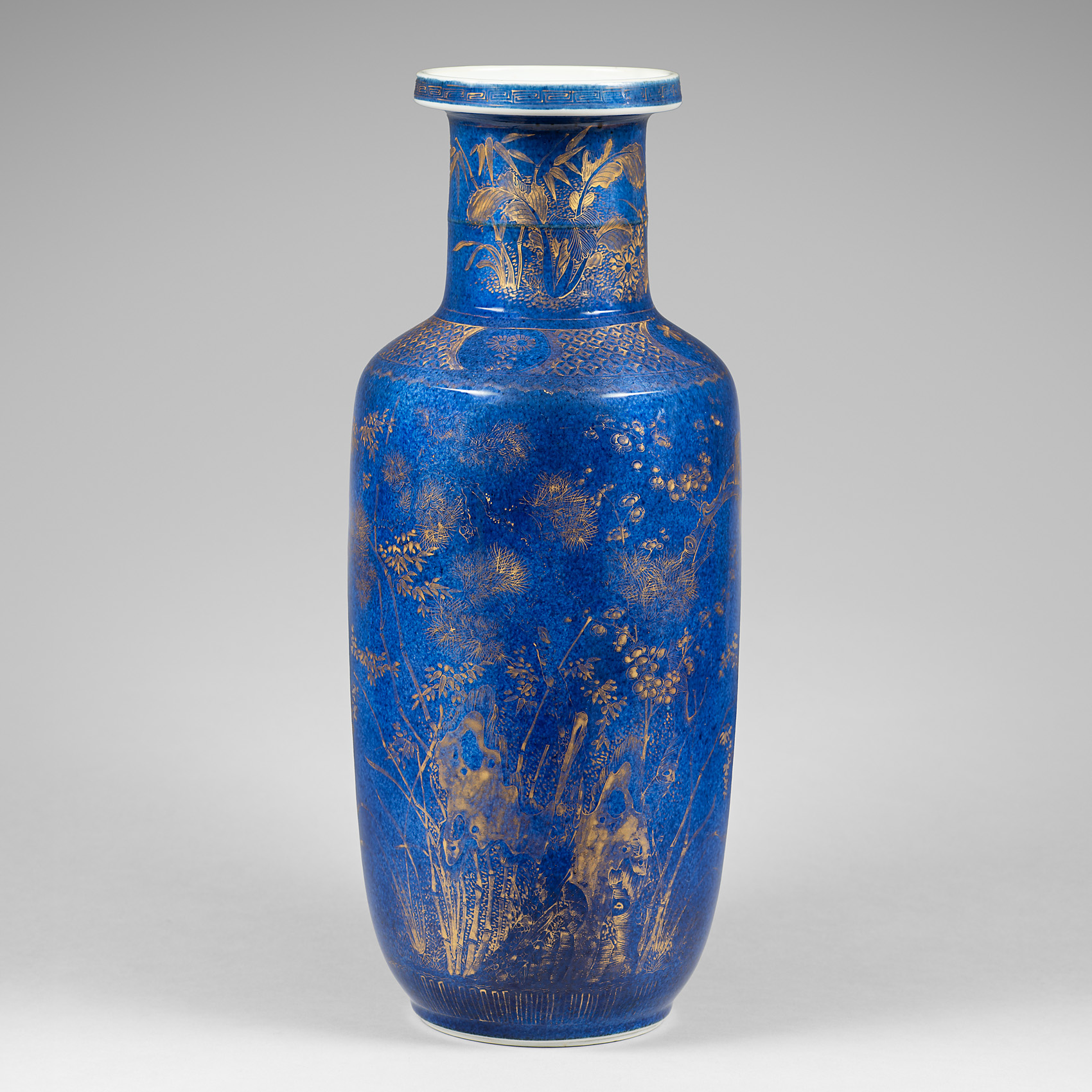
A large powder-blue rouleau vase decorated with the « Three Friends of Winter ». China, Kangxi

The large rouleau vase has broad, gently rounded shoulders, a cylindrical body tapering towards a straight foot, and a tall cylindrical neck encircled at the centre by a raised rib, rising to a wide, thickened and everted lip projecting beyond the neck. It is covered with a powder-blue underglaze and decorated with overglaze gilding.

The decoration extending around the body, comprises gnarled evergreens, slender canes, and budding floral branches set against the deep powder-blue ground. These botanical elements are enlivened by small birds perched or in flight, forming a continuous winter landscape pencilled in a delicate, linear style enhanced with fine gilt highlights against a deep powder-blue ground. The composition is enlivened with small birds, either perched on branches or shown in flight, together with rocks and low vegetation, all rendered in a delicate, linear style, forming a continuous winter landscape.

Above the foot is a broad border of upright lotus leaves, while the rim is encircled by a key-fret (huiwen) border. Around the shoulders runs a thick decorative band, framed by double lines, enclosing a flower-head pattern and multi-lobed cartouches containing chrysanthemum blossoms.Around the neck, chrysanthemum flowers and bamboo are again painted, accompanied by butterflies. The underside is glazed but undecorated.

COUNTRY : China
TIME: Kangxi (1662-1722)
MATERIAL : Porcelain
SIZE : 45 cm
REFERENCE : E914
PROVENANCE : From a French private collection
STATUS : vendu
Related works .

Another powder-blue vase of comparable size, likewise decorated with the Three Friends of Winter, is held in the collection of the Shanghai Museum[1]. Other related vases have been published by Jorge Welsh and Luisa Vinhais in their exhibition catalogue Noble Blue : The Enduring Appeal of Blue Ground Chinese Porcelain[2].

[1] Qingzheng, Wang, Kangxi Porcelain Wares from the Shanghai Museum Collection, 1998, pp. 308-309, no. 200

[2] Jorge Welsh and Luisa Vinhais, Noble Blue: The Enduring Appeal of Blue Ground Chinese Porcelain, 2023, pp. 88-97

Additional information.

The trio of plants depicted on the vase, collectively known as the Three Friends of Winter (歲寒三友, Suihan Sanyou), constitutes one of the most symbolically charged themes in Chinese art. It comprises the pine, bamboo, and prunus—species capable of withstanding the rigours of the season.

The pine, evergreen throughout the year, symbolises longevity, constancy, and moral strength. The bamboo, upright yet flexible, evokes integrity, modesty, and the ability to bend without breaking. The prunus, which blossoms in the depths of winter before the cold has fully abated, embodies renewal, resilience, and purity. Together, these three plants form an allegory of the ideal virtues of the scholar-gentleman in the face of adversity.

The theme appeared as early as the Song dynasty and became firmly established in literati painting, poetry, and the decorative arts. Under the Ming and Qing dynasties, it evolved into a canonical motif, frequently depicted on porcelain, lacquer, ink painting, and scholar’s objects. Far from being a mere vegetal ornament, it conveys a moral and intellectual message immediately intelligible to the informed Chinese viewer.

This blue ground is known in Chinese as 洒蓝 (salan), literally powder blue), also historically referred to as 吹青 (chuiqing), literally “blown blue”; in French as bleu poudré and in English as powder blue or blown blue. It first appeared at Jingdezhen during the Xuande period of the Ming dynasty, and reached full maturity during the reign of the Kangxi Emperor. 

To achieve this glaze, a bamboo tube was dipped into a cobalt-blue glaze solution and used to blow the pigment onto the surface of a previously fired white-glazed porcelain vessel. This technique resulted in an uneven distribution of pigment, forming speckled patterns of varying density and depth. A thin layer of transparent glaze was then applied, before high-temperature firing.

The rouleau vase was one of the forms that emerged at Jingdezhen during the first half of the Kangxi reign (1662–1722), probably developing from the traditional shape known as the rollwagen, which became popular in China during the mid-17th century.

Question about condition report

Question about condition report