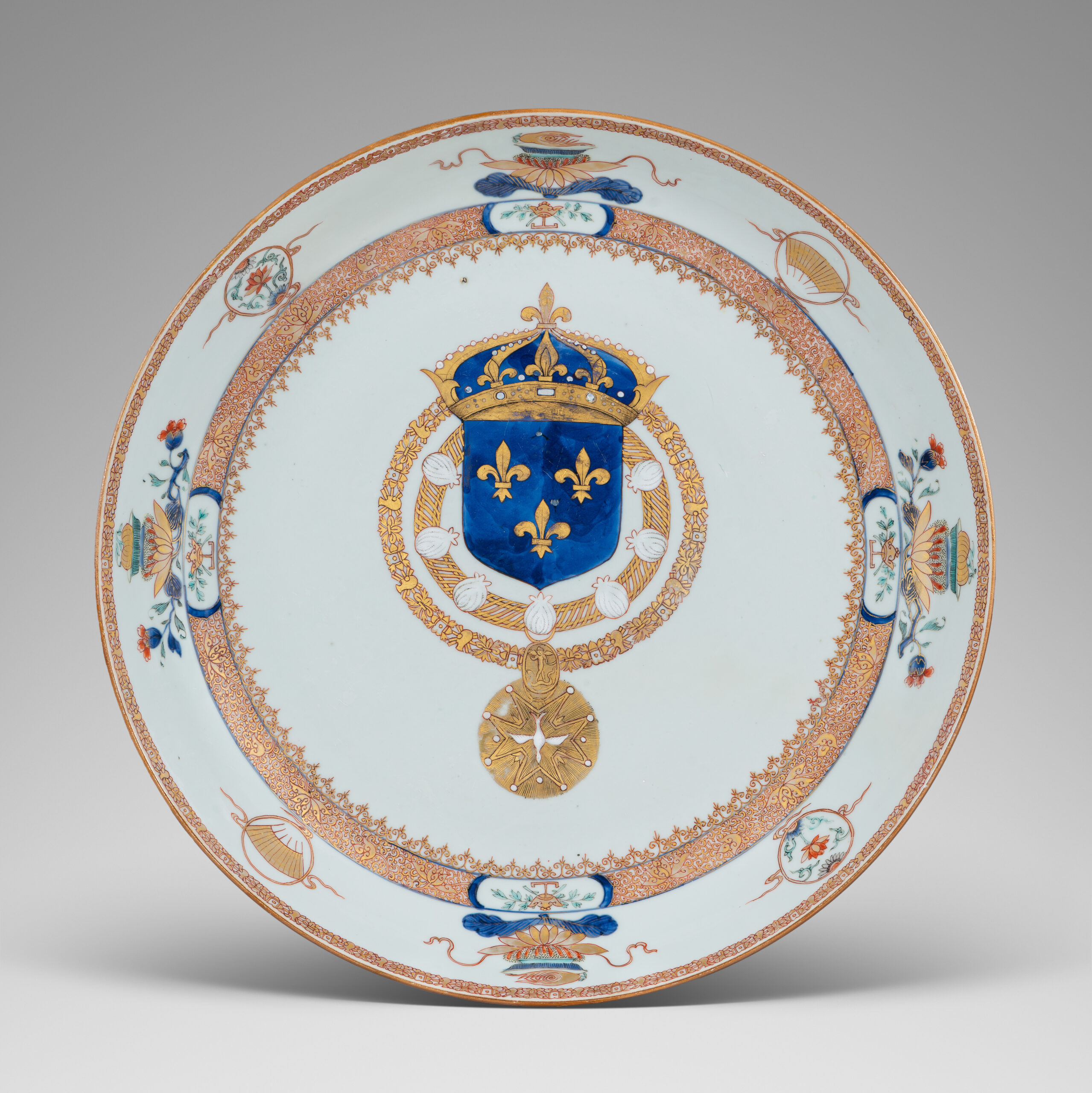
A large royal dish for the French market for Louis XV, King of France (1710–1774). Kangxi

This dish is decorated in the famille verte palette with translucent enamels and displays the characteristic pattern of porcelain orders commissioned in China for Louis XV, King of France (1710–1774). The central composition is dominated by the royal coat of arms: D’azur à trois fleurs de lys d’or, encircled by the collars of the Order of Saint Michael and the Order of the Holy Spirit, all surmounted by the royal crown.
COUNTRY : China
TIME: Kangxi (1662–1722)/ Yongzheng period (1723-1735), c. 1720–1725
MATERIAL : Porcelain
SIZE : 37.5 cm
REFERENCE : E700
PROVENANCE : From an important European collection
STATUS : disponible
Related works .

Recorded shapes for these royal commissions include large chargers; small tureens of graduated sizes; a large rounded tureen; two candlesticks; wine coolers; an écuelle; oil and vinegar cruets; sauceboats; one spice box; ewers with octagonal basins; tea, chocolate, or coffee sets; knives; three very large fountain vases, and bidets.

A dish of the same scale remains in the collection of the Château de Versailles[1], with two chargers[2]and three small tureens[3]. Two chargers are held in the collections of the Musée de la Compagnie des Indes[4], Lorient and the Musée Adrien Dubouché[5], Limoges, while the Musée des Arts Décoratifs, Paris held a mustard pot[6], a candlestick[7], and two knives[8]

[1] Inv. V2018.23

[2] V.2019.1 / V.2019.2

[3] V.2019.3/4/5

[4] Inv. 2012.16.1.

[5] Inv. ADL5727

[6] Inv. 2025.23.1

[7] Inv. 12292

[8] Inv. 28710 A-B

Additional information.

The main ornamental motif consists of underglaze blue double lotus leaves supporting a chrysanthemum flower, which is topped by a basket containing a finger citron (Buddha’s hand)—a symbol of happiness and longevity—and a gourd, representing abundance. It is also possible that these gourds were intended by Chinese craftsmen as double persimmons (shishi), with the surrounding tendrils mimicking ruyisceptres to form the auspicious rebus shishi ruyi (“may all things go according to your wishes”). Such symbolic meanings, however, were almost certainly overlooked by the French patrons of the period.

Additional motifs include peony sprays, fans, and chrysanthemum heads enclosed within rounded cartouches. The rim is adorned with a floral frieze incorporating the King’s cypher—a double opposing ‘L’ with laurel branches—set within four cartouches. The cavetto exhibits two distinct friezes: one with fer-de-lance motifs and the second with lotus leaves.

These commissions presumably date to the 1720s and 1730s. The orders of the 1720s closely followed the return of the Court to Versailles at the conclusion of the Regency. This dating reflects the prestige of Chinese export porcelain services, considered essential symbols the renewed grandeur of the monarchy. The earlier pieces were produced in the famille verte palette with translucent enamels, while later examples transitioned to the famille rose palette with opaque enamels.

Question about condition report

Question about condition report