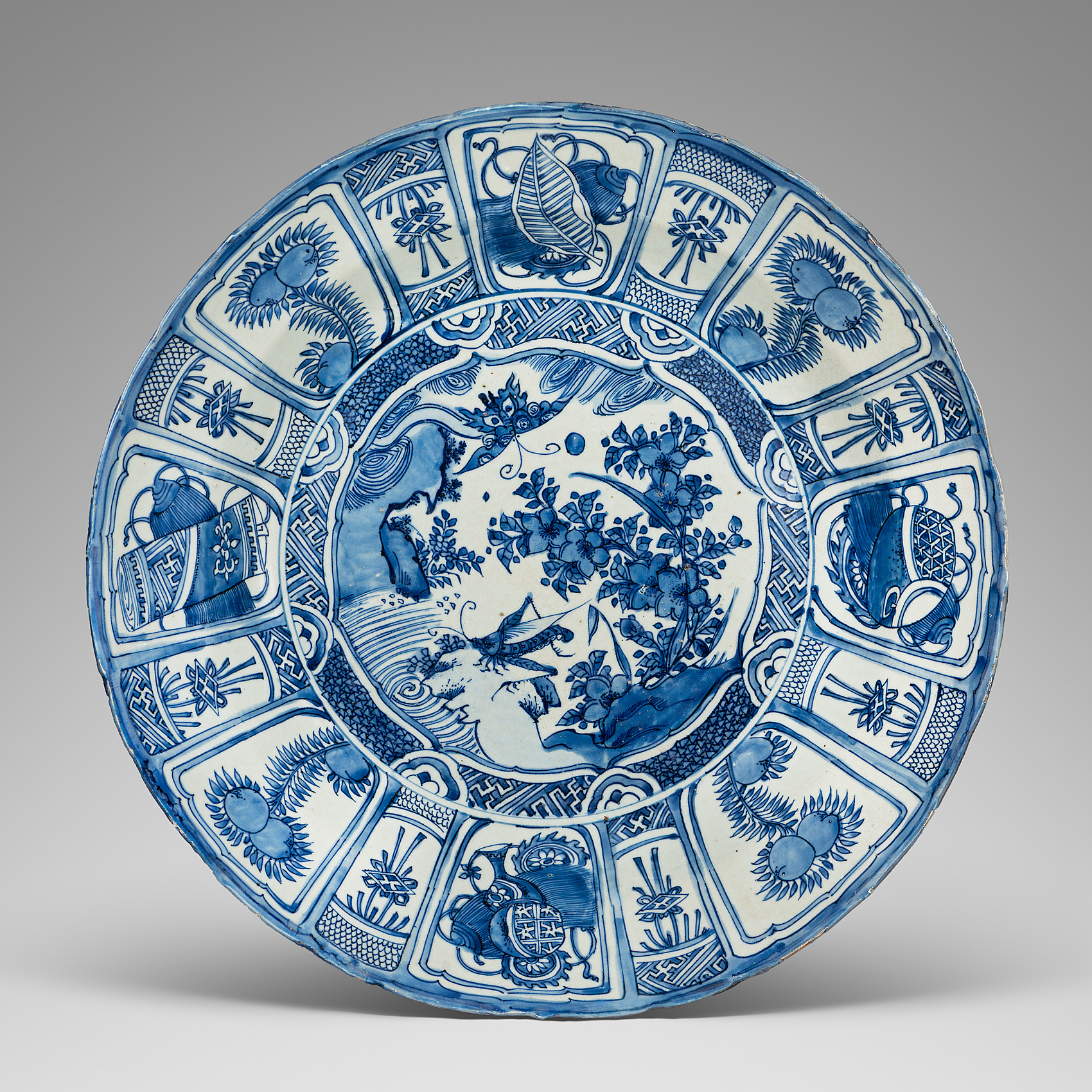
A massive blue and white kraak porcelain ‘Grasshopper and Butterfly’ charger. China, Ming dynasty, Wanli period (1573–1620).

The rounded sides rising from a short tapering foot to a broad everted flaring rim, richly decorated in bright shades of underglaze blue and painted to the interior with a very fine medallion enclosing a naturalistic scene depicting a grasshopper beside a stream. The insect is perched on a small riverbank, its long hind legs folded beneath its body, facing a flowering shrub that rises from a rocky outcrop on the right. On the left, a large rock with irregular contours overlooks the bank. Curving lines in the foreground indicate flowing water, while a butterfly hovers above the scene. The central scene is enclosed by framed by shaped panels enclosing various diaper grounds, surrounded by large floral lappets enclosing further geometric patterns, peaches and auspicious objects extending over the cavetto and wide flaring rim, the exterior painted with roundels enclosing floral sprays.

COUNTRY : China
TIME: Dynastie Ming (1572-1620), Wanli period (1573-1619)
MATERIAL : Porcelain
SIZE : 50 cm
REFERENCE : E962
PROVENANCE : From a private French collection, acquired by the previous owner in London, circa 1960–1980
STATUS : vendu
Additional information.

The decoration belongs to the long-established Chinese caochong (草虫), or “insects among grasses”, tradition, a subject that flourished in painting from the Song dynasty onwards before being adopted on porcelain during the late Ming period. Rather than depicting a specific narrative, caochong compositions celebrate the careful observation of the natural world, where insects, flowering plants and rocks are arranged in harmonious balance. Such imagery reflects the Chinese appreciation of seasonal change and the vitality of nature, transforming humble creatures into subjects worthy of artistic contemplation. The butterfly carries auspicious associations with joy and longevity through its homophony with die (耋), denoting advanced age, while the grasshopper, admired for its vigour and recurring appearance with the changing seasons, reinforces the theme of natural renewal. Although no established rebus appears to unite these two insects as a fixed symbolic pair, their association belongs to a refined visual vocabulary that was particularly appreciated by Ming scholars and painters. Their adaptation to kraak porcelain demonstrates how Jingdezhen potters successfully translated literati pictorial traditions into decorative compositions intended for the export market, preserving both their elegance and their symbolic resonance.

Question about condition report

Question about condition report