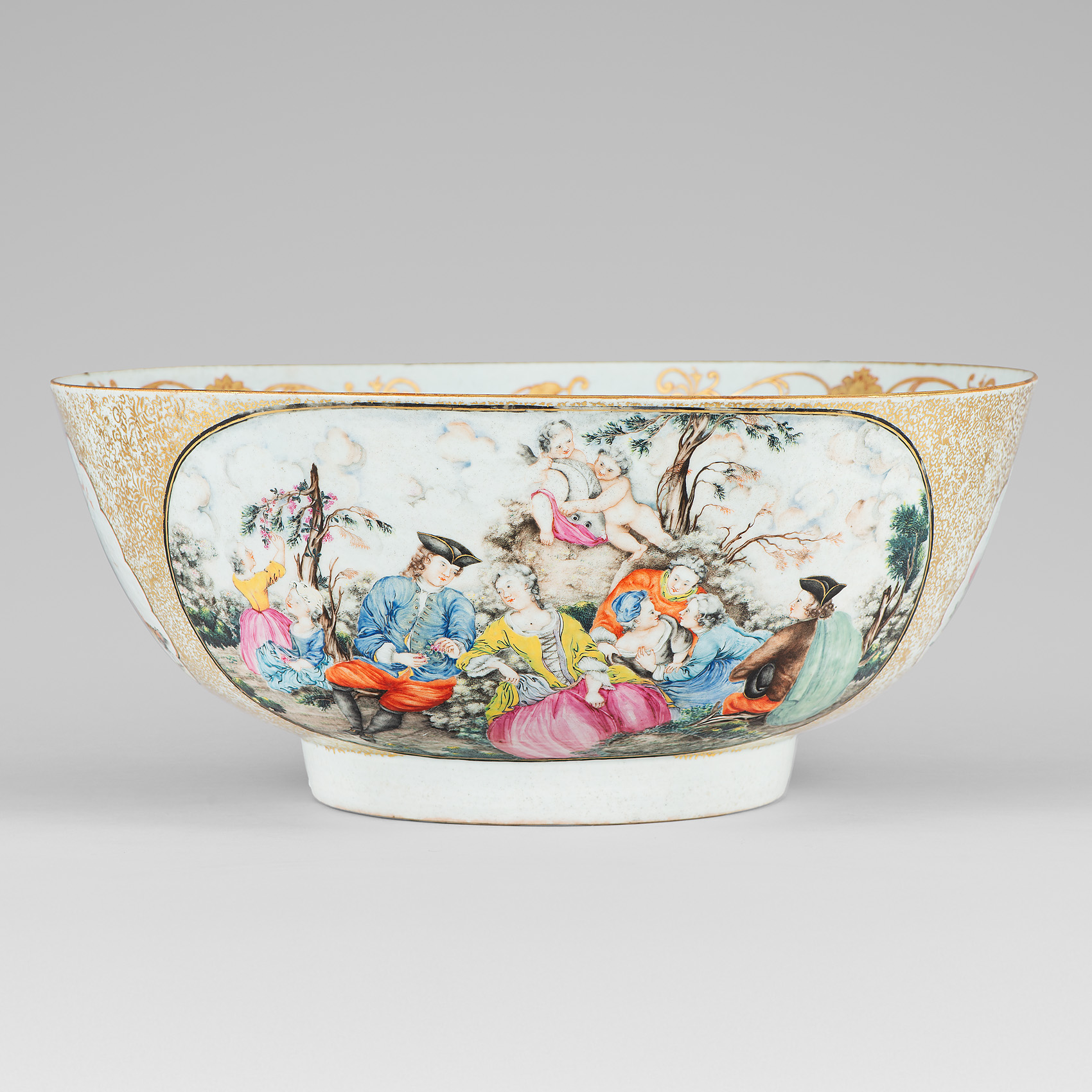
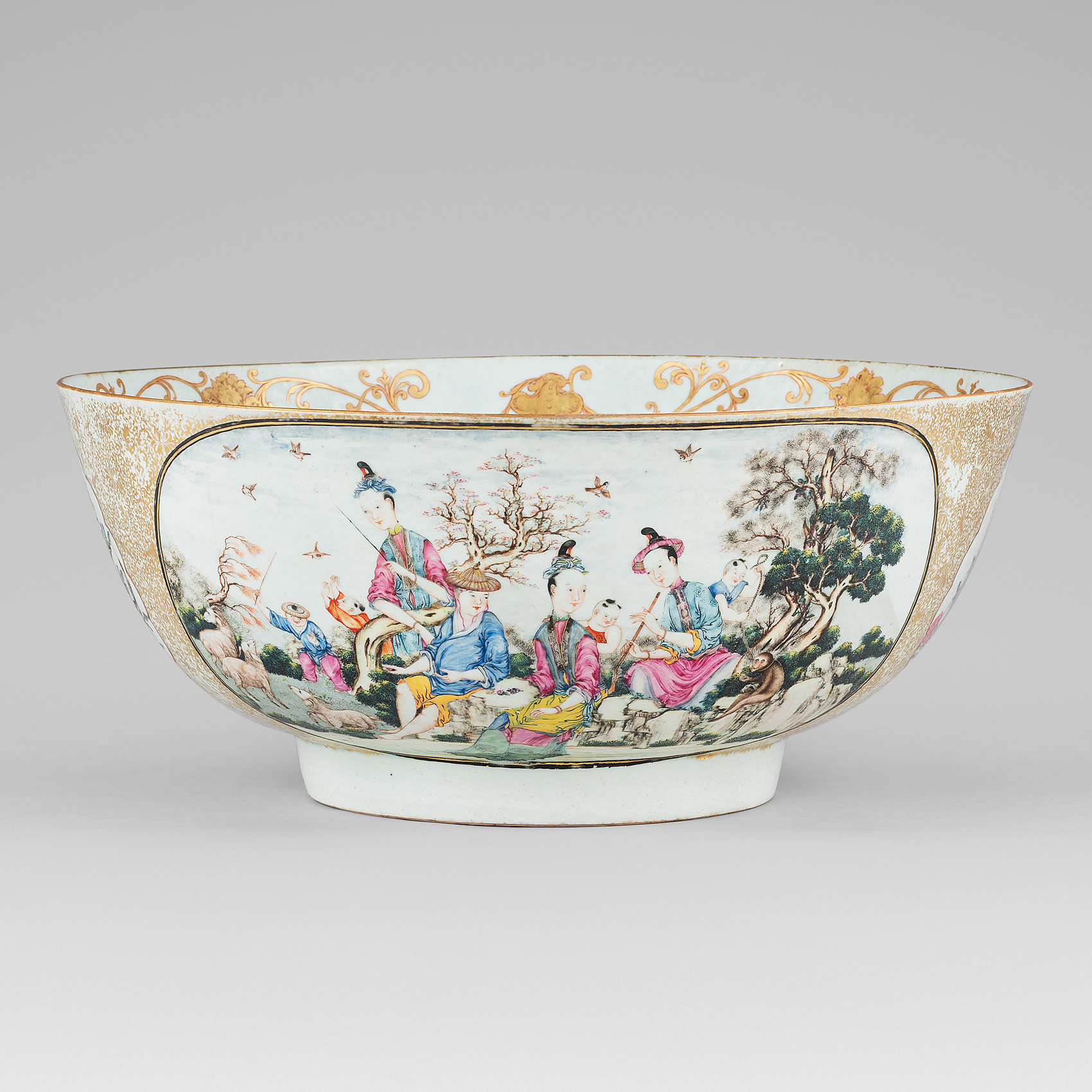
Additional information.The scene depicted is L’Amour et le Badinage, engraved by Pierre Filloeul (1696–1755) after Jean-Baptiste Pater, being a variation of his Die Freuden des Landlebens. Pater’s original painting was recorded in the collection of Baron Maurice de Rothschild (1881–1957) in 1928[1].
The European cartouche reflects the distinctly French pictorial style known as the fête galante. The term describes elegant outdoor gatherings enjoyed by the aristocracy from the early 18th century through the 1770s. In art, it refers to scenes of refined leisure — a genre formally recognised in 1717 by the Royal Academy of Painting and Sculpture to accommodate the innovative works of Antoine Watteau (1684–1721).
Following the death of Louis XIV in 1715, the French aristocracy gradually moved away from the formal grandeur of Versailles toward the more intimate settings of Parisian townhouses and follies. The French term folie—referring to private residences dedicated to beauty and pleasure—plays on a deliberate linguistic ambiguity. It is often cited as an alteration of feuillée (leafy bower), evoking a secluded shelter. Yet the name also hints at the ‘mad’ expenses required for their construction and echoes the euphemistic ‘petites maisons’—a term used both for these houses and the asylums where the ‘mad’ were confined.
This specific sociability, combined with the extreme refinement of such estates, is masterfully captured in Jean-François de Bastide’s short novel La Petite Maison (1758). The plot follows the virtuous yet aesthete Mélite, who bets she will never succumb to the advances of Trémicour. Upon visiting his ‘petite maison’, she wanders through its two wings and gardens, eventually accepting a gift of porcelain figures after admiring a Chinese cabinet panelled in lacquer. Overwhelmed by the sensory perfection of the setting, she ultimately loses both her composure and her bet.
In these settings, elegantly dressed figures engaged in music, flirtation, and light theatrical play. Fashion itself evolved to match this new intimacy; women’s attire became less restrictive, notably with the emergence of the robe volante. Inspired by robes de chambre (dressing gowns), these flowing garments epitomised the relaxed elegance of the Regency. The fête galante thus emerged as a more refined and courtly variation of the fête champêtre.
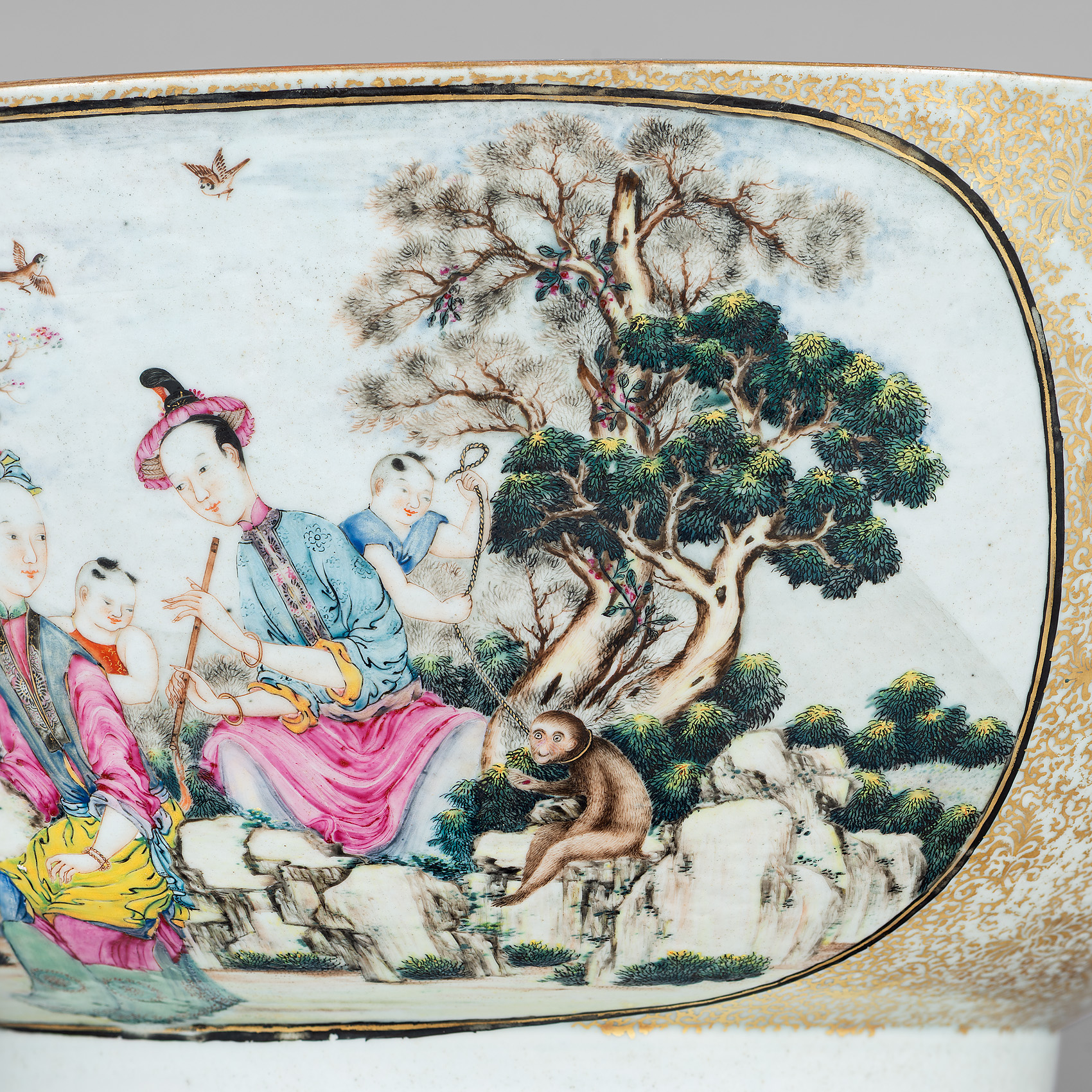
It is unusual in the repertoire of Chinese export porcelain to find a vessel decorated with such a clear juxtaposition of European and Chinese motifs. These two scenes appear to offer parallel explorations of the same theme—the pursuit of leisure and refined sociability.
The word ‘punch’ finds its origins in the traditions of the British East India Company. Seeking a refreshing beverage suited to the heat and humidity of India, sailors concocted a drink known in Hindi as paantsch (meaning ‘five’), referring to its five essential ingredients: a spirit, sugar, citrus, water, and spices. Initially, the base was arrack, a potent local spirit distilled from coconut or rice. As the British colonial presence expanded into the Caribbean, the character of the drink evolved; arrack was largely supplanted by rum, distilled from locally grown sugar cane. By the 18th century, punch had become a cornerstone of sociability in Georgian England. It was the centrepiece of sophisticated gatherings, served both as a restorative before and after the hunt, and as a staple of the convivial atmosphere in London’s exclusive gentlemen’s clubs.
During this period, large quantities of punch bowls were produced in China for export to Europe. These were decorated with various motifs, ranging from traditional Chinese subjects—as seen on the present example—to designs faithfully copied from European prints or bespoke armorial bearings commissioned by individual patrons.
[1] Communication William Motley