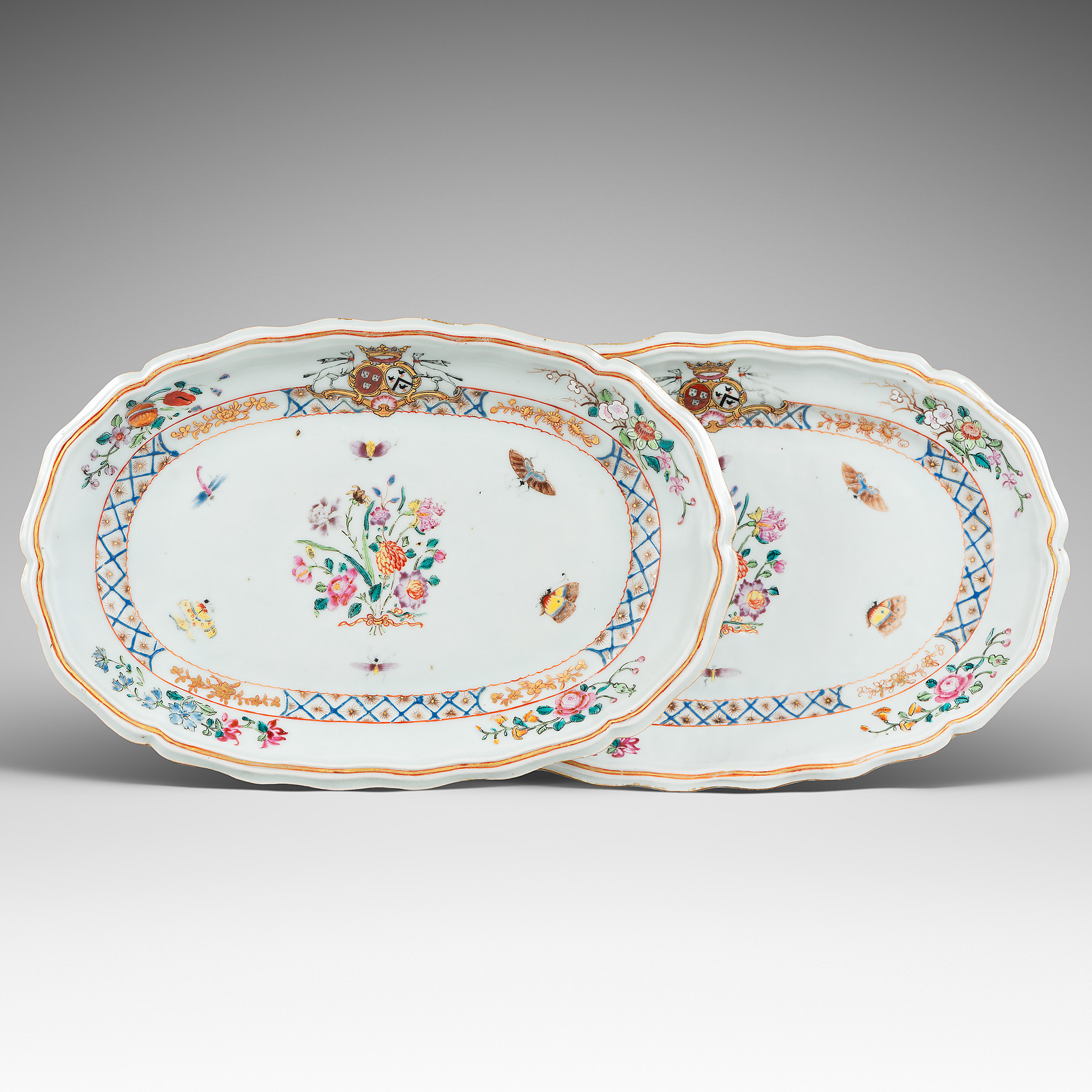
A pair of armorial oval dishes for the French market (Le Prestre de Chateaugiron – Floyd de Tréguibé). China, Qianlong

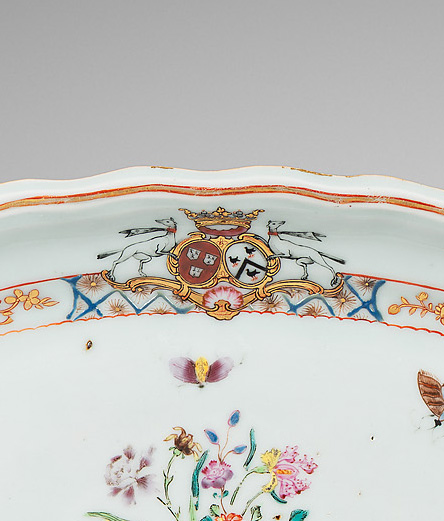
The dishes are decorated in the famille rose palette, of oblong and lobed form, with a floral decoration and diaper borders. At the centre are the arms of the Le Prestre de Châteaugiron family, De gueules, à trois écussons d’hermines (ici d’argent), à la bordure engrêlée d’or, and those of the Floyd de Tréguibé family, D’argent, au chevron de sable, accompagné de trois corneilles de même. The arms are placed beneath a ducal mantle, supported by ermine figures, and surmounted by a black velvet parlementary cap (mortier).

COUNTRY : China
TIME: Époque Qianlong (1736- 1795), circa 1770-1775
MATERIAL : Porcelain
SIZE : 28 cm x 18 cm
REFERENCE : E878
STATUS : disponible
Related works .

The decoration of this service closely follows that of the first Le Prestre service, as well as those made for the duc d’Aiguillon (1720–1788) and Monseigneur de Beaumont du Repaire (1703–1755). These three orders were probably ordered in Brittany around 1760 and likely produced at the same time.

Additional information.

Auguste-Félicité Le Prestre de Châteaugiron (1728–1782) was the grandson of Président de Lézonnet and the second son of Président de Châteaugiron, Jacques-René Le Prestre, and Louise-Jeanne de Robien. He belonged to a leading circle of Breton parliamentary families in the first half of the eighteenth century, notably the Le Prestre, Robien, Langle, Boisgelin and La Briffe d’Amilly families.

The younger son of a prestigious, wealthy and devout lineage, favourable to royal authority and long distinguished in military service under the Dukes of Brittany and later the Kings of France, he served as councillor at the Parlement of Brittany (1749–1763), avocat général (1753–1771), superintendent of the household of Madame la Dauphine (1770), councillor at the Parlement of Paris, président à mortier at the Parlement of Brittany (1771), councillor to the King, and president of the Grand Conseil (1774).

In 1761, he married Jeanne-Charlotte Floyd de Tréguibé, from a family of English nobility established in Brittany during the seventeenth century. He became particularly known for his role in the Affair of Brittany (1764–1768), surrounding La Chalotais, during which, as avocat général, he supported the duc d’Aiguillon, governor of Brittany, much to the displeasure of the parliamentary opposition. He would later leave Brittany for Paris.

Question about condition report

Question about condition report