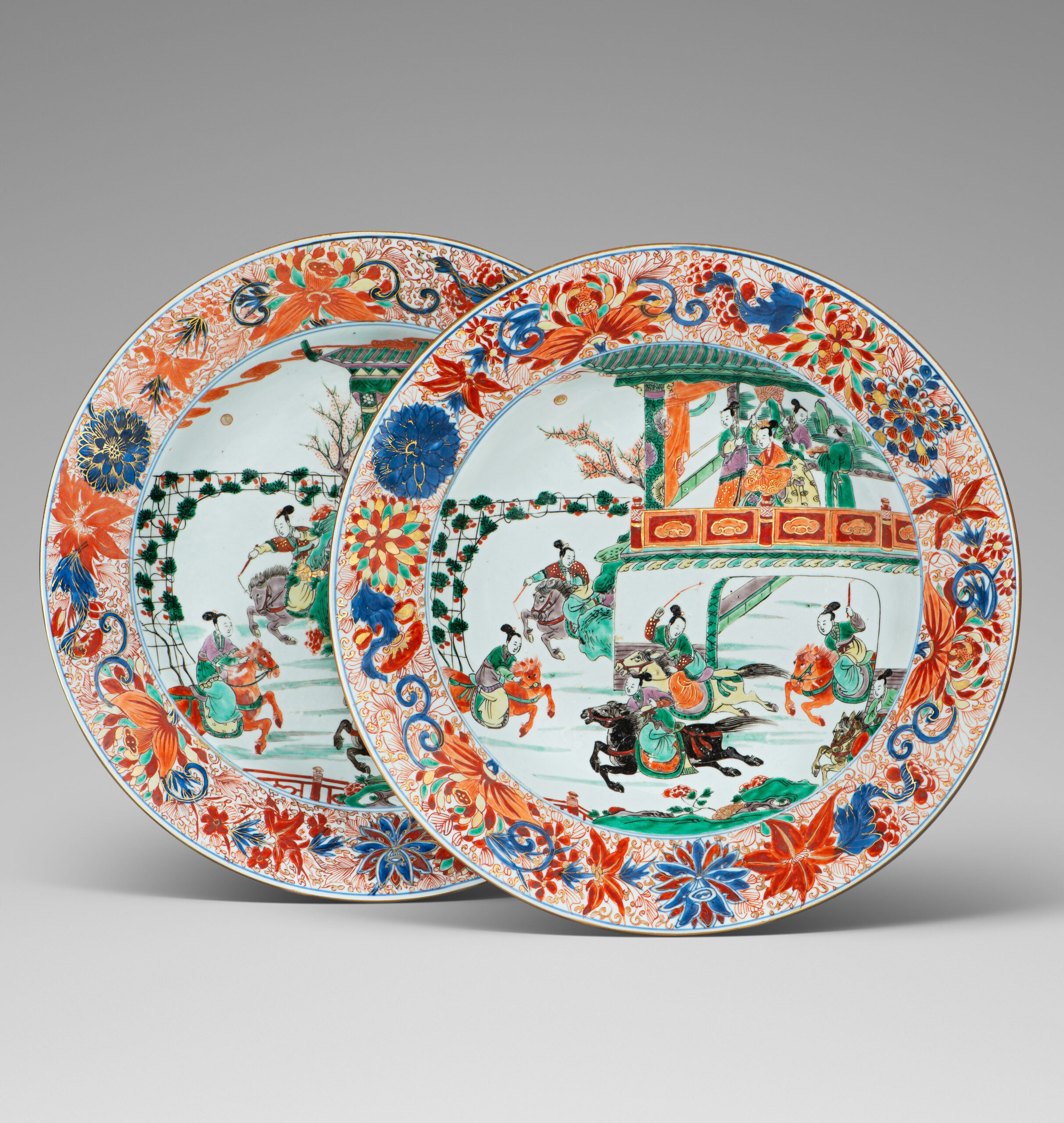
A pair of large figural famille verte chargers with the “Sui Yangdi guan gongnü paoma”. China, Kangxi

Brilliantly enamelled in the famille verte palette, the decoration of this pair of chargers is masterfully arranged around a central narrative scene. Set within a palace garden enclosed by flowering trellises and architectural elements, the composition features female riders portrayed in multi-coloured robes. Each figure is captured in a spirited pose, mounted upon horses rendered with exceptional vigour and a dynamic sense of motion. To the right, a multi-storey pavilion with a balustraded terrace serves as an observation point for several women; their presence establishes an intricate exchange of glances. This layering of spatial planes adds a sophisticated depth to the composition, drawing the viewer’s eye through the various levels of the garden and architecture. The rim is decorated with a profuse floral design, alternating large stylised blossoms—such as peonies, lotus flowers and chrysanthemums—with scrolling leafy tendrils, creating a decorative contrast with the central scene.
COUNTRY : China
TIME: Kangxi (1662-1722)
MATERIAL : Porcelain
SIZE : 39 cm
REFERENCE : E942
PROVENANCE : From the Collection of Duchess Isabella Lubomirska (born Czartoryska) (1736-1816), Lancut Castle, Poland
From the Collection of the Counts Potocki, Lancut Castle, Poland, until circa 1944
Paul-Louis Weiller (1893-1993), and thence by descent
STATUS : vendu
Related works .

The present pair originally formed part of a larger ensemble from the collections of Duchess Isabella Lubomirska (born Czartoryska) (1736–1816), Łańcut Castle, Poland. It subsequently passed into the collections of the Counts Potocki, Łańcut Castle, Poland, where it remained until circa 1944. The pair later entered the collection of Paul-Louis Weiller (1893–1993).

An example of this enamelled version in famille verte enamels, depicting the Empress Xiao, is held in the collection of the Tokyo National Museum⁴.

Another charger was formerly in the collection of Edmond de Rothschild at the Château d’Armainvilliers[1].

[1] Paris, 11 décembre 2014

Additional information.

This scene is widely known on eighteenth-century Chinese export porcelain. For a long time, it was interpreted as representing Yangmen nüjiang 楊門女將 (“The Female Generals of the Yang Family”), the story of twelve warrior women of the Yang family who opposed the forces of the Liao dynasty (907–1125) during the Northern Song period (960–1127). Numerous publications and catalogues continue to describe it in this manner.

Subsequent research[1] by the sinologist Ni Yibin confirmed the hypothesis advanced by Jacquemart and Le Blant, demonstrating that the scene in fact derives from the episode Sui Yangdi guan gongnü paoma 隋煬帝觀宮女跑馬 (“Emperor Yang of Sui watching palace women riding horses”). This episode is recounted in the Qing-dynasty novel Romance of the Sui and Tang (Sui Tang yanyi 隋唐演義) by Chu Renhuo (1635–1682).

In chapter 35 of the novel, Emperor Yang of Sui and Empress Xiao command their palace attendants to reenact the departure of the legendary concubine Wang Zhaojun by riding through the imperial gardens for their. A woodblock print from the 1695 edition of Romance of the Sui and Tang provides a direct visual reference.The print depicts Emperor Yang of Sui and Empress Xiao seated together in a pavilion, watching palace women riding horses, whereas porcelain illustrations depict either the Emperor or the Empress.

On this pair of famille verte chargers, the balcony scene is limited to Empress Xiao, two court ladies, and an attendant bearing a fruit-laden tray; notably, the Emperor is omitted. They represents an iconographic variant of the large charger enamelled in famille rose–verte enamels illustrated in this catalogue, on which only the Emperor is depicted[2].

[1] Jeffrey P. Stamen and Cynthia Volk with Yibin Ni, A Culture Revealed: Kangxi-Era Chinese Porcelain from the Jie Rui Tang Collection 文采卓然:潔蕊堂藏康熙盛世瓷, Jieruitang Publishing, 2017, Bruges, pp. 30-33.

[2] Notice 33

Question about condition report

Question about condition report