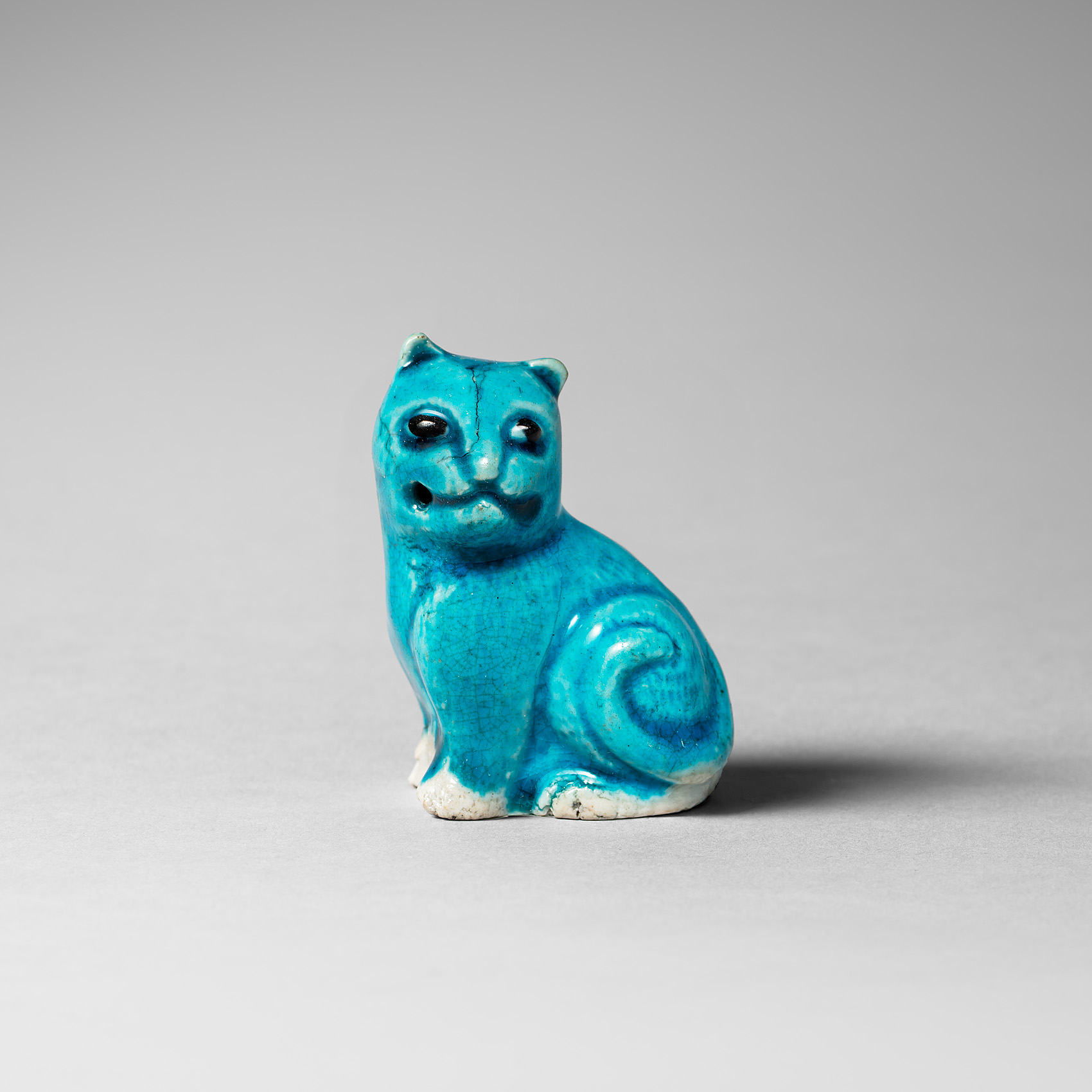
A turquoise-glazed biscuit water dropper modelled as a cat. China, Kangxi

The water dropper is modelled in the form of a seated cat with its head turned slightly to the left. The body is covered with a vibrant turquoise glaze, leaving the paws and the underside unglazed. The fur is finely incised beneath the glaze, while the eyes are picked out in black enamel. The tail is tightly curled around the right side of the body in a spiral. A small aperture on the left side of the mouth serves as the water spout, while the filling hole is concealed on the reverse. The base is left unglazed.

COUNTRY : China
TIME: Kangxi (1662-1722)
MATERIAL : Porcelain
SIZE : 6.6 cm
REFERENCE : F038
PROVENANCE : RMP, London
STATUS : vendu
Related works .

A related figure of a water dropper modeled as a turquoise cat was in the private collection of Mrs. Léon Waanieck (Paris, Palais Galliera, 30 novembre 1960, no. 38).

Comparable biscuit figures of cats, enamelled in yellow (PO 4363) and green (PO 4388), are preserved in the Dresden Collection.

Additional information.

The cat is traditionally an auspicious animal in China. The cat (mao 猫) is homophonous with the word for ‘aged eighty to ninety'( mao 耄), making the cat a symbol of longevity. Cats are believed to have been introduced into China by Buddhist monks. European iconography of the period also featured frequent feline imagery portraying the animal as both playful and mischievous.


Question about condition report

Question about condition report