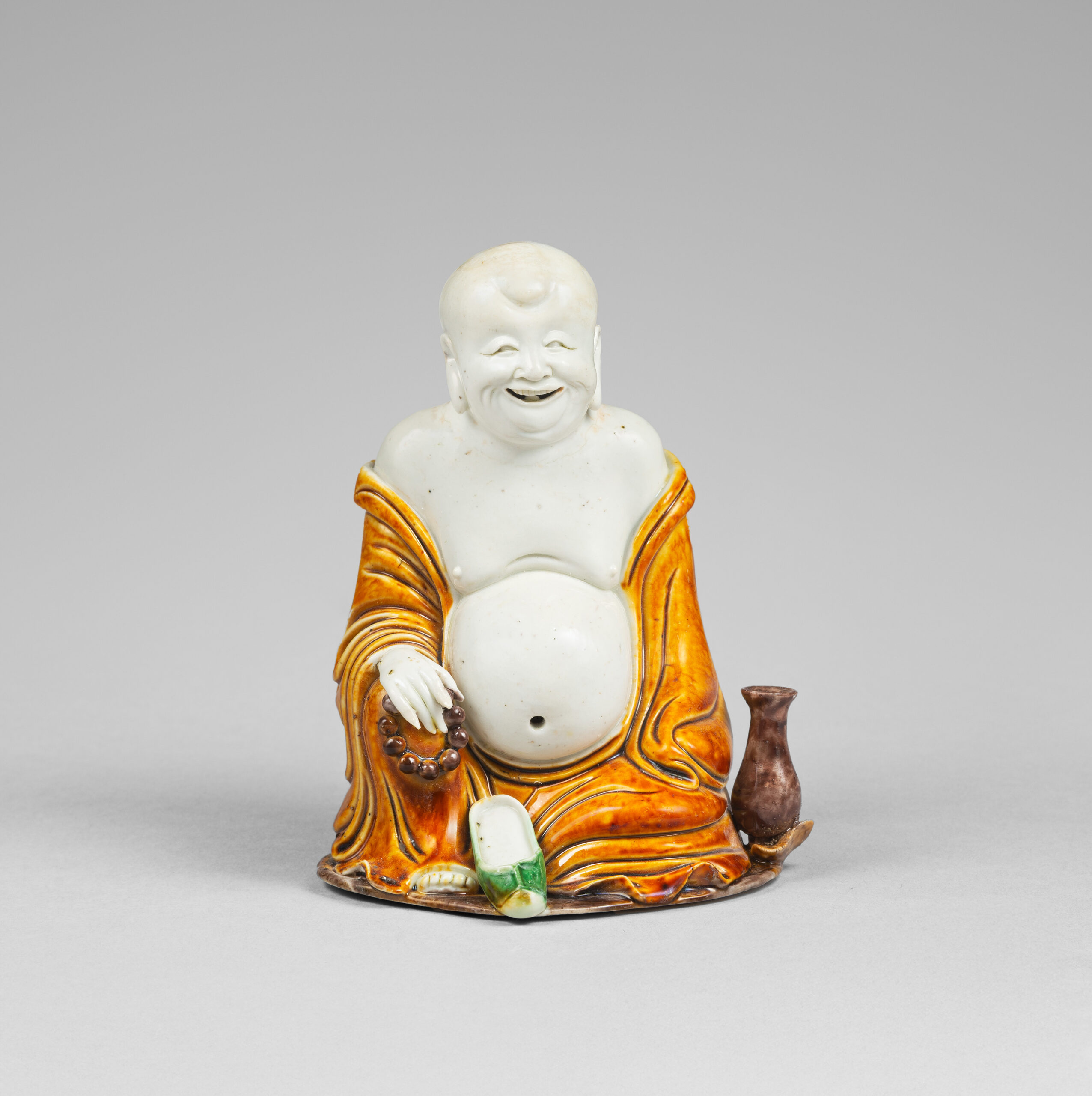
Additional information.This type of figure is sometimes described as a Luohan, Budai or more generally a monk, the latter probably being the most appropriate designation. A Luohan is an enlightened disciple of the Buddha,represented in Chinese art as an ascetic monk, often with strongly individualised features, sometimes eccentric, yet imbued with spiritual gravity.
While a missing shoe is a motif frequently associated with certain wandering Luohans, the figure’s prominent belly, sagging chest, and elongated earlobes—coupled with the jovial, smiling expression and the prayer beads held in one hand—strongly suggest a representation of a monk or Budai. Also known as Milefo, the pot-bellied Buddha, Budai is a mythological figure derived from Maitreya, the Buddha ofthe Future, whose name evokes mercy. During the Song dynasty (960–1280), he ranked among the mostpopular deities in East Asia.
Although such figures were produced for both the Chinese and export markets, the popularity of these pieces in eighteenth century Europe probably had more to do with the appeal of their jolly faces and rotund bellies than with the Chinese iconography. The model first reached Europe in the form of Blanc de Chine version produced at the Dehua kilns. These pieces were exported in the late seventeenth century and one is known to have been included in the 1688 Burghley House inventory, described as “1 ball’d fryor sitting,” listed in the contents of “My Ladys Dressing Room.” These small laughing figures continued to be produced in Blanc de Chine well into the eighteenth century.
During the Kangxi period, comparable examples were produced with solid-toned robes, as well as covered in rich, turquoise-tone glazes. Slightly differing models can also be found decorated with checkered robes. Polychrome and gilt examples were exported in the Yongzheng and Qianlong periods, the robes detailed with more decorative medallions and borders. Larger versions were also made later in the century, modelled in the form of soup tureens, sometimes incorporating a European coat of arms on the belly.
When a particular China trade figure became popular in England and on the Continent, copies were promptly replicated by various European factories. In the first quarter of the eighteenth century similar models were produced in blue and white faience at the Delft factory of Lambert van Eenhoorn, De Metalen Pot. White-glazed versions were executed by Böttger at Meissen, circa 1713, and are known to have been in the collection of Augustus the Strong.