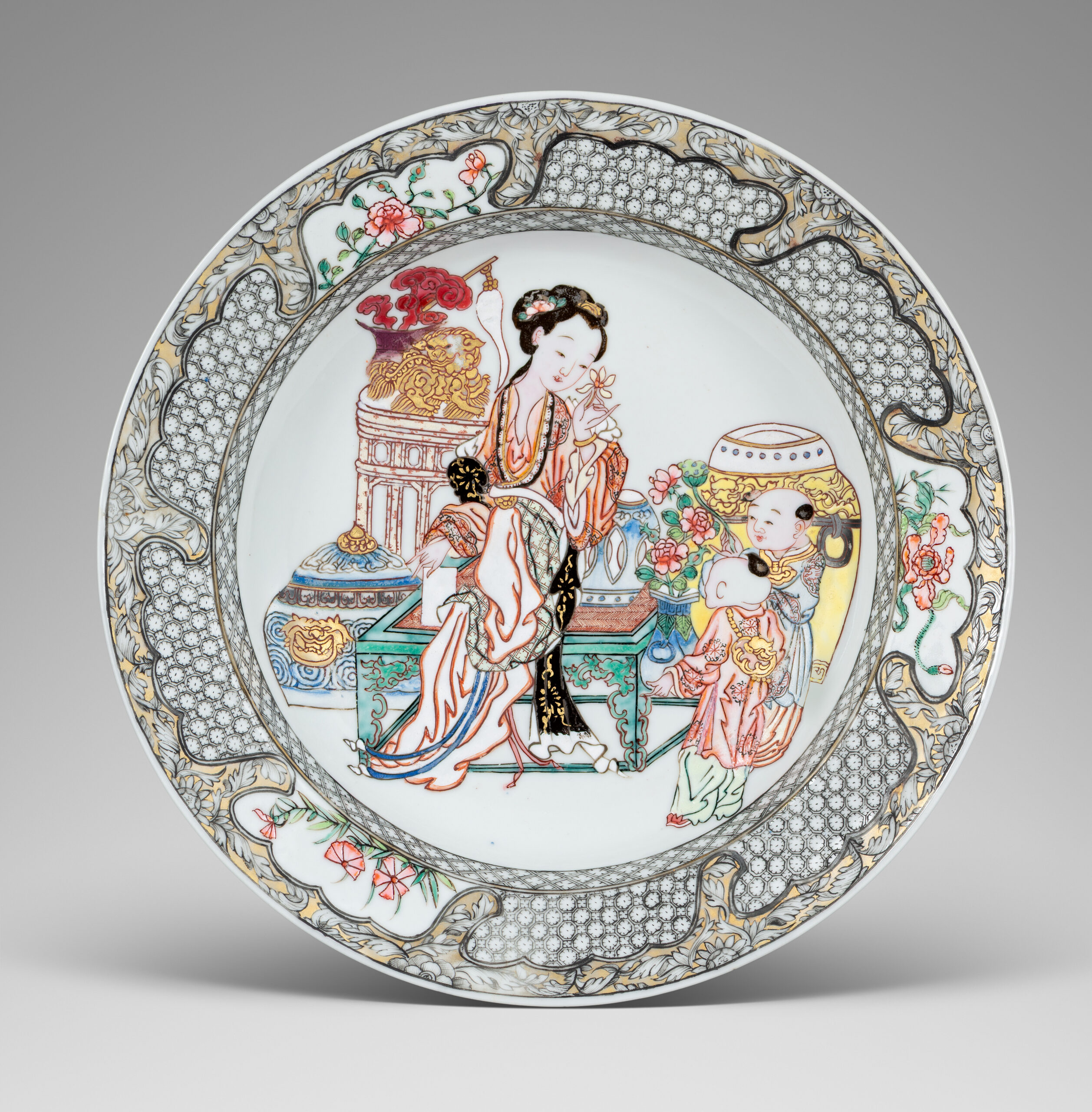
Additional information.The distinctive feature of this plate is the exceptional thinness of its body, which eventually became to be known as “semi–eggshell porcelain.” This technique, also known as danpi or tuotai (literally bodiless ware). It first appeared in China during the Ming dynasty, under the reign of the Yongle emperor (1402–1424). It was rediscovered under the Chenghua emperor (1464–1487), reaching a remarkable level of refinement, and again under the Wanli emperor (1572–1620), before being revived during the Qing dynasty, notably under the reigns of Kangxi (1662–1722) and Yongzheng (1723–1735). The production of “eggshell” porcelain consisted primarily of bowls, cups with saucers, and plates.
The remarkable thinness of this porcelain was achieved by means of a paste composed mainly of kaolin, with a smaller proportion of petuntse. After throwing, the body was further pared down on the wheel to reduce its thickness to a minimum. This technique produced an almost translucent material, of striking lightness and delicacy, as though it were made of glaze alone.
Under the Yongzheng reign (1723–1735), eggshell and semi–eggshell porcelains produced at Jingdezhen were painted with exceptionally refined decoration in the famille rose palette, possibly enamelled at Guangzhou (Canton) [1]. The reverse of these porcelains is sometimes covered with a ruby-red enamel, known as “ruby back,” which further enhances the precious quality of the material.
The basin of this plate is painted with a domestic subject emblematic of this production. It depicts an elegantly dressed mother educating her sons in a luxurious and culturally rich environment. This theme, one of the ideals of Confucian society, expresses a wish for individual happiness and familial harmony.
Such plates were often referred to as “sample plates” (assiettes d’échantillon) in the trade vocabulary of the nineteenth century. This term, used by Albert Jacquemart[2] was probably borrowed with varying degrees of relevance, from a term used for European porcelain, particularly from the Sèvres Manufacture. It originally referred to an “experimental” plate, whose decoration, by nature unique, was conceived to demonstrate artistic and technical virtuosity, to serve as a model for future creations, and to be displayed rather than used.
This decorative type, representing a mother and her sons, was produced in numerous variations, both in the treatment of the central scene and in the execution of the borders. It was also painted in China in enamels on copper in Canton around the mid-eighteenth century, and was later copied in Europe during the nineteenth and twentieth centuries.
During the nineteenth century, the Parisian art dealer Nicolas Joseph Malinet (1805–1886) was a specialist in these works. They were collected in France by discerning amateurs such as Adèle de Rothschild (1843–1922) and Adolphe Thiers (1797–1877), and in Belgium by Raoul Warocqué (1870–1917).
[1] Bill Sargent, Chinese and European Ruby-Back Porcelains, Orientations, vol. 54, no. 6, nov/dec 2023, p. 61
[2] Albert Jacquemart et Edmond Le Blant, Histoire artistique, industrielle et commerciale de la porcelaine…, Paris, J. Techener, 1862