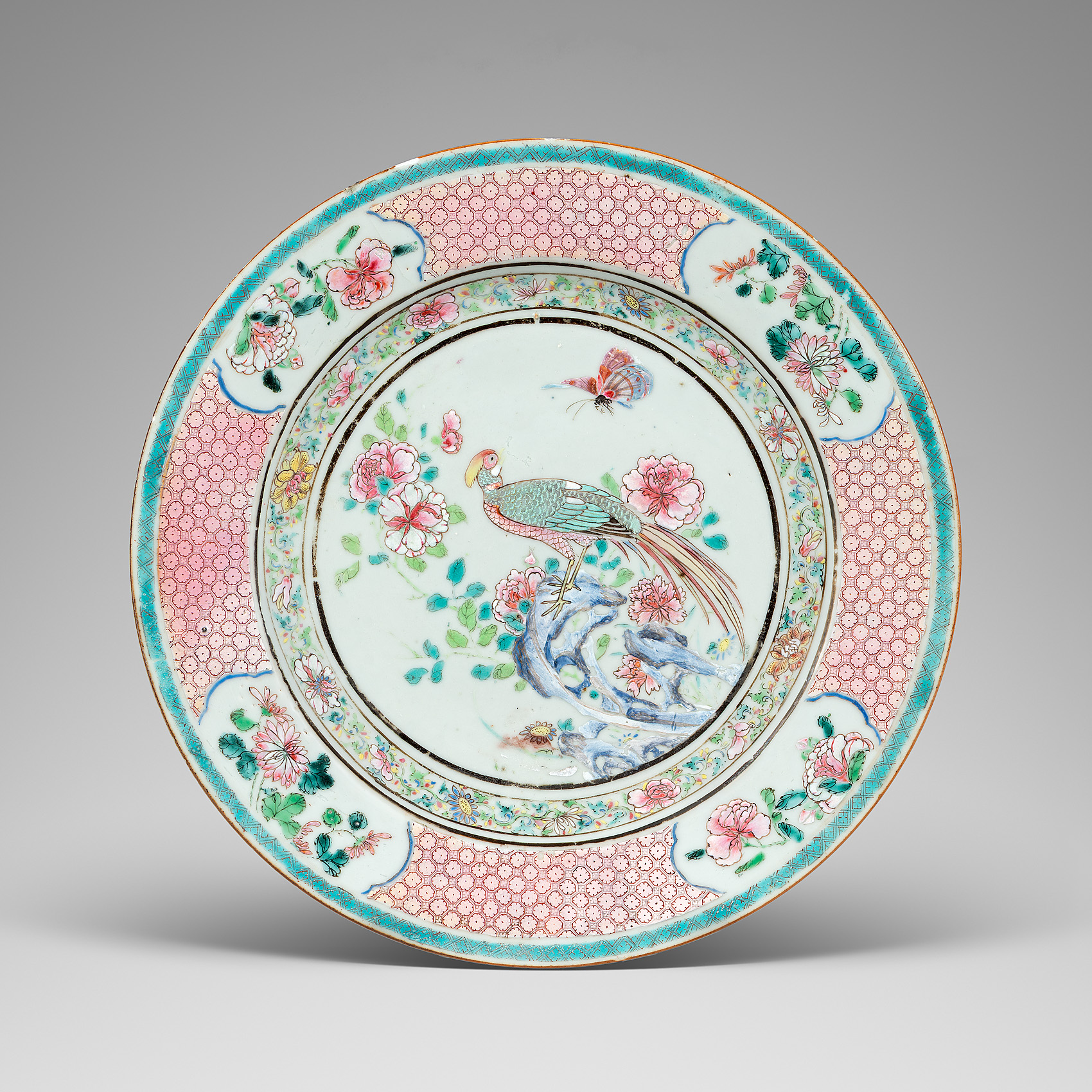
Additional information.The order reattributed to Louis-Alexandre de Bourbon, comte de Toulouse (1678-1737), son of King Louis XIV
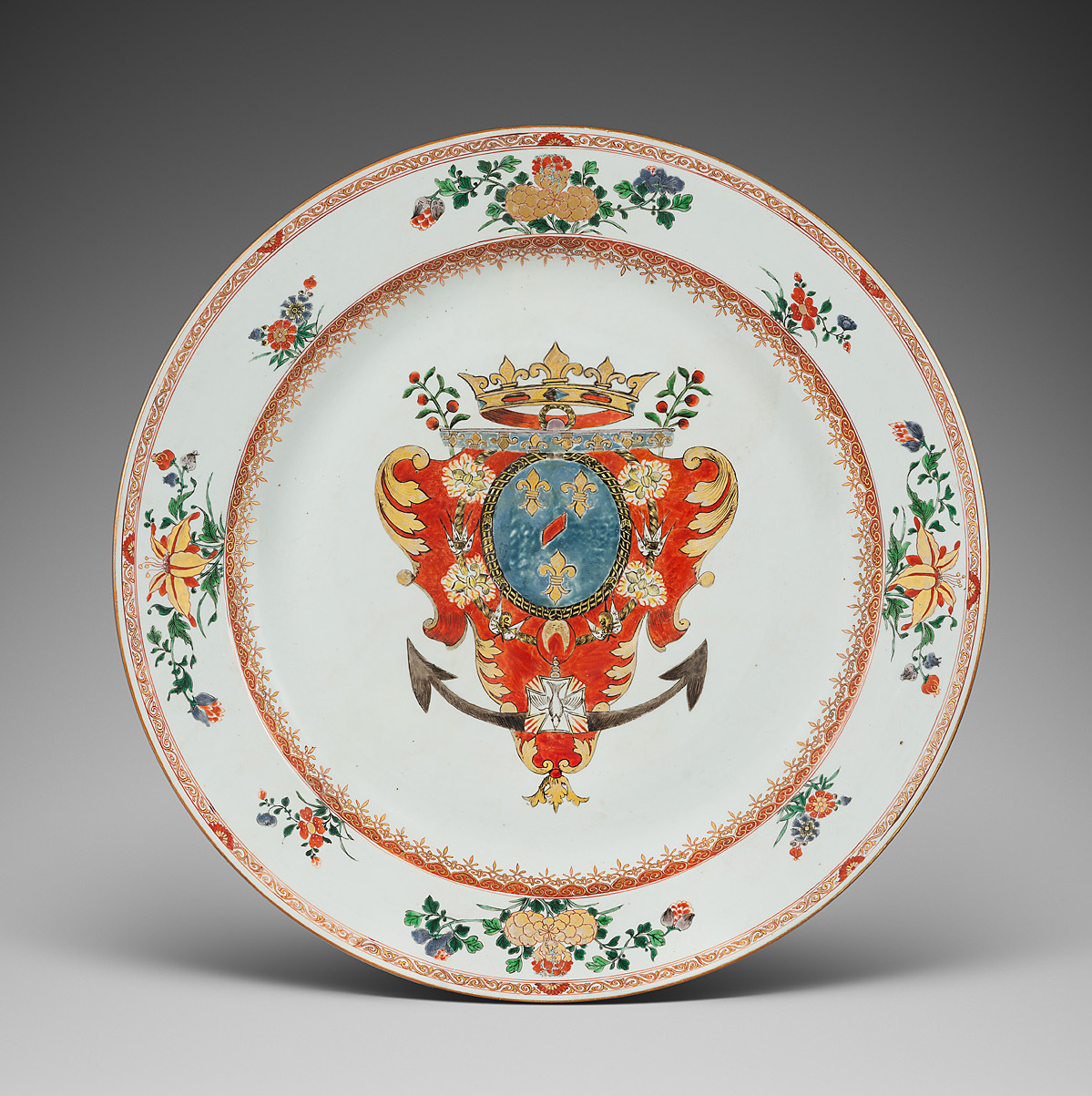
The present attribution to Louis Jean Marie de Bourbon (1725–1793), son of Louis Alexandre de Bourbon (1678–1737), rests on established heraldic principles.[1] According to these, a coat of arms bearing a single anchor denotes the rank of Grand Admiral of France en survivance—that is, held in anticipation of succession—whereas two anchors indicate the full office. As the duc de Penthièvre held this position from 1734 to 1737, the commission is generally dated to that period.
However, several arguments now call this attribution to the duc de Penthièvre into question. Two distinct editions of engravings after Hyacinthe Rigaud’s 1708 portrait of Louis Alexandre de Bourbon contradict the supposed rule: in both, he appears at the same age, yet with differing versions of his coat of arms—one with a single anchor, the other with two.[2] Comparable inconsistencies, where strict heraldic conventions are not observed, can also be found on silver tokens. Further doubt arises from the objects themselves. These large chargers were fashionable from the late seventeenth to the early eighteenth century but fell out of use in the 1730s. Intended primarily for display, they were arranged on buffets alongside silverware, serving as markers of wealth, power, and social standing at a time when only a privileged few could commission such pieces from China.
Furthermore, the service is decorated in the famille verte palette, with a predominance of iron-red—once again a style more typical of the years 1720–1725 than of the 1730s. The overall decoration displays a chromatic range imitating Japanese Imari ware, combining iron-red overglaze and gilt accents with a distinctive underglaze blue. The frieze of fers-de-lance on the cavetto is likewise characteristic of the late Kangxi period.
Another argument supporting the reattribution lies in the presence of the collar of the Order of the Holy Spirit encircling the coat of arms. Louis Jean Marie de Bourbon was admitted to the Order on 1 January 1742, five years after the proposed dating (1734–1737) put forward by Antoine Lebel.[3] By contrast, Louis Alexandre de Bourbon was received into the Order on 2 January 1693—a date fully consistent with the inclusion of the collar on porcelain produced circa 1720–1725. The comte de Toulouse also commissioned Delft earthenware bearing his arms. These pieces show a shield with a single anchor and the PAK mark (for the De Grieksche A factory), used between 1701 and 1722. This provides further evidence that the supposed heraldic rule was not applied consistently.
Louis Alexandre de Bourbon was one of the most prominent figures at the courts of Louis XIV and later Louis XV. Created comte de Toulouse in 1681, he accumulated a number of prestigious offices: in 1711 he was appointed Governor of Guyenne and Brittany, while also serving as Lieutenant General, Admiral, and Grand Huntsman. Immensely wealthy, he stood among the most powerful men of his time.
As head of the Naval Council under Louis XV, he had his portrait painted around 1708 by Hyacinthe Rigaud, depicted before a stormy seascape animated by ships—an explicit reference to his maritime command. He resided at the Hôtel de Toulouse, near the Place des Victoires (now occupied by the Banque de France), one of the most important private residences in Paris, and also owned the Château de Rambouillet. A discerning collector, he was notably an important amateur of Chinese and Japanese porcelain.
During the War of the Spanish Succession, he was entrusted with the defence of Sicily. In 1704, off Málaga, the fleet under his command inflicted significant losses on the Anglo-Dutch forces led by George Rooke. In recognition of this victory, his nephew, Philip V of Spain, invested him with the Order of the Golden Fleece that same year.
[1] Antoine Lebel, Armoiries Françaises et Suisses sur la Porcelaine de Chine au XVIIIe siècle, 2009, pp. 48-49
[2] Drevet, Pierre, 1714
[3] Armoiries françaises et suisses sur la porcelaine de Chine au XVIIIe siècle, 2009, pp. 48-49
[4] Inv. RFML.OA.2022.5.1
[5] 40 cm
[6] 2017.4.1
[7] Inv. 1987.35, Helena Woolworth McCann Collection, Purchase, Gift of Winfield Foundation, by exchange, 1987
[8] now in a private French collection