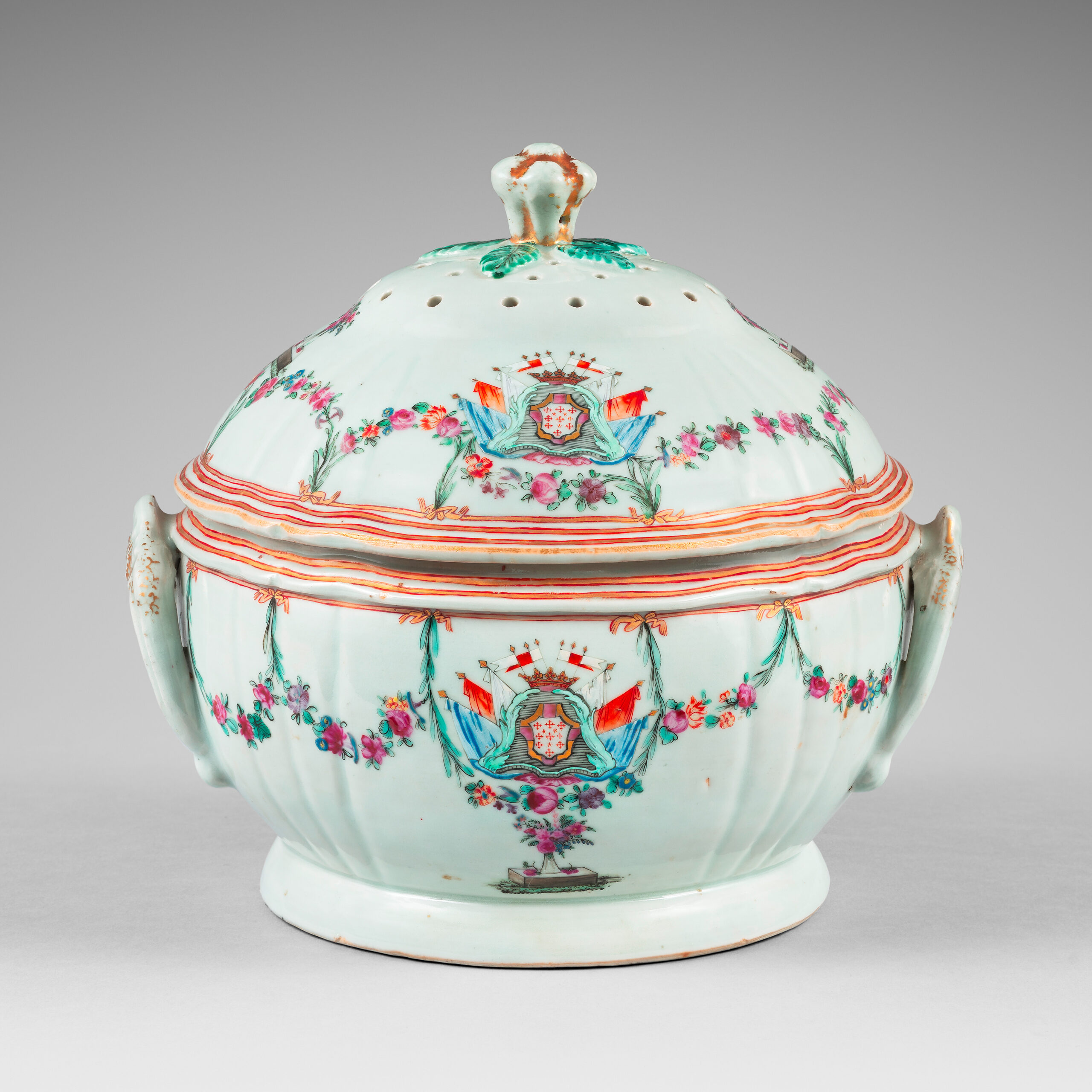
Additional information.This service was probably commissioned by Thomas Miniac, Sieur de La Villeneuve (1647–1722). The younger brother of Pierre Miniac, he commanded frigates on the Cadiz route during the 1680s before turning to local financial administration from 1690, serving as receiver of municipal revenues and excise duties. He also appears to have been involved in tax-farming partnerships. In 1695, he married Marie-Anne Bourgault, with whom he had two daughters. One married the prominent merchant Hyacynthe Chappedeleine in 1706; the other, Marie-Rosalie, married Jean Nouail du Parc in 1709 and, following his death, married Nicolas Magon de la Gervaisais, Lieutenant-General of the King’s Armies, in 1725. Thomas Miniac was also the brother-in-law of Nicolas de Vauborel (1671, Antrain – 1742, Saint-Malo), who likewise commissioned a Chinese export porcelain service in the Imari palette bearing his arms. Vauborel served as the King’s Lieutenant in the government of the town and castle of Saint-Malo and was made a Knight of the Royal and Military Order of Saint Louis on 12 April 1718.
The service may alternatively have been commissioned by Pierre Miniac, Sieur de la Moinerie (1644–1705). Having commanded frigates on the Cadiz route, he became a prosperous merchant and shipowner, assessed for the capitation tax at 150 livres. Between 1690 and 1705, he fitted out vessels for the Newfoundland fisheries and privateering expeditions. He acquired noble status through the purchase of an office as Counsellor-Secretary to the King attached to the Parlement of Pau, which he held until his death. In 1673, he married Anne Géraldin, with whom he had fourteen children, including a daughter, Anne, who married Michel Locquet de La Chardronnière in 1711, and several sons who pursued careers at sea as officers and captains.
Another possible patron was Thomas-Auguste Miniac, Sieur de la Moinerie (1676–1712), son of Pierre Miniac. He first went to sea at the age of fifteen and became one of the most accomplished privateer captains of his generation, a rival and near equal of Duguay-Trouin. Like Duguay-Trouin, he commanded a privateer at the age of twenty and subsequently entered the French Royal Navy with a commission as frigate captain. During the War of the Spanish Succession, he was entrusted with the command of warships, including the 56-gun Superbe, fitted out by Chappedeleine in 1708. Aboard this vessel, he undertook several successful privateering expeditions before being captured in 1710. Released in a prisoner exchange, he commanded the Fidèle during the expedition against Rio de Janeiro in 1711. He perished on the return voyage when his ship was lost in a storm off the Azores in January 1712.
A less likely possibility is Charles-Thomas de Miniac (1690–1746, Saint-Malo), Seigneur de La Ville-ès-Nouveaux and du Tressaint. In 1728, he married Anne Fournier de Varennes, from Saint-Domingue (present-day Haiti), with whom he had two children. She was the daughter of Jean Fournier de Varennes, Lieutenant-Colonel of Cavalry in Saint-Domingue and Councillor of the Superior Council of Cap-Français.
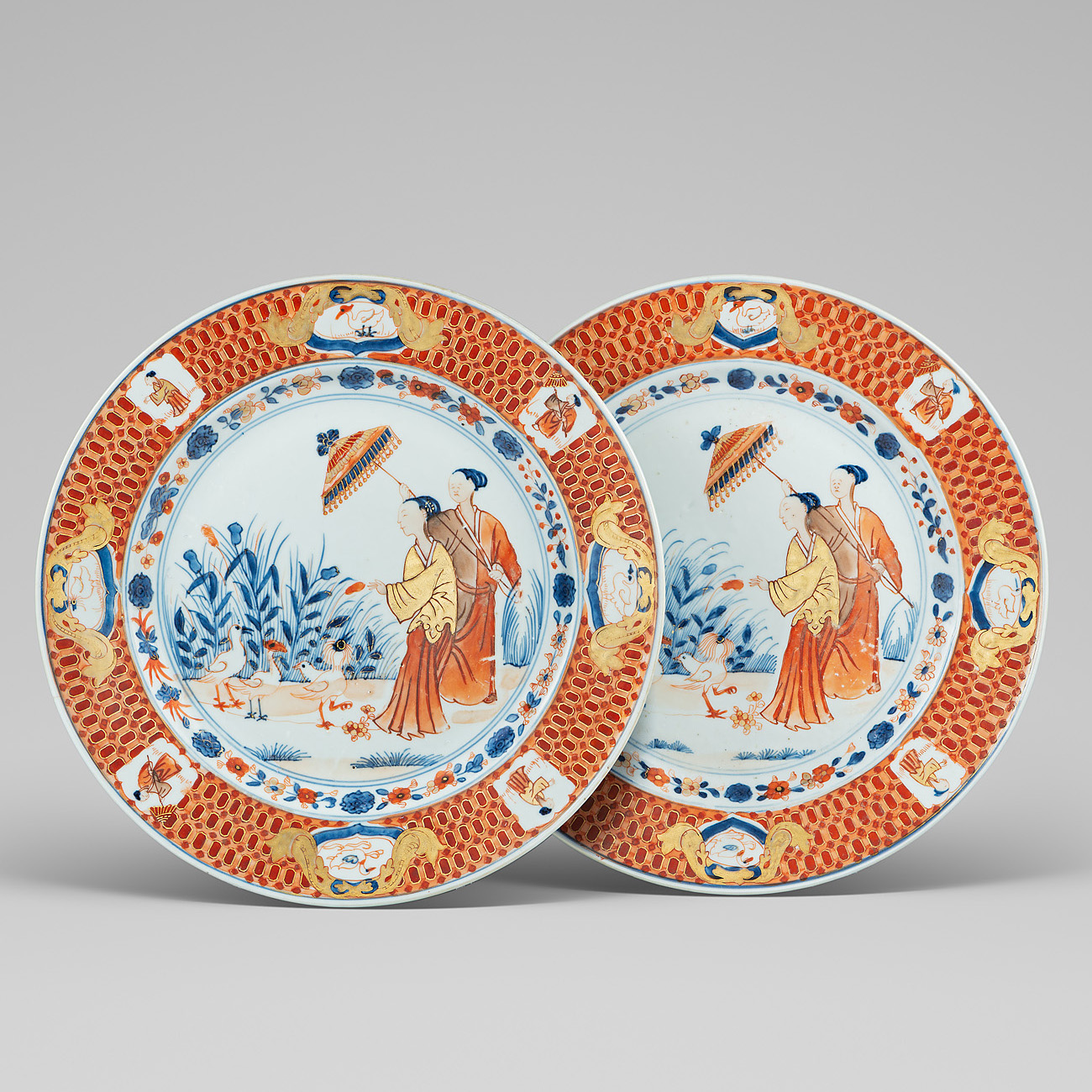
This service, among the earliest Chinese armorial porcelain commissions for the French market, is decorated in the Imari palette and may be compared with the service commissioned for Philippe d’Orléans, Regent of France, dating from around 1715.
Literature: Antoine Lebel, French and Swiss Armorials on Chinese Export Porcelain of the 18th Century, 2009, p. 191.