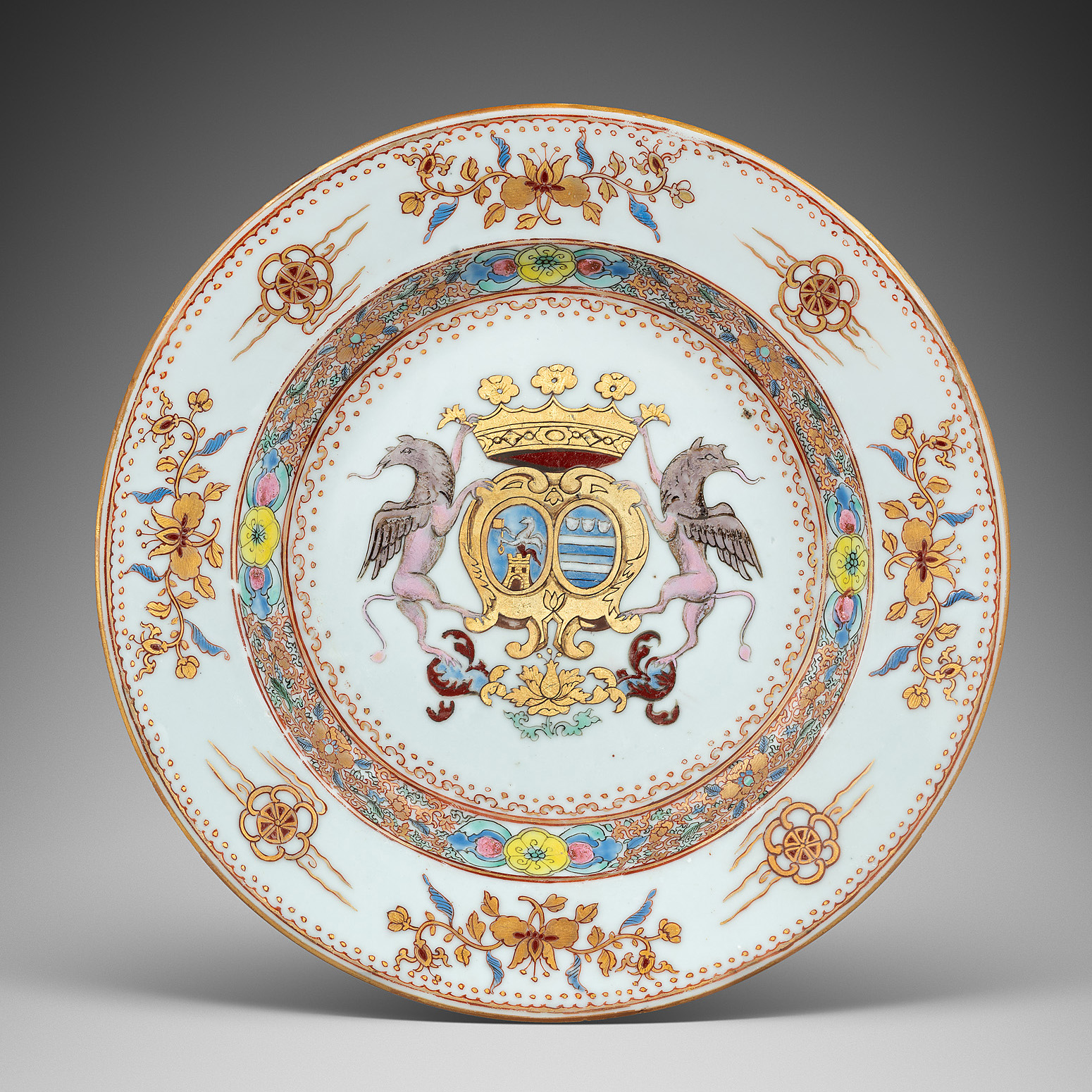
Additional information.This beautifully enameled dish is the result of the first ventures of the Swedish East India Company. The company, founded in Gothenburg on 14 June 1731 by Henrik König, was the first Swedish organization to succeed in trading with the East. Since the city of Gothenburg was the only port located on the east coast of Sweden, giving access to Europe and the East, it was the natural choice for the center of East India trade. The first application for a charter for an East India company was submitted to King Gustavus Adolphus in 1624. Proposed by the Dutchman Willem Usselinx, the charter was actually granted but Swedish involvement in the Thirty Years War prevented the actualization of the company. The next proposal came some forty years later, drawn up by Olle Borg, a Swede who had worked for the VOC for eighteen years. Borg succeeded in issuing and filling stock orders and nominating a board of directors, but political troubles terminated that company as well. In 1720, Baron Daniel Nicholas von Höpken (see following plate), who was then Secretary of State, was granted a charter but was not able to raise the necessary capital to proceed in trading. Finally, in 1731, Henrik König was granted a fifteen year charter by the Swedish parliament, giving permission to trade with the East Indies and all other places east of the Cape of Good Hope.
König elected Colin Campbell, a Scot, and Niclas Sahlgren, a merchant from Gothenburg, as his partners on the board of directors, and Campbell served as supercargo on the first voyage. On 9 February 1732, the Friedericus Rex Sueciaesailed from Gothenburg with three other English supercargoes along with Campbell. It returned safely to Gothenburg over a year later, having been briefly detained by seven Dutch war ships in Batavia.
The company not only received foreign opposition, namely the English, French and Dutch, who did not appreciate the competition, but also found resistance at home. Local Swedes did not appreciate the “invasion” of foreign goods (porcelain, silk and tea), nor the foreign partners in König’s venture. The company prevailed, however, despite the complaints, and sent the second expedition, the Queen Ulrica Eleonora, on 9 February 1733. The Swedes were to experience many more difficulties in the East, but the success of these first two missions formed a solid foundation on which the company could grow.
It is possible that this plate was part of a service carried back by one of the first expeditions, as the next voyage was not made until 1739. Painted in famille rose enamels and gilt, it displays the central coat of arms enclosed by an enameled and gilt band that also appears on the Höpken service. The border design is also found in different variations on other export services.
The service was commissioned by Carl Gyllenborg (1679–1746), who married Sarah Wright in 1710. One of the leading figures in Swedish diplomacy and politics during the first half of the eighteenth century, Gyllenborg was born in Stockholm into a prominent noble family, the son of Count Jacob Gyllenborg, a royal councillor and Governor of Uppland. His career acquired an international dimension at an early stage: sent to London in 1703 as secretary to the Swedish legation, he was appointed resident there in 1710 and envoy extraordinary in 1715. It was in London, in 1710, that he married Sarah Wright (1680–1745), the wealthy English widow of Elias Derith. Well connected within British political and intellectual circles, particularly among the Tories and Jacobite sympathisers, Sarah Wright possessed a considerable fortune that enabled the couple to maintain a prominent household in the English capital. Gyllenborg himself became closely involved in diplomatic intrigues aimed at restoring the Stuart dynasty to the British throne. Suspected of participating in a Jacobite conspiracy, he was arrested by the British authorities in 1717 and detained for several months. Upon his return to Sweden, he continued his remarkable political ascent: appointed a Councillor of the Realm in 1723 and President of the Chancellery in 1739, he became one of the principal leaders of the Hat Party (Hattarna) and remained among the most influential figures in the kingdom until his death in 1746.
The commission of this armorial service should be understood within the context of the beginnings of direct maritime trade between Sweden and China. The Swedish East India Company (Svenska Ostindiska Companiet), founded in Gothenburg in 1731, dispatched its first voyage to Canton the following year. The armorial porcelains brought back on these early expeditions reflect the immediate enthusiasm of the Swedish aristocracy and elite for Chinese luxury goods, which had now become directly accessible through a national trading company. The Gyllenborg-Wright service thus belongs to this first generation of privately commissioned Swedish armorial porcelain from China.