Additional information.The kendi was popular in south-east Asia as a water vessel used for the ritual pouring of libations (the term is derived from the Sanskrit kundika, a vessel typically presenting a taller neck). The form, which may have been developed in India as early as 2000 BC, was produced by the Chinese for export from the Tang Dynasty (618-906) onwards.
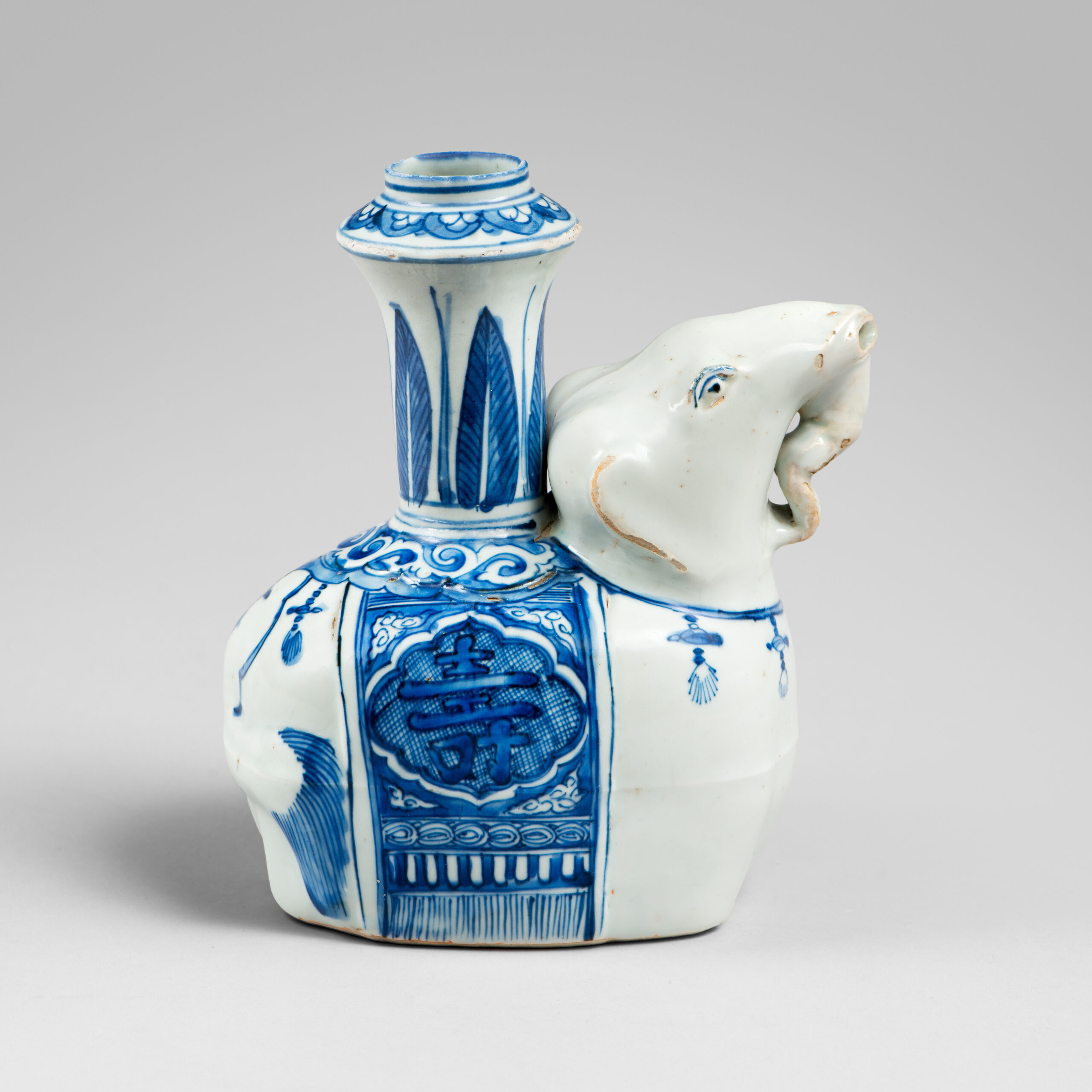
This elephant-shaped vessel belongs to a rare group of kraak zoomorphic kendis made for the Middle Eastern and European markets in the late 16th and early 17th centuries. The number of surviving examples in museums and private collections attests to their appeal during the period. This success may have been due to the ingenious way in which liquid is poured: as the vessel is tilted, water spurts from both tusks, with the two streams crossing just a few centimetres below.
In Chinese culture[1], the elephant is revered as an animal of high moral standing. One of the Seven Treasures of Buddhism, it serves as a symbol of strength, sagacity, and prudence. While wild elephants roamed across China during Antiquity, they were largely driven south of the Yangtze River by 1000 BC. Thereafter, the Chinese maintained their knowledge of the species through diplomatic gifts of tamed Asiatic elephants (Elephas maximus) from neighbouring kingdoms.
Following the introduction of Buddhism into China (c. 67 AD), the elephant was elevated to the status of a celestial animal. In the decorative arts—spanning bronze, jade, and porcelain—it is frequently depicted supporting vases or pagodas, or serving as a mount for the deity Puxian Pusa (known in Sanskrit as Bodhisattva Samantabhadra, the Bodhisattva of Universal Benevolence). A particularly popular motif is ‘Washing the White Elephant’. This scene functions as a visual pun: in Chinese, the words for ‘elephant’ (xiang) and ‘superficial appearance’ or ‘illusion’ (xiang) are homophones. Thus, the act of ‘cleansing the elephant’ (sao xiang) represents the cleansing of illusions (sao xiang), a fundamental step towards Buddhist enlightenment. This motif is well-documented on kraak porcelain, such as an example from the second quarter of the 17th century held in the Museum of East Asian Art, Berlin[2].
Elephant-shaped kendis, such as this example, reveal the Chinese potter’s unawareness of the actual anatomy of the animal. This is clearly seen in the diminutive size of the elephant’s ears and the unnaturalistic manner in which the trunk coils backwards towards the neck.
It is interesting to note that a small celadon glazed vessel in the form of a standing elephant dating to the Yuan dynasty (1271–1368) was discovered in the Philippines. This early example presents a flower-head on the animal’s forehead, a long patterned saddle-cloth, a bridle with pending tassels, and a decorative border surrounding a short tubular aperture on its back. Such a vessel may have inspired the form and decoration of the elephant-shaped kendi discussed here[3].
[1] Teresa Canepa, Kraak Porcelain: The Rise of Global Trade in the Late 16th and Early 17th Centuries, Jorge Welsh Books, 2008, p. 188
[2] inv. no. 1998-9
[3] Teresa Canepa, Kraak Porcelain: The Rise of Global Trade in the Late 16th and Early 17th Centuries, Jorge Welsh Books, 2008, p. 188