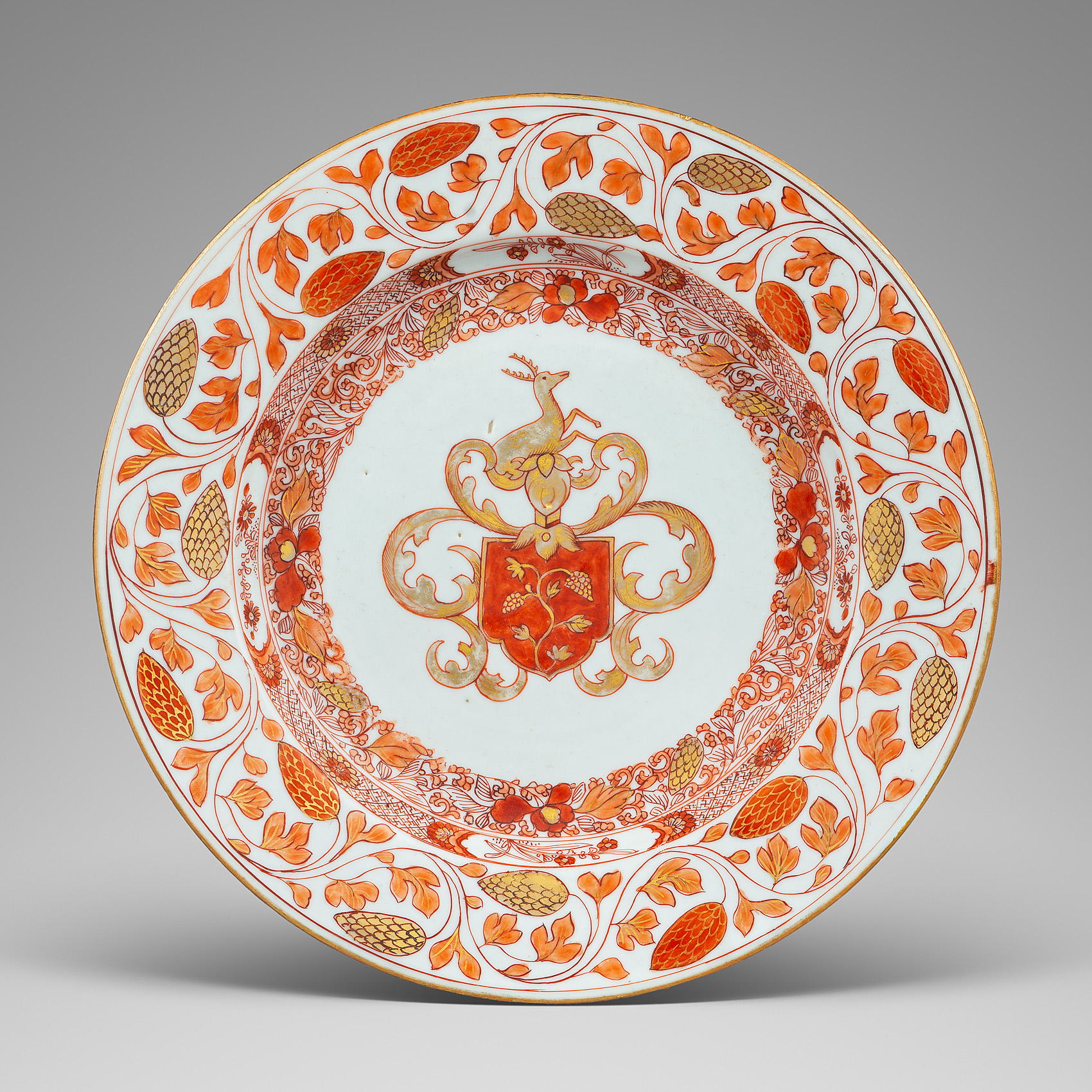
An unusual Chinese armorial plate for the Portuguese market (Barcelar). China, Kangxi
The plate is enamelled in rouge-de-fer and gold with a central armorial shield, surrounded by scrolling vine with clusters of grapes, the cavetto with floral reserves and chrysanthemums on a swastika trellis ground.
The arms are known on an other “blue service” (see Nuno de Castro, Chinese Porcelain At The Time Of Empire, 2007, p. 107 and Cohen & Cohen (Londres), 1999, p. 5.
Additional information.
The arms have been identified as those of Pedro Vaz Soares Bacelar, a Portuguese nobleman and military officer active in the Estado da Índia at the end of the seventeenth and beginning of the eighteenth century. His date of birth remains uncertain, variously given as circa 1645 or 1680. He was the son of Duarte Cláudio Huet, a nobleman originally from Verdun in Lorraine who entered Portuguese service and became a Knight of the Order of Christ, and Constança Malheiro Pereira Bacelar Sotomaior, whom Duarte married at Monção on 25 February 1653. Constança was the daughter of Marcos Malheiro Pereira Bacelar, Knight of the Order of Christ and General of the Minho army, and Helena de Meireles Sotomaior.
Pedro Vaz Soares Bacelar pursued a distinguished military career in Portuguese India, serving as a captain of infantry and galleys before holding senior commands in the northern territories. His appointment as Captain-General of the Northern Fortresses is documented in an official decree issued at Goa on 5 April 1701, concerning the administration of the Portuguese trading establishment at Baçaim (Bassein). He married D. Maria Cirne, daughter of Manuel Cirne da Silva and Mariana de Mesquita.
His documented presence in India raises the possibility that the porcelain service was commissioned through Portuguese commercial networks in Asia, although a direct commission by Bacelar has yet to be established.
The scrolling vine decoration is characteristic of Chinese export porcelain made for the Portuguese market during this period.