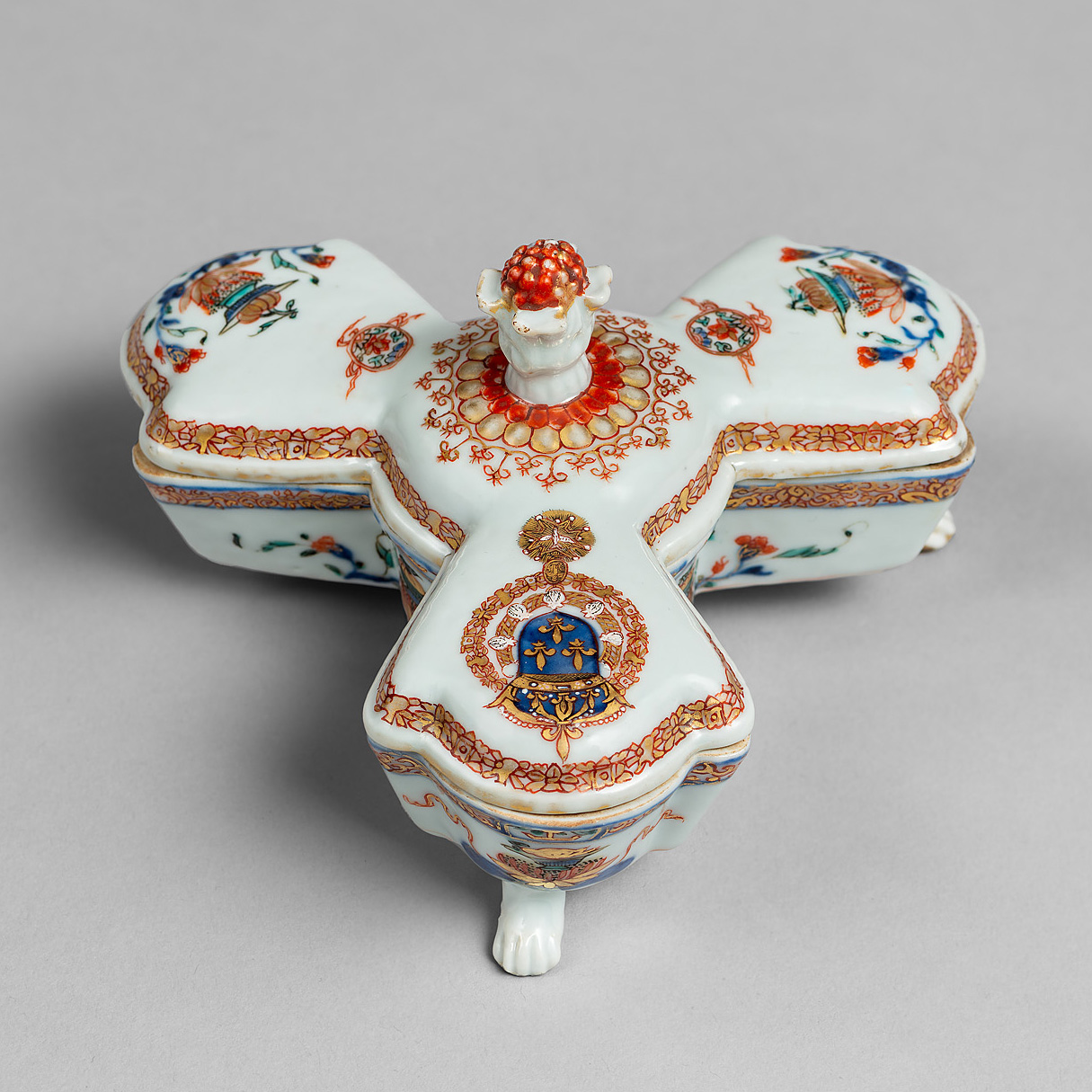
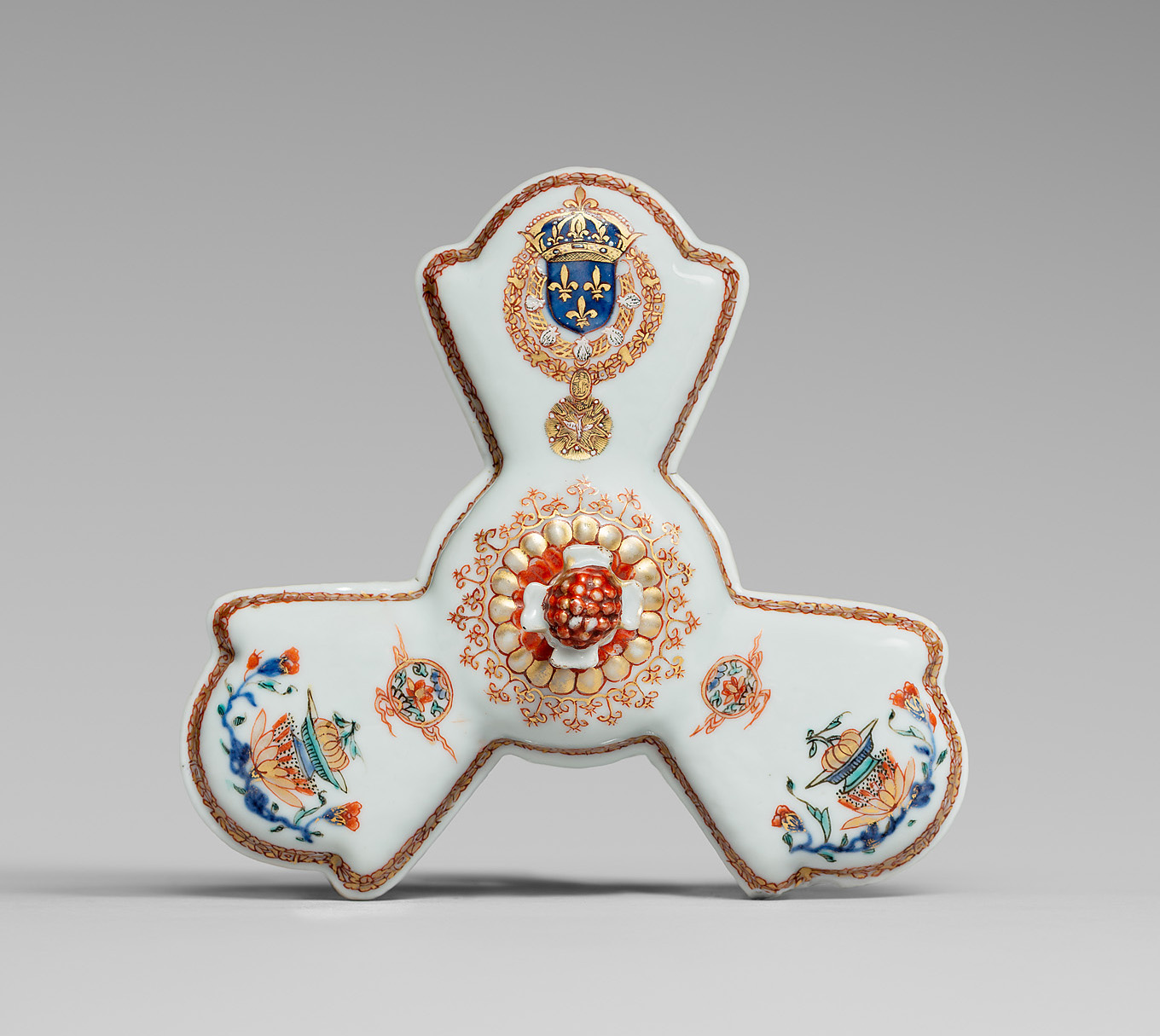
The form of this spice box is widely recognised through numerous 19th-century examples inspired by this very model; however, those later versions are typically decorated with red overglaze enamels and grey-leaf cartouches. The re-emergence of the original Royal spice box is, therefore, an event in its own right. Chinese export porcelain bearing the arms of Louis XV attracted considerable interest during the 19th and 20th centuries and was, consequently, frequently copied. Numerous discrepancies exist between the King’s original spice box and these later iterations.
Most notably, the royal arms are often painted in reverse on the red-decorated examples; on the original model illustrated here, however, the heraldry perfectly follows the contours of the vessel. Furthermore, the interiors of 19th-century boxes often reveal an unglazed orange body, a characteristic unknown in 18th-century Chinese export porcelain.
Th fer-de-lance border on later pieces is markedly stiffer than on the original royal commission. Finally, in most 19th-century examples, the colours of the principal motif are absent, replaced by a greyish ground. The gilt cross-hatched border on a red ground along the rim—which fails to match that of the cover—is also too pronounced for an 18th-century attribution.
In the 18th century, the spice trade formed part of a global system dominated by chartered companies, notably the Vereenigde Oostindische Compagnie and the East India Company; meanwhile, the Compagnie française des Indes orientales maintained a more modest presence. Pepper, nutmeg, mace, cloves, and cinnamon were transported from India, Ceylon, and the Indonesian archipelago along maritime routes linking Batavia, Calcutta, and Pondicherry to Amsterdam, London, and Lorient. Although these commodities were no longer the extreme rarities of previous eras, they remained strategic goods often subject to strict monopolies—particularly those enforced by the Dutch in the Moluccas.
Public auctions in Europe structured pricing and ensured distribution among the elites and the rising bourgeoisie. Over the century, however, the primacy of spices yielded to tea, coffee, and sugar, reflecting a shift in tastes and commercial networks.
The trade in spices and porcelain is, remarkably, the source of some of the few Chinese loanwords in the French language. In 1762, the Dictionnaire de l’Académie française formalised several such terms: the spice badiane (star anise), derived from the Chinese bajiao (‘eight horns’), possibly via Persian; and the essential components of porcelain, kaolin (gaoling) and petuntse (baidunzi). The introduction of these words into the French lexicon mirrors the appreciation of the goods themselves in the salons of the Enlightenment.
The form of this box was inspired by a French prototype produced in soft-paste porcelain at the Saint-Cloud manufactory and in earthenware, probably following a silver original. In the 18th century, such vessels were frequently referred to as ‘pepper holders’ (poivriers).