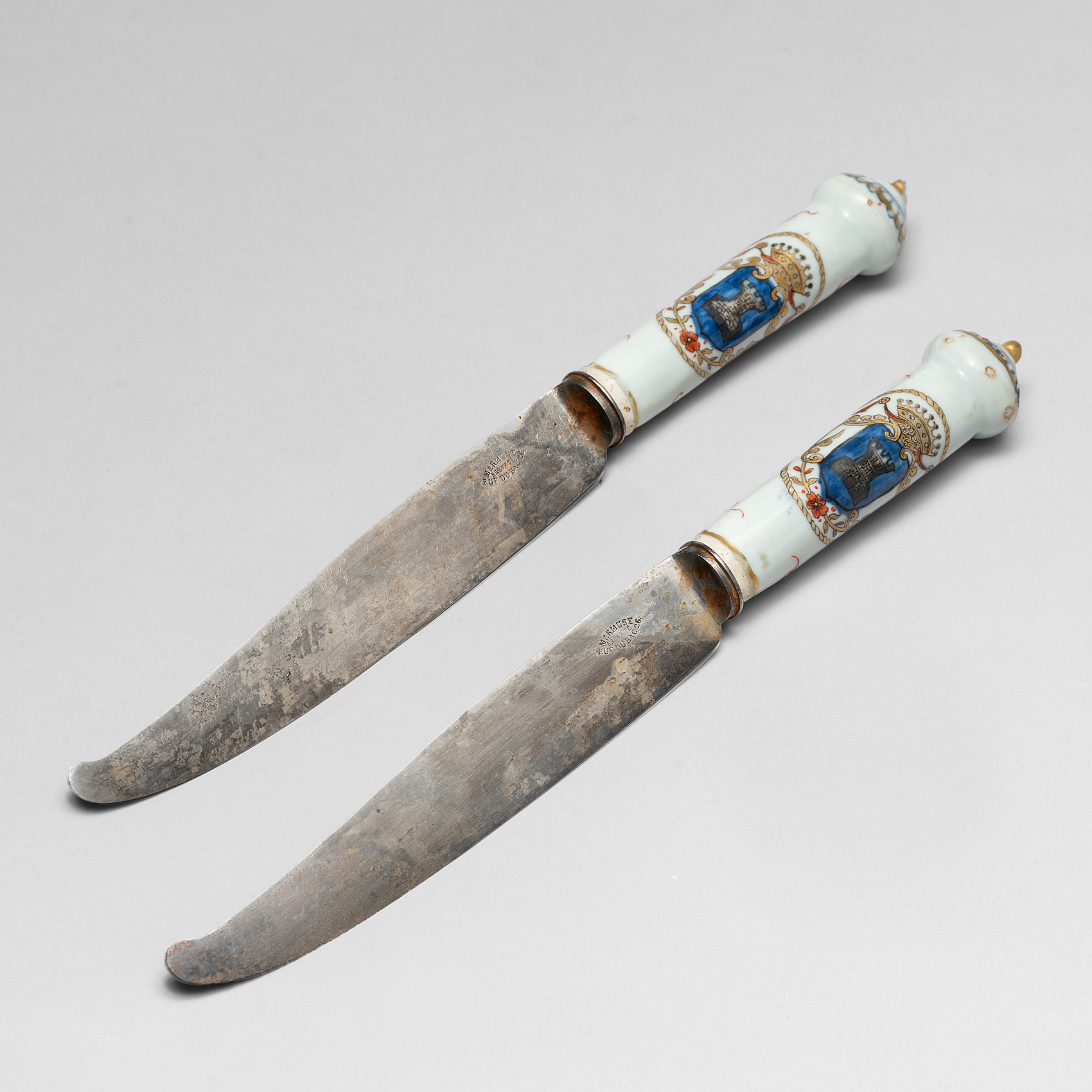
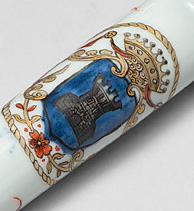
Additonal informations :The Vauborel family belonged to an old lineage of nobility originating from Normandy (Mortainais/Avranchin) and Brittany (Saint-Malo), several of whose members served as officers in the government of Saint-Malo.
Nicolas de Vauborel was born in 1671 in Antrain (Brittany) and died on 15 December 1742 in Saint-Malo. He served as lieutenant du roi in the government of the town and citadel of Saint-Malo, and was made a Knight of the Military Order of Saint Louis on 12 April 1718.
His father, Jacques de Vauborel, was also lieutenant du roi at Saint-Malo and died in 1674. His brother, Malo-Gabriel de Vauborel, was admitted as a page to the Grande Écurie in 1723 and later became a cavalry captain in the Régiment du Dauphin-Étranger cavalerie.
Nicolas de Vauborel married Perrine Bourgault de la Hanrière, who brought him a substantial dowry of 60,000 livres. She was the daughter of Pierre Bourgault, sieur de la Hanrière, originally from Paris, who married around 1663 Françoise Avril of Rennes. The couple had thirteen children born in Saint-Malo between 1665 and 1682. Pierre Bourgault became one of Saint-Malo’s leading merchants in the last quarter of the seventeenth century, holding shares in twelve shipping companies between 1682 and 1685. After his death in 1696, his widow took over the family business in partnership with her son-in-law, Alain Le Breton de la Plussinais, who had married one of her daughters, Marie Bourgault, in 1692.
Thomas Miniac, sieur de la Villeneuve (1647–1722), and his wife Marie Anne Bourgault—brother-in-law and sister-in-law of Nicolas de Vauborel—were among the witnesses at the marriage. The Miniac family is known to have commissioned a very similar Imari-palette service, thus ranking together with the Vauborel order among the earliest known armorial porcelain services made for the French market.
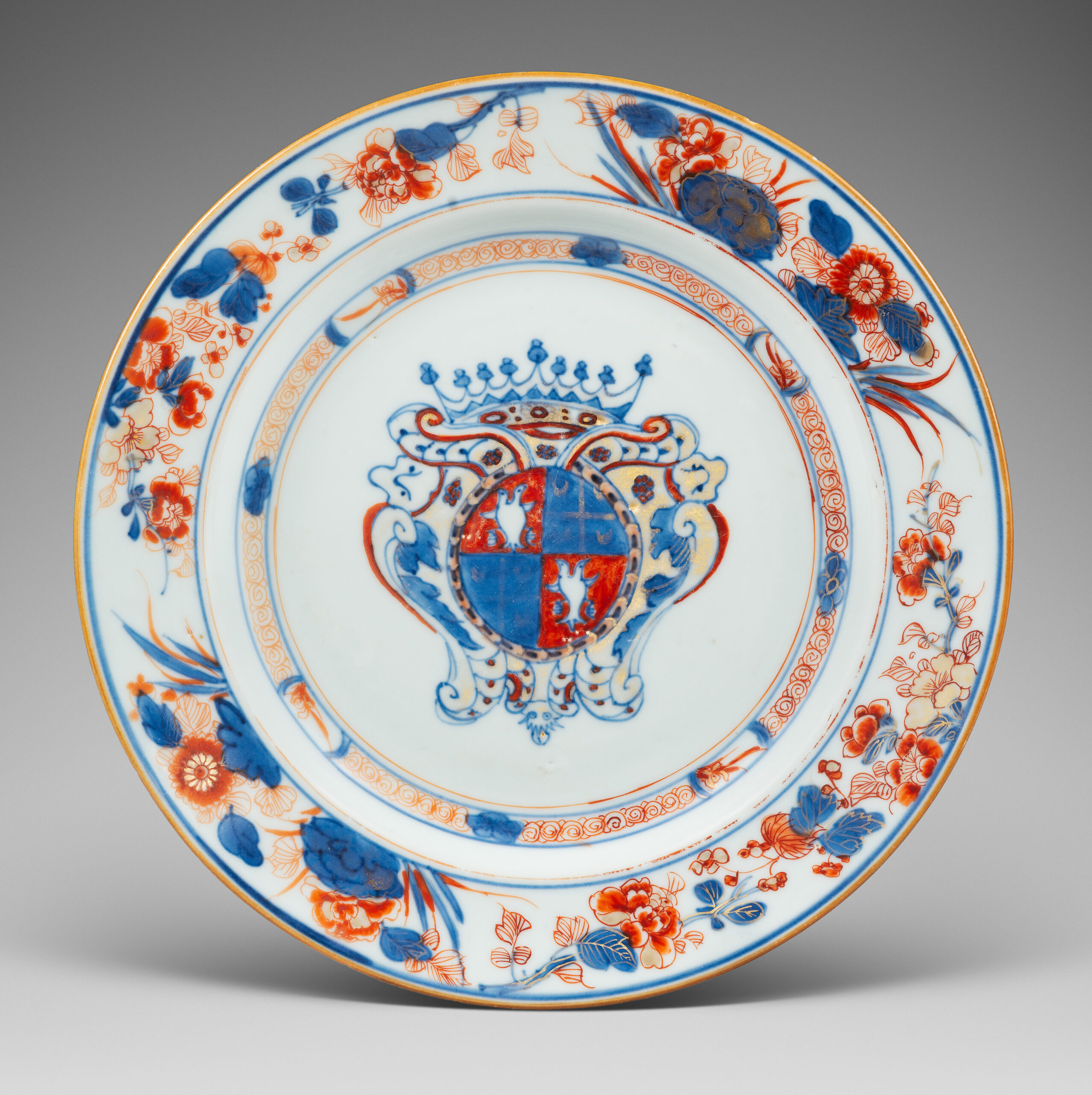
A Chinese armorial plate with the coat of arms of Miniac family, relatives of Nicolas de Vauborel, Saint-Malo, circa 1715
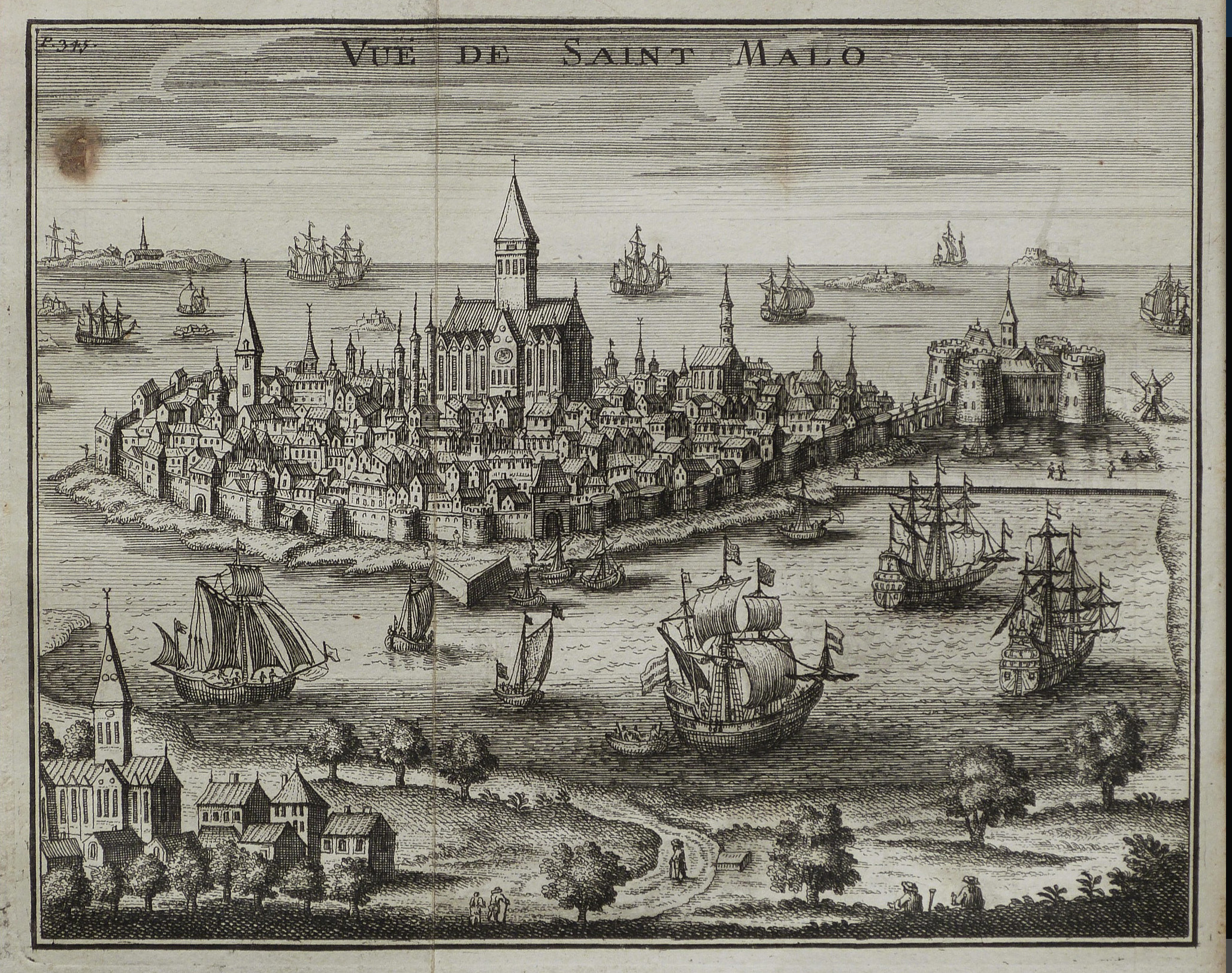
Saint-Malo in the Early Eighteenth Century
At the beginning of the eighteenth century, Saint-Malo was both a strategic military stronghold and a major trading port. The government of Brittany was divided into two lieutenances générales and several smaller particular governments, one of which was that of Saint-Malo. The local military administration comprised a governor, a commander, a lieutenant du roi, a major, and a brigade colonel of engineers.
Although not formally part of the military government, the milice bourgeoise also played an important role. It was organized into battalions and companies under the authority of the town council, with the mayor serving as its colonel. Fourteen companies took turns providing service: each evening the militia patrolled the streets and guarded the city gates. From 1680 onward, Saint-Malo saw a succession of governors, among them Amador de Guémadeuc (1679), Pierre de Lannion (1710), Malo III de Coëtquen (1717), Hautefort (1727), Choiseul (1743), La Tour-Maubourg, Montazet, and L’Hospital.
Alongside the governor—often a largely honorary position held by a grand seigneur residing at court—stood a lieutenant du roi, a title instituted by the royal edict of 1692. This officer was in practice the true military governor, as he bore the full weight of command and responsibility. He oversaw the garrison, maintained the fortifications, managed alerts, and coordinated the city’s defense in case of attack. As the king’s representative in military ceremonies, he also played a local diplomatic role, acting as intermediary between the royal authority and the Malouin merchant community.
The defense of Saint-Malo relied on several complementary forces: infantry units drawn from royal regiments stationed in Brittany; artillerymen from the Compagnie des canonniers garde-côtes responsible for the city’s batteries, islets, and sea walls; milices garde-côtes composed of local inhabitants mobilized in times of alert to handle light artillery, patrol the coastline, and reinforce regular troops; and a network of capitaineries de côte, small posts and watch stations spread around the bay.
The city’s security was further ensured by the royal flotilla—light vessels stationed on the River Rance for coastal patrols. Privateers, financed and armed by Malouin merchants, also formed part of this extended defense system during wartime, notably in the War of the Spanish Succession and the War of the Austrian Succession. The royal navy and privateers cooperated closely in matters of intelligence, artillery support, and convoy escort. The lieutenant du roi maintained close relations with local merchants for naval logistics and the commissioning of privateers.
Bibliography:
E. Frain, Les Du Vauborel, Normands et Bretons, leurs pays d’origine, leur archiviste, leurs premières alliances, 1886.