The oviform bottles have a tall neck and are tapering towards the foot. They are decorated in underglaze blue with birds among blossoming and budding tree peonies. The base is marked underneath with the initials IC within a laurel wreath.
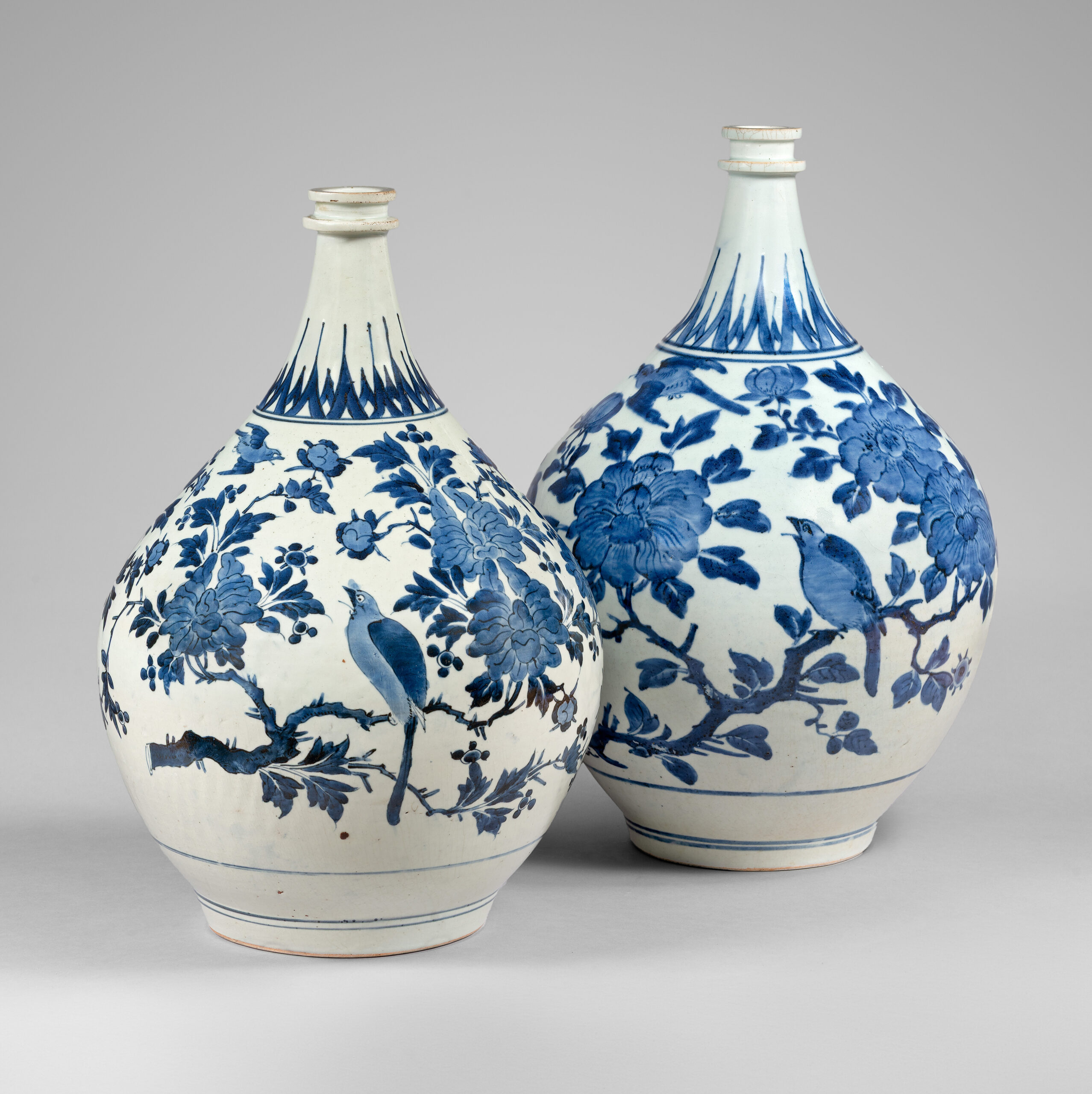
The oviform bottles have a tall neck and are tapering towards the foot. They are decorated in underglaze blue with birds among blossoming and budding tree peonies. The base is marked underneath with the initials IC within a laurel wreath.
Comparable examples exist in varying scales[1], though few reach the monumental proportions of the present pair. A smaller bottle (c. 25.5 cm) is in the collection of the Victoria and Albert Museum[2], while another is held by the Stilte-stichting Landgoed Den Bosch Collection[3] (c. 39 cm). A further example[4]in the Portland Art Museum stands at 42 cm.
[1] Yvan Trousselle, La Voie du Imari : l’aventure des porcelaines à l’époque Edo, 2008, p. 151
[2] C.6-1920
[3] London, 2023
[4] Access number 80.65
Even before the Dutch East India Company (VOC) was founded in 1602, the Dutch were trading in Japan from a settlement in Hirado, on the west coast of Kyushu[1]. It was the famous Will Adams, the pilot aboard the De Liefde, the first Dutch ship to reach Japan, who thanks to his diplomatic gifts, secured the commercial interests of the Dutch in Japan. Portuguese, Spanish and English merchants competed fiercely, but in the end the Shogunate awarded the monopoly on the trade in Japanese commodities to the VOC as its only Western partner. Since 1641 the Company had a factory on the artificial island of Deshima in Nagasaki Bay, where it remained until the mid-19th century, long after the VOC went bankrupt in 1799.
Initially, the Company traded in copper, gold, silver, camphor, sulphur and lacquerware. When it became difficult to obtain porcelain after 1645 due to the civil wars in China, the VOC added Japanese porcelain to its export assortment in the late 1650s. The Dutch merchants ordered it in Arita, not far from Nagasaki, where Japanese potters had used the local clay deposits to make porcelain since the early 17th century. The lack of Chinese porcelain throughout South-East Asia sparked a demand for Japanese replacements, but the sakoku edict of 1635, which closed the country to foreign influences, forbade Japanese merchants from engaging in overseas trade. The Chinese were therefore granted a special dispensation to export Arita por- celains, which was later extended to the VOC. The porcelain trade for the Dutch home market lasted until the 1680s, when Chinese porcelain became available again. It was cheaper than the Japanese, the varieties were more fashionable and the logistics and selling procedures were more efficient. However, Dutch VOC employees continued buying porcelain privately until the mid-18th century. Underglaze-blue, but in particular polychrome Japanese porcelain like Imari or Kakiemon, was profitable merchandise. The Japanese only sold small quantities to the Dutch, and because of its scarcity, it became fashionable in the Netherlands.
There is a special category among the wide assortment of Japanese export porcelains produced for the Dutch: the so-called apothecary bottles decorated in underglaze blue with initials in Latin script. They are not mentioned at all in the Company’s shipping lists and small quantities were evidently ordered privately by Dutch customers. However, how they were used, who the initials represented, and when these bottles were produced, remains unclear.
A good example of these initialled bottles are the present examples bearing at the base of the bottles the initials “IC” encircled by a laurel wrath. The mouth has the typical raised double ring that served to secure the cord that held a piece of parchment over the opening to protect the contents.
What did these bottles contain ? Although traditionally called “apothecary bottles”, it is highly unlikely they were used to store medicinal tinctures or powders that were only occasionally used to treat illnesses. They are far too prestigious with the initials so prominently displayed and besides, they must have been expensive, which refutes a mere pharmaceutical function. Some bottles made for other people and bearing their initials are known in larger numbers and apparently belonged to sets. These can be correlated with references in VOC documents and probate inventories of “keldertjens”, an untranslatable Dutch name for a wooden box with compartments to store bottles for wine or liquor. Therefore, it is generally accepted that this type of porcelain bottle was also made for alcoholic beverages and was produced in sets of four, six, nine or even more, that were stored in a specially made box. Indeed, as a host it must have been socially rewarding to pour your guest a glass of brandy from a bottle that was specially made in Japan and included your own initials in the decoration.
Most bottles the Dutch initials bottles are c. 24 cm high and can hold about 2 litres, befitting their purpose as container for wine or liquor. Some initialled bottles, however, are much larger and can only be handled by more than one person. Their function is unclear, but they may have been used to store larger volumes of a beverage.
Who ordered these bottles ? Bottles with almost 40 different initials were traced in collections worldwide. Some can be identified with a degree of certainty, for instance, examples with the initials “IVH” that most likely stand for Joan van Hoorn, a high-ranking official in Batavia and Governor General from 1704 to 1709.
Bottles inscribed with “IC” were made for Joannes Camphuis, who served intermittently as a director of the VOC in Deshima from 1671 to 1676 and Governor-General in Batavia from 1684 to 1691. Johannes Camphuys was a senior official of the VOC succeeding Rijckloff van Goens. He administered the Dutch territories of Batavia (today’s Jakarta), the principal political, administrative, and commercial centre of the VOC in Asia. Trained within the Company’s senior administrative staff, Camphuys pursued a largely bureaucratic and diplomatic career, focusing more on the management and consolidation of commercial networks than on military expansion. His tenure coincided with a pivotal period in Asian trade, marked by disruptions in Chinese porcelain exports in the late-Ming to early-Qing period, as well as by the increasing European demand for Japanese porcelains sourced from Arita by the VOC.
His long residence at Deshima allowed him to establish sustained contact with Japan, fostering an appreciation of local customs and craftsmanship. This experience—unusual for a future Governor-General—helped shape a particular sensitivity to the quality and refinement of objects, notably Japanese porcelain, which was then regarded in Europe as a prestigious alternative to Chinese wares. As Governor-General, Camphuys was central to the exchange networks between Asia and Europe, notablyfor Chinese porcelain from Jingdezhen, Japanese wares from Arita and Imari, and a wide array of luxury goods including lacquer and textiles.
Bottles with other initials also seem to refer to prominent individuals in Batavia or in Deshima who were in a position to privately order such porcelains in Arita.
Only one bottle with the VOC initials (on the base) is known, and the examples that occasionally appear on the market with the VOC monogram conspicuously displayed on the belly, must be regarded as modern fakes. In theory, it is possible that people connected with the VOC in the Netherlands ordered such bottles in Japan, but until now no evidence confirming this has been found.
Dated bottles are not known, and we have to rely on the names of those owners we can identify with some certainty, and on the dates of their tenures in Deshima or Batavia. That gives us a period roughly spanning half a century, from 1670 to 1720, during which this very special group of Japanese export porcelains was produced.
[1] Christiaan Jörg, Galerie Nicolas Fournery – Inaugural catalogue, A Japanese porceoain bottle with Dutch initials, pp. 8-19