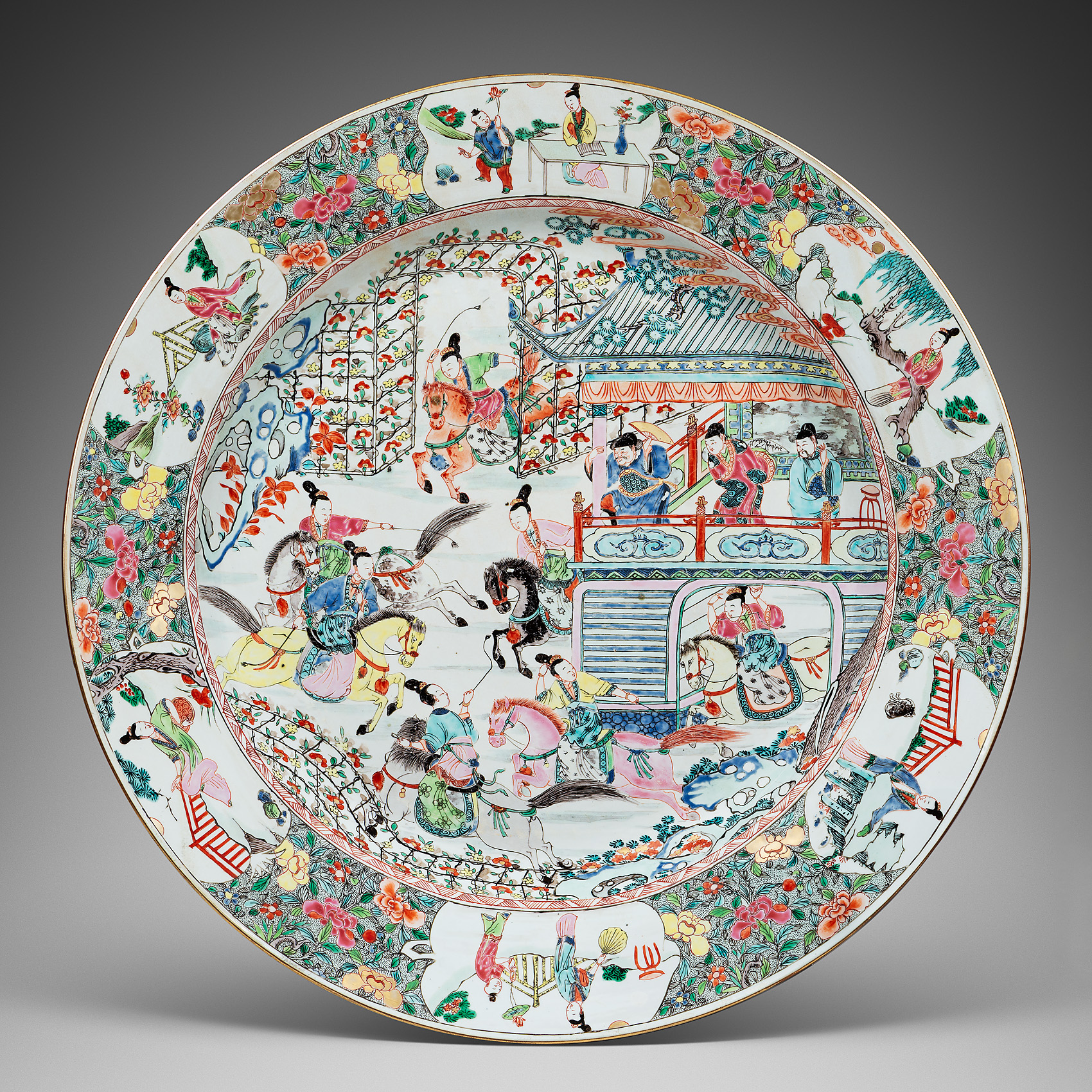
Additional information.This vibrant scene is a celebrated motif within the repertoire of 18th century Chinese export porcelain. For decades, it has been traditionally identified as depicting the Yangmen nüjiang 杨门女将 (“The Female Generals of the Yang Family”), the legendary tale of twelve warrior women who defended the Northern Song dynasty (960–1127) against the Liao inva- ders. This interpretation remains prevalent in many contemporary publications and catalo- gues. However, a more nuanced reading was proposed as early as the 19th century by Albert Jacquemart (1808–1875) and Edmond Le Blant (1818–1897) in their seminal work, Histoire artistique, industrielle et commerciale de la porcelaine. They suggested that the scene il- lustrates Emperor Yang 炀帝 of the Sui dynasty (581–618) observing the ladies of his court during an equestrian display. This alternative interpretation shifts the focus from a scene of martial heroism to one of imperial leisure and courtly elegance, reflecting the sophisticated tastes of the Yongzheng and early Qianlong periods.
Subsequent research[1] by the sinologist Ni Yibin confirmed the hypothesis advanced by Jacquemart and Le Blant, demonstrating that the scene in fact derives from the specific episode Sui Yangdi guan gongnü paoma 隋煬帝觀宮女跑馬 (“Emperor Yang of Sui watching palace women riding horses”). This narrative is recounted in the Qing-dynasty novel Romance of the Sui and Tang (Sui Tang yanyi 隋唐演義) by Chu Renhuo (1635–1682).
In chapter 35 of the novel, Emperor Yang of Sui and Empress Xiao command their palace attendants to reenact the departure of Wang Zhaojun—a legendary Han dynasty concubine—by riding through the imperial gardens for their amusement. A woodblock print from the 1695 edition of Romance of the Sui and Tang provides a direct visual reference. It was published by Sixue Caotang (思雪草堂), the personal studio and creative hub of Chu Renhuo located in Suzhou. At the time, Suzhou was the preeminent center for fine printing and literary culture in China. The high artistic quality of the illustrations explains why they served as such sophisticated prototypes for the decoration of imperial and export porcelain.
Another iconographic variant is also known, in which only Empress Xiao observes the scene[2]. In these compositions, a group of women rides between arches and trellises, while the figures on the balcony are reduced to the empress and her attendants. Such variations testify to the diversity of forms taken by this theme and underline its popularity on Chinese export porcelain destined for Europe in the eighteenth century.
Despite its outward charm, the scene functions as a moralising narrative, conveying a cautionary message: a decadent and self-indulgent ruler ultimately forfeits the Mandate of Heaven, as exemplified by Emperor Yang, the last sovereign of the Sui dynasty. Romance of the Sui and Tang by Chu Renhuo fictionalises the historical events surrounding the collapse of the Sui dynasty and the subsequent rise of the Tang.
Emperor Yang of Sui (r. 606–618) is remembered for enduring achievements, including the construction of the Grand Canal linking the Yellow and Yangzi Rivers, successful military campaigns that expanded Sui territory, and a cultivated engagement with the arts. Nevertheless, his reign is equally associated with an increasingly decadent and self-indulgent lifestyle in its later years. At the West Park outside Luoyang, his consorts frequently organised extravagant equestrian displays and theatrical entertainments performed by court ladies for his amusement.
Porcelains described as famille rose-verte represent a pivotal transitional phase in Jingdezhen’s production. They mark the technical shift from the translucent famille verte enamels of the Kangxi reign (1662–1722) to the emergence of the famille rose palette, which reached its maturity during the Yongzheng (1723–1735) and Qianlong (1736–1795) eras. This modern designation refers to wares that combine the transparent green, yellow, and black enamels inherited from the Kangxi palette with the earliest opaque pink pigments. Derived from colloidal gold, these enamels were still applied with a sense of restraint and experimentation.
These works bear witness to a period of technical and stylistic innovation, during which workshops explored new chromatic possibilities without abandoning the compositional schemes and vigorous drawing inherited from famille verte. Pink enriches the palette without dominating it. The decoration, often ambitious and narrative—court scenes, historical or literary episodes, and animated landscapes with figures—reflects a pronounced taste for complex compositions.
These very massive chargers were fashionable from the late seventeenth to the early eighteenth centuries, before falling out of favour in the 1730s. Intended exclusively for display, they were presented on buffets, often alongside silverware, as conspicuous markers of wealth, power, social status and authority, at a time when only a privileged elite was able to commission such objects of such a scale from China.
[1] Jeffrey P. Stamen and Cynthia Volk with Yibin Ni, A Culture Revealed: Kangxi-Era Chinese Porcelain from the Jie Rui Tang Collection 文采卓然:潔蕊堂藏康熙盛世瓷, Jieruitang Publishing, 2017, Bruges, pp. 30-33
[2] Notice 26