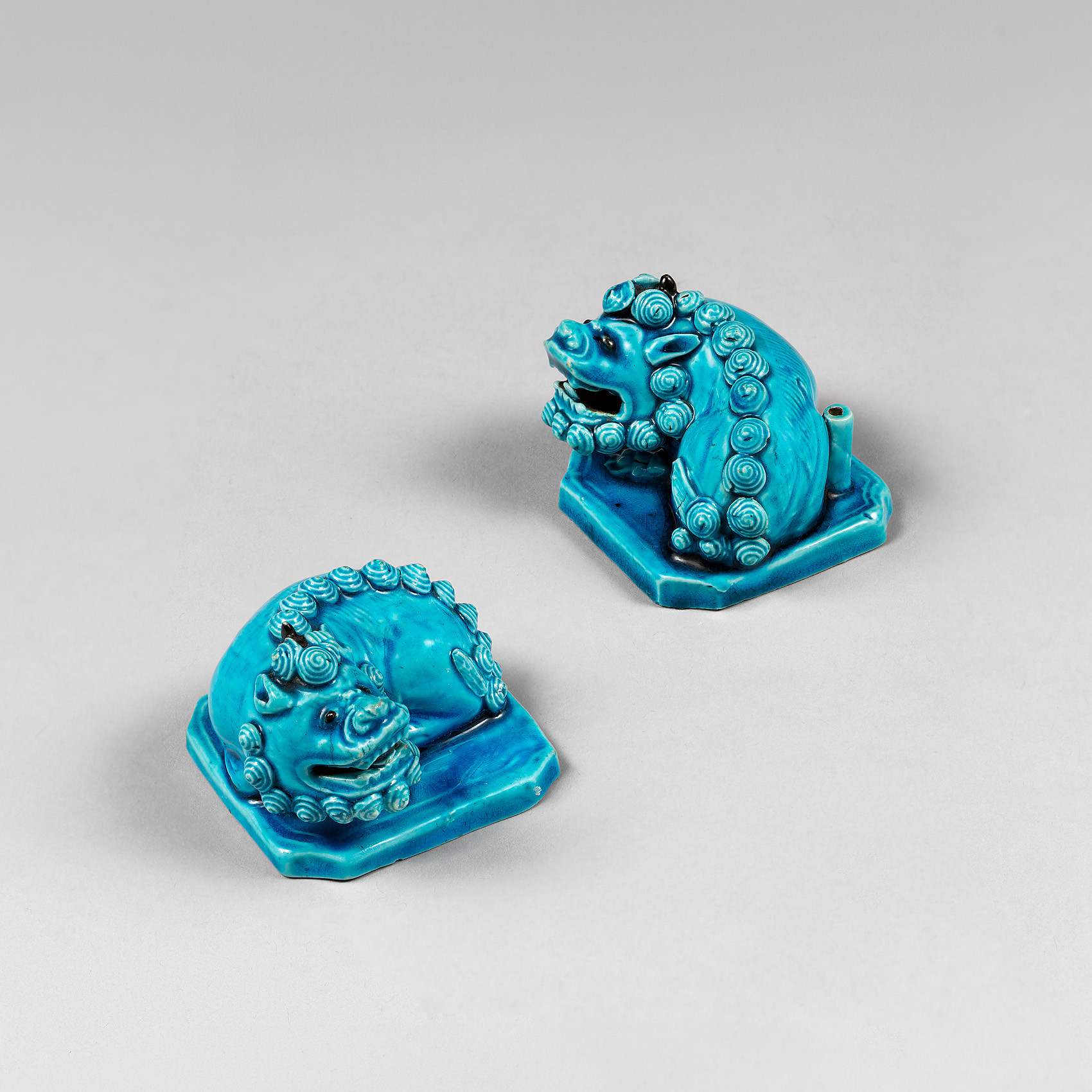
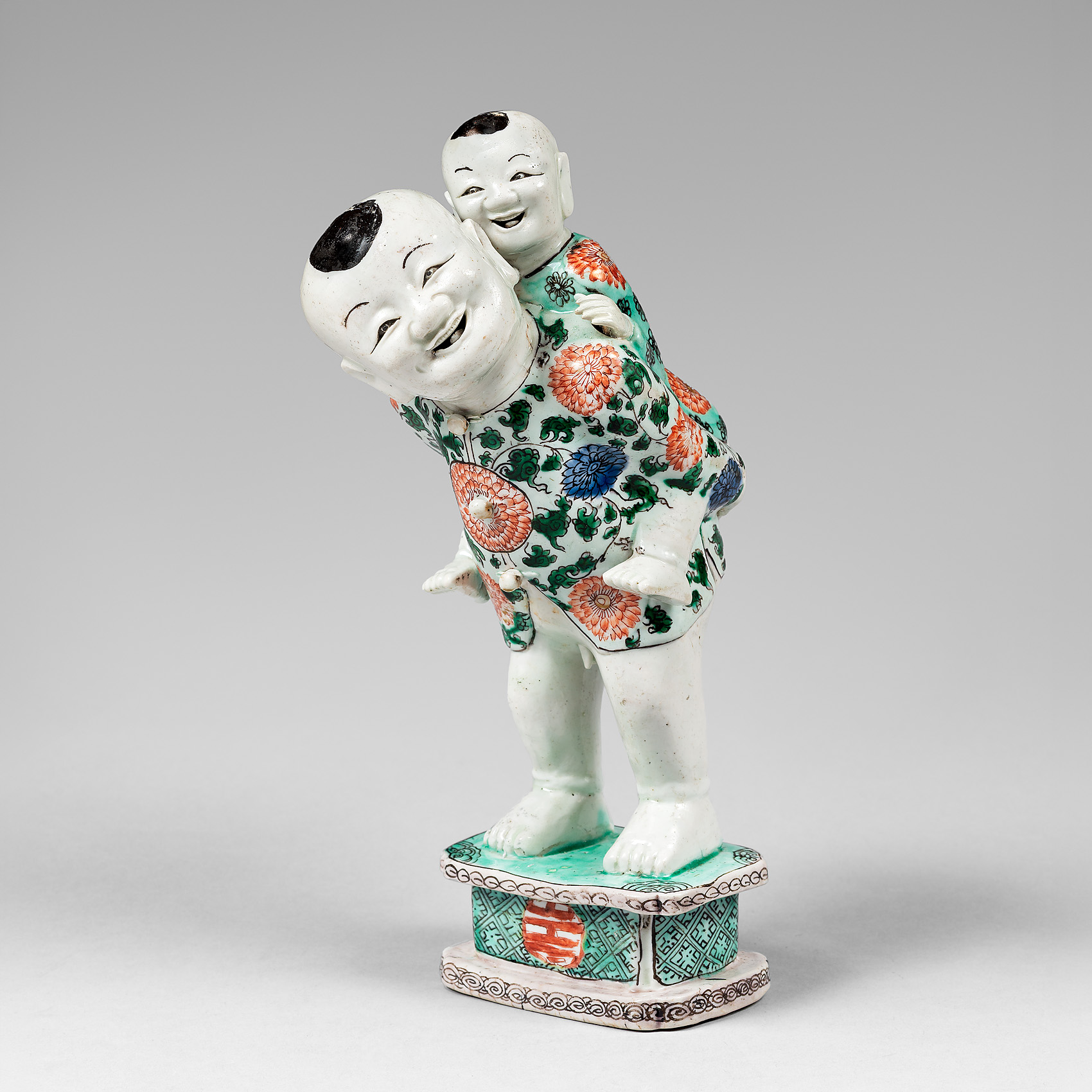
Additional information.Even though many 18th-century Chinese turquoise pieces were intended for export to the West, they must also be understood within the cultural context of their production. The diverse forms created in this palette provide a unique insight into Chinese heritage. While much of the production centred on religious figures, many turquoise biscuit wares from the Kangxi period (1662–1722) were initially intended for the scholar’s studio. Chinese potters devoted exceptional care to reproducing archaic forms in turquoise porcelain—objects deeply connected to the aesthetic of the literati. The very name of the palette evokes the world of scholar-officials. Indeed turquoise glaze is known in Chinese as Kongque lan, or “Peacock Blue.” The peacock was a symbol of rank and dignity, most notably represented by the peacock feathers awarded by the Qing Emperors to be worn on the hats of high-ranking officials. The number of “eyes” on the feather—one, two, or three—was strictly regulated by the imperial court to indicate the wearer’s specific grade and merit.
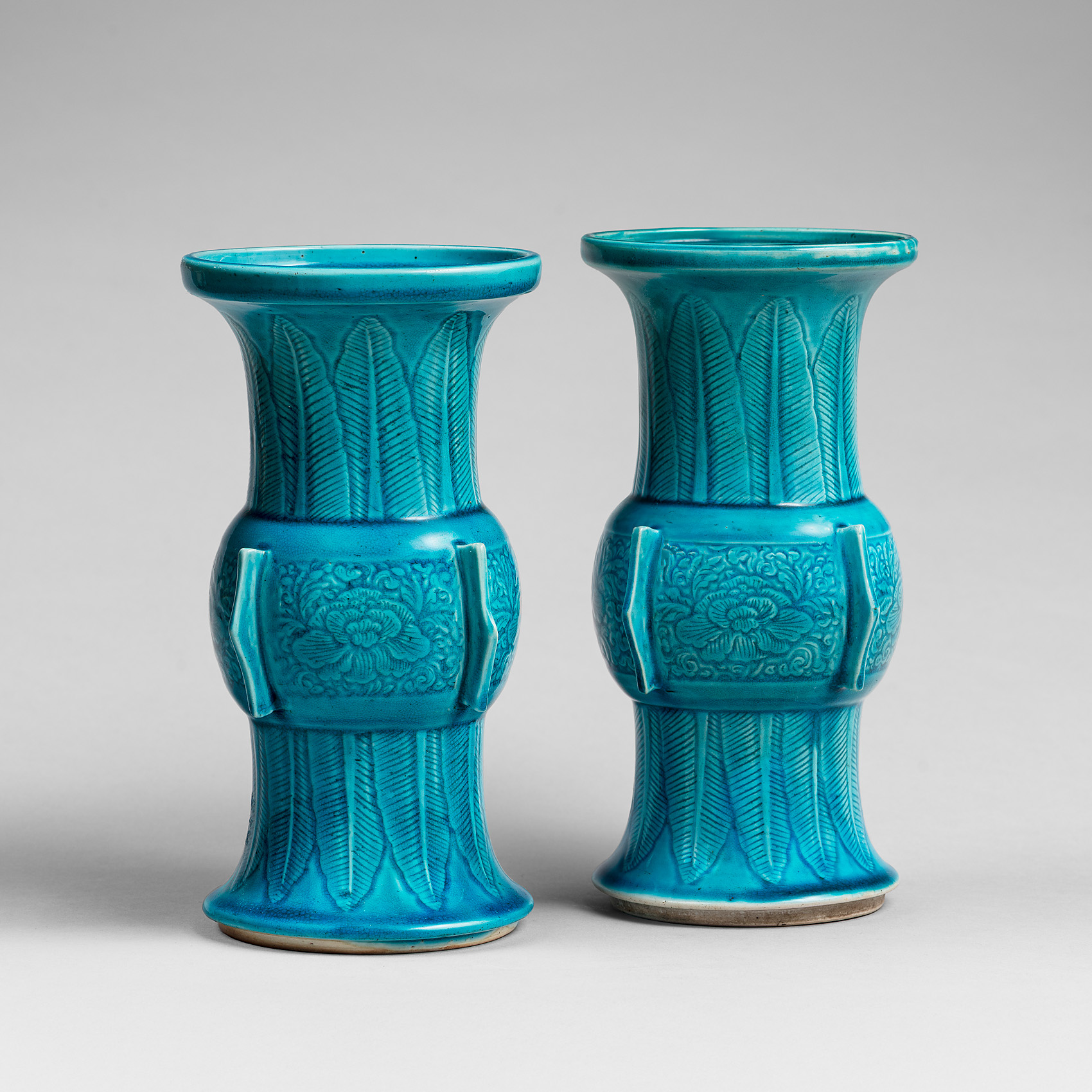
The zun (尊) form originates in the ritual bronze vessels of the Shang (c. 1600–1046 BC) and Zhou (1046–256 BC) dynasties, where it was used to hold wine offerings in ceremonial contexts. Defined by a powerful vertical silhouette, with a cylindrical or slightly swelling body surmounted by a flared, trumpet-shaped neck, the structure is typically articulated in distinct horizontal registers, lending the piece a stable, architectural presence. From the Song (960–1127) dynasty onward, potters revived this form in an archaistic spirit, drawing inspiration from ancient bronzes admired by scholars and collectors. The emphasis gradually shifted from ritual function toward purity of line and the tactile quality of the glaze. Under the Ming and especially the Qing dynasties, the zun became a preferred vessel for monochrome glazes and moulded decorations, reflecting a deeply cultivated antiquarian taste.
This aesthetic was championed by figures such as the influential scholar Wen Zhenheng (1585–1645), who in his Treatise on Superfluous Things (Zhangwu Zhi) advocated for the use of ancient zun bronze vases as receptacles for flower arrangements, noting that a single flowering branch could bridge the gap between the natural and the eternal.
The original bronzes of antiquity were typically adorned with symmetrical motifs such as the ferocious taotie mask, whereas the present vases offer a more complex stylistic synthesis. The rigid architectural frame of the archaic zun is softened by the inclusion of naturalistic peony sprays. While the austere Wen Zhenheng might have questioned such a decorative departure, the Qing artistic repertoire thrived on this very ability to repurpose classical models.
Even when rendered in porcelain, the zun retains strong scholarly associations, evoking a continuity with China’s ancient past through a formal language rich in historical reference. Its powerful, structured silhouette lends the piece a presence that is at once dignified and decorative, explaining its enduring appeal in later archaistic productions. Beyond its visual appeal, the peony (mudan) serves as a metaphor for integrity under the shifting caprices of power. This is captured in a legend involving the formidable Empress Wu Zetian (r. 690–705), the only female sovereign in Chinese history to have reigned in her own right. The Empress once commanded all flowers to bloom in mid-winter; the peony alone refused to bow to her imperial whim. After being banished to Luoyang and set ablaze, the flowers miraculously regrew (to this day, Luoyang remains the horticultural heartland of the peony). This moral fortitude is complemented by the flower’s romantic associations, most notably in the late-Ming masterpiece The Peony Pavilion by Tang Xianzu (1550–1616). In this drama, the eponymous Peony Pavilion (Mudan ting) is the place where the accomplished heiress Du Liniang encounters in a dream the impoverished but promising young scholar Liu Mengmei—a destined union that she spends the rest of the play seeking to realize.
A pre-eminent example of this French fascination is the celebrated turquoise porcelain garniture including a perfume fountain, now held in the Louvre[1], formerly in the collection of Queen Marie-Antoinette. As discussed by Stéphane Castelluccio in Collecting Chinese and Japanese Porcelain in Pre-Revolutionary Paris[2], these Chinese wares were paradoxically recorded in Ancien Régime inventories as “Japanese.” At the time, such hesitant typologies were not merely geographical errors; the label “Japanese” was often a mark of prestige, signifying a quality of paste and glaze considered superior to standard Chinese exports.
[1] OA 47, OA 49, OA 5267
[2] Los Angeles, The J. Paul Getty Museum, 2013.