Additional information.The Commission of the Duc de Luynes (1695–1758)
By Patrice Vasson, independent scholar
In Paris under the Regency of Philippe d’Orléans, immense fortunes were made and lost amid the speculative frenzy unleashed by John Law’s financial system. Shares in the Mississippi Company soared, fuelling a fever of speculation. Those who prospered from the scheme became known as the enrichis du système, or “Mississippians”; through their connections with the Orléans and Condé families, they successfully advanced their interests. All cultivated a taste for the arts and left their mark on the urban landscape. Grand hôtels particuliers, decorated in the latest fashion, were erected, while existing residences were lavishly remodelled amid this climate of financial exuberance. John Law’s reorganisation of the Company gave rise to a new commercial structure, whose monopoly was definitively re-established in 1723.
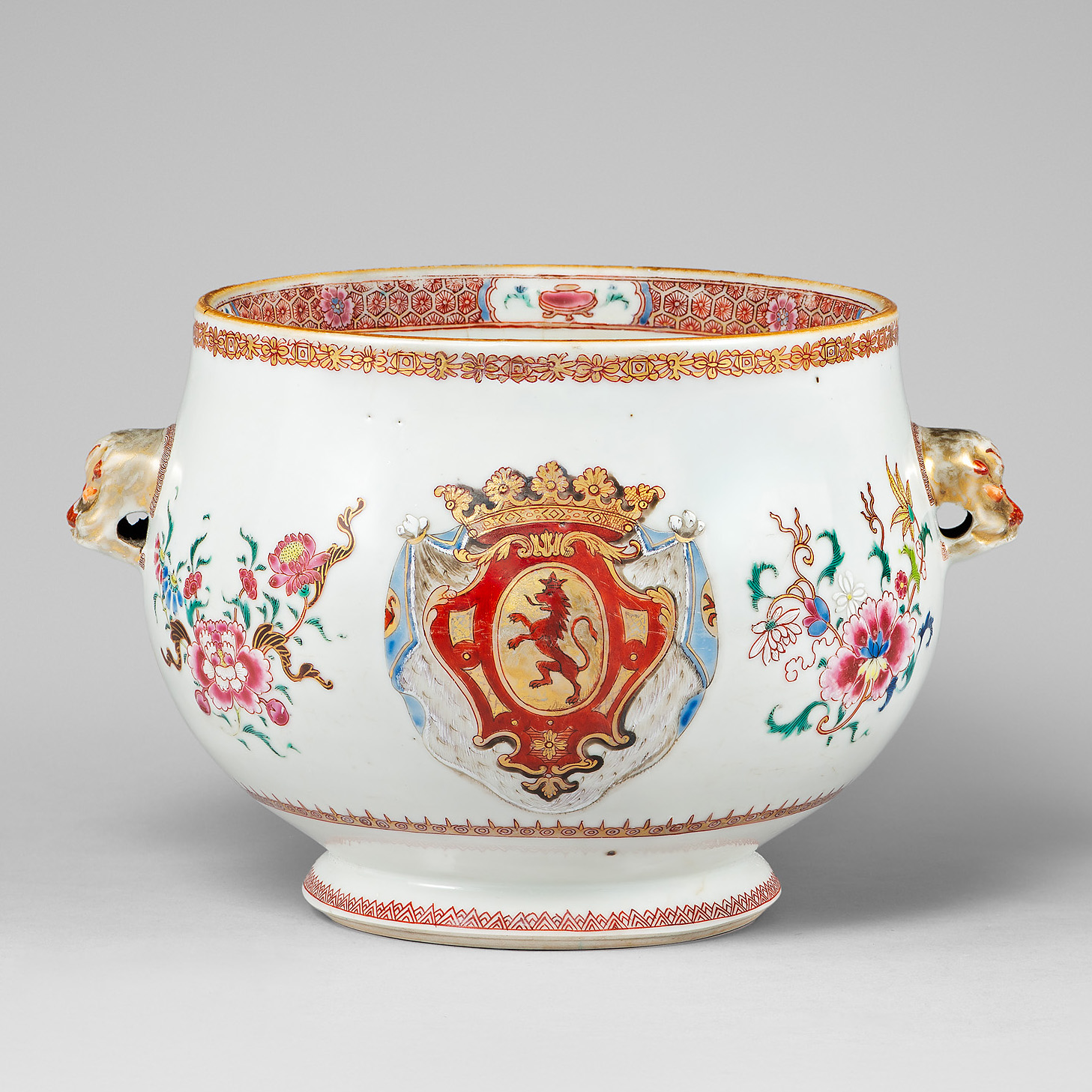
Following the Chinese porcelain commissions made for the King and the Comte de Toulouse, a new type of commission emerged around 1725 for prestigious and wealthy patrons moving within the circles of royal power or the French East India Company. These wares adopted decorative elements from the armorial service enamelled in the famille verte palette for King Louis XV, but rendered them instead in famille rose enamels. Dispersed over time or broken through everyday use, only a small number of pieces from these commissions have survived. Exceptionally limited in number, they all share a common decorative vocabulary: a honeycomb border, a band depicting the collar of the Order of the Holy Spirit, opposing cartouches containing the double-L cipher directly derived from Louis XV’s commission, and scattered sprays of peonies.
The patrons were:
- Louis-Auguste d’Albert d’Ailly, Duc de Chaulnes (1676–1744), uncle of the Duc de Luynes and one of the eight honorary directors appointed by the assemblies of shareholders of the French East India Company in 1721.
- Charles-Philippe d’Albert, Duc de Luynes (1695–1758).
- Noël Danycan de l’Épine (1656–1735), the celebrated Saint-Malo shipowner and former privateer in the service of Louis XIV, whose son, Noël Danycan de Landivisiau (1686–1730), served as Commissaire général of the Bank and the French East India Company from 1720 to 1721, and as an inspector of the Company from 1723 until his death.
- Nicolas-Michel Judde (1694–1770), a Rouen merchant and secretary to the Great Chancery of the kingdom, who in 1733 settled in the same street as the headquarters of the French East India Company, the rue Neuve-des-Petits-Champs.
- Louis-Euverte Angran (1678–1733), a member of the first bureau of the Conseil des Indes in 1723, intendant du commerce in 1724, and inspector and royal commissioner to the French East India Company from 1723 to 1731.
- André Jubert de Bouville (1698–1742), councillor at the Cour des Aides in Paris.
- Philippine-Élisabeth d’Orléans (1714–1734), daughter of the Regent.
- Louis-Nicolas de Neuville de Villeroy (1663–1734), younger son of François de Neufville de Villeroy (1644–1730), Marshal of France and Duke of Villeroy.
The decoration of the service commissioned around 1725 by Charles-Philippe d’Albert de Luynes constitutes a genuine rediscovery, as the commission is not recorded in the literature devoted to the subject.[1] A teabowl and saucer, together with a plate and a pair of barber bowls from the same commission, are preserved in three private collections. The service was most likely intended for the Château de Dampierre, one of the finest residences in France.
Charles-Philippe d’Albert, 4th Duc de Luynes and de Chevreuse, was born in Paris on 30 July 1695. He was the son of Honoré-Charles d’Albert, lieutenant-captain of the King’s Chevau-Légers, and Marie-Jeanne de Courcillon (1671–1718), daughter of the Marquis de Dangeau, the celebrated chronicler of the court of Louis XIV. Considering him too young for court life, his father kept him away from Versailles, thereby shielding him from the moral dangers of a court constrained by the severity of Louis XIV. In 1710, he married Mademoiselle de Neufchâtel (1696–1721), then aged thirteen and a member of the Bourbon-Soissons family. Through the marriage, she brought him the sovereign principalities of Neufchâtel and Valangin. Charles-Honoré d’Albert, 3rd Duc de Luynes, died two years later, on 5 November 1712. On 25 July 1717, Charles-Philippe was appointed mestre de camp of a cavalry regiment bearing his name and served during the conflict between the Regent and Philip V, King of Spain. The war ended with the signing of the Peace of The Hague on 20 February 1720.
During the decade of his widowhood, much of which he spent in retirement at the Château de Dampierre, the Duc devoted himself to various improvements to its interiors and furnishings. It was in this context that, in 1722, he commissioned Hyacinthe Rigaud to paint a portrait of his five-year-old son, Marie-Charles-Louis. It was also during these years that the two armorial porcelain commissions were placed.
His aunt, Jeanne-Baptiste d’Albert de Luynes (1670–1736), who became Comtesse de Verrue, had been the mistress of Victor Amadeus II, Duke of Savoy. After fleeing the court of Turin, she returned to Paris in 1700 and settled in an hôtel particulier in the rue du Cherche-Midi. Widowed in 1704, she spent her immense fortune there, indulging an extraordinary passion for collecting. Her friendship with the Condé family placed her at the heart of political and financial circles during the Regency. She became involved at an early stage and on a considerable scale, first in the French East India Company and subsequently in Law’s financial system. Thanks to her connections, she withdrew in time to escape the collapse of 1720. Her circle included the Vicomte Angran de Fontpertuis, an important collector of porcelain, lacquer and “shells”. She shared with him a passion for works of art and curiosities, which she acquired in profusion. She even had, for example, “rare birds from the Indies brought over at immense expense”.[2]
The only known representation of Charles-Philippe d’Albert de Luynes is a drawing made in 1758 by Louis Carrogis de Carmontelle.[3] The Duc is shown standing, leaning against a daybed, seemingly lost in thought, with a serene expression. Before him, Chinese porcelain cups are arranged on a tray upon a table, a detail that seems to evoke his taste for the precious wares and luxuries of the East.
[1] Antoine Lebel, Armoiries françaises et suisses sur la porcelaine de Chine au XVIIIe siècle, 2009.
[2] Noémie Wansart, L’entourage de la comtesse de Verrue : une circulation originale des œuvres d’Art, Cahiers Saint-Simon, 2009, p. 5.
[3] Musée Condé, Chantilly, CAR 174.