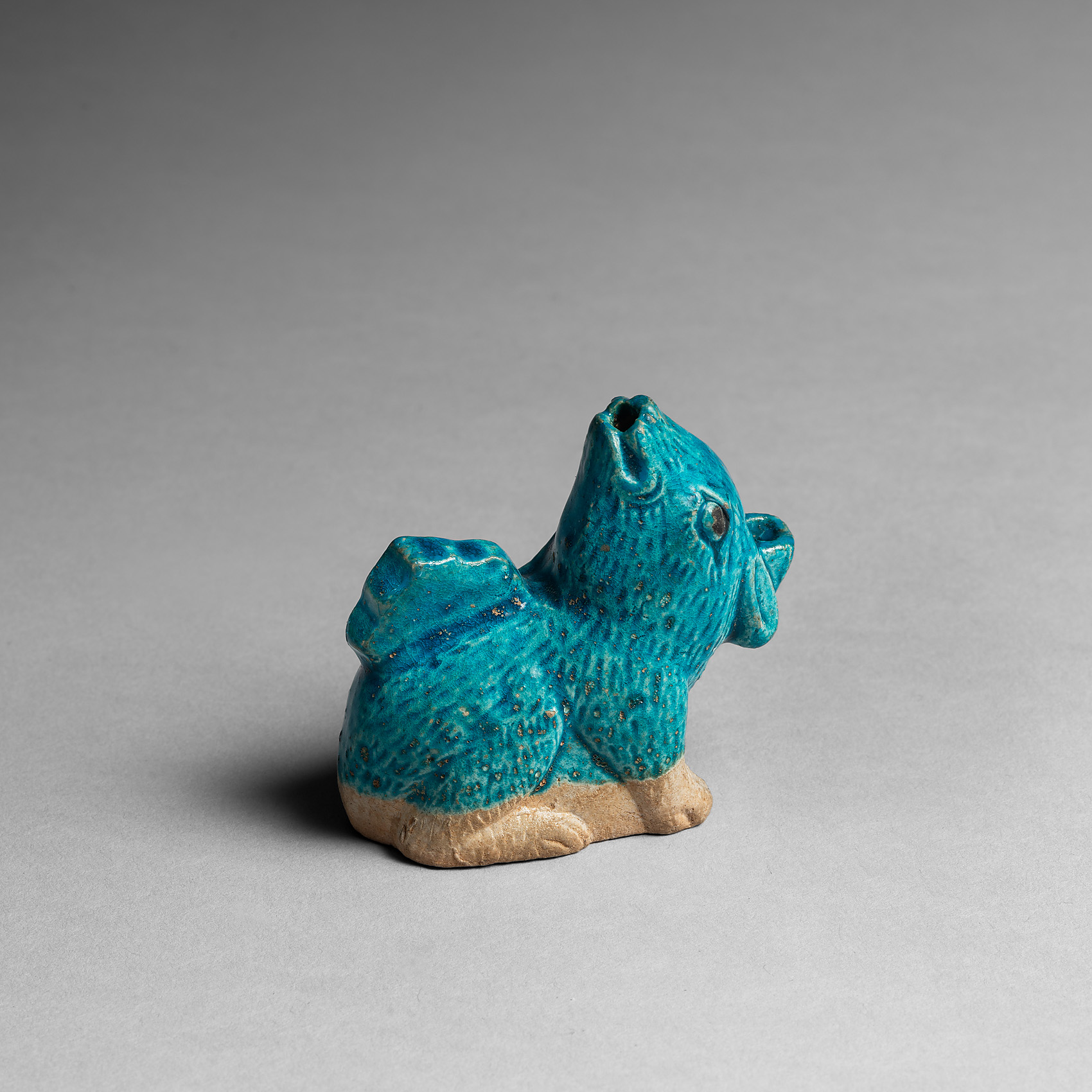
A Chinese turquoise-glaze “rabbit in the moon” water dropper. Kangxi

The figure depicts a rabbit lying down, its head raised toward the sky and mouth slightly open, holding in its jaws a stem of lingzhi fungus, the rounded cap of which rests upon its back. The volumes are full, with the legs folded beneath the body and the head finely proportioned. The animal is covered with a brilliant turquoise glaze. A small opening behind its head allows water to be poured.
COUNTRY : China
PERIOD : Kangxi (1662-1722)
MATERIAL : Porcelain (biscuit)
SIZE : 6,5 cm x 5 cm
REFERENCE : E719
STATUT : sold
Additonal informations :

In Chinese, it is called 月兔 (yuè tù), literally “Moon Rabbit,” but also 玉兔 (yù tù), “Jade Rabbit” — the term “jade” evokes purity, brilliance, and celestial radiance. The most widespread legend presents it as the companion of the Moon goddess, Chang’e (嫦娥), seen pounding or grinding an elixir of immortality in a mortar for the deities and immortals.

The myth of the Moon Rabbit dates back to ancient poems of the Han dynasty and even earlier. In the anthology Chu Ci, it is mentioned that there is a rabbit on the Moon pounding herbs for the immortals. During the Tang dynasty and later periods, the motif reappeared frequently in poetry — for instance, Li Bai evokes the Moon Rabbit in several of his poems. Over time, the Moon Rabbit became an integral part of the Mid-Autumn Festival celebrations, when people admire the full moon, share mooncakes, and recall the association between Chang’e and the rabbit.

Demande de condition report

Question about condition report