A large famille rose cockerel figure. China, Qianlong

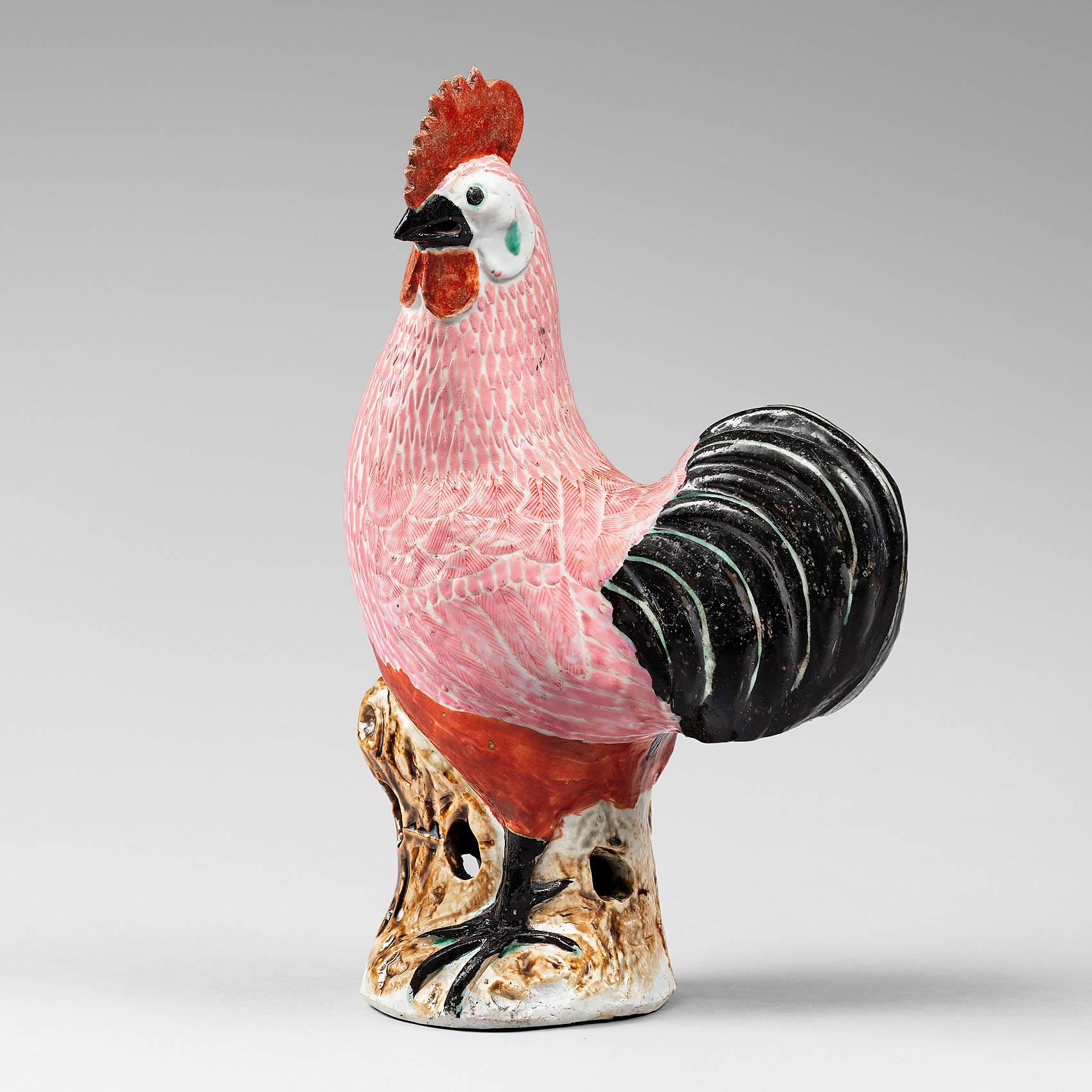
The rooster is depicted standing upright, its body leaning slightly forward, its head turned to the left. The surface of the body is carefully modelled and incised to render the texture of the plumage, with overlapping feathers indicated on the breast, wings and back. The rest of the body is enamelled in pink.

The head is left plain, with the comb and wattles enamelled in red. The beak, the eyes, the tail, the legs and the claws are enamelled in black on green.The tail is formed of layered, arched feathers, enamelled with thin lighter lines accentuating the curvature and segmentation of the feathers. The figure stands on a pierced base modelled as a tree stump or mound, enamelled in tones of brown, ochre and cream, with apertures on the sides. The underside of the base is left unglazed.

COUNTRY : China
TIME: Qianlong (1736-1796), circa 1750-1780
MATERIAL : Porcelain
SIZE : 30 cm
REFERENCE : E665
PROVENANCE : Collection Héliot & Fils, 52 avenue Victor Emmanuel III, Paris
STATUS : vendu
Related works .

Six comparable pairs of famille rose roosters[1] are listed in the 1777 inventory of the Chinese Pavilion at Drottningholm where they are still on display.

A pair of figures, from the Copeland collection are preserved in the collection of the Peabody Essex Museum. They are illustrated by Bill Sargent in The Copeland Collection: Chinese and Japanese Ceramic Figures, 2006, pp. 141-143.

Laurent Héliot (1848–1909) was a Parisian art dealer, originating from Burgundy. His life and career are sparsely documented, and he often appears only as a name in lists of dealers or donors. He nevertheless played a significant role in building the collection of Ernest Grandidier (1833–1912), supplying nearly a third of the ceramics.

Several French museums acquired objects from Laurent Héliot who also made a number of donations to public institutions. He loaned pieces for the exhibitions organised by the Union centrale des Arts décoratifs. He appears as one of the “active members” of the Association amicale franco-chinoise in the year of its foundation.

His sons, Gaston Héliot (1879–1936) and Maurice Héliot (1877–?), donated a large baluster vase to the Musée du Louvre in memory of their father a few weeks after his death; the vase is on display in the Musée Guimet [2]in Paris.

Between 1886 and 1910, the Union centrale des Arts décoratifs purchased thirty-five Chinese pieces from Héliot, dating from the Ming and Qing dynasties—including twenty-four porcelains and eight glass pieces—as well as a small number of Japanese works. After 1909, Gaston Héliot resumed his father’s activity as a dealer in Asian art, possibly with the assistance of his brother. In the 1920s, Gaston Héliot became Vice-President of the Société des Amis du musée Cernuschi.

[1]  Aka Setterwall, The Chinese Pavilion at Drottningholm, Allhem, Sweden, 1974

[2] Inv. G 565

Additional information.

In China, the rooster (gongji) is a motif frequently found across decorative arts. The homophone ji means both “rooster” and “fortunate” which makes the bird an auspicious symbol.

A rooster has five virtues: a literary mind, marked by the comb; a warlike disposition, marked by the spurs; courage, as he fights his enemies; benevolence, as he clucks for the hens while scratching for grain; and faithfulness, as he never loses track of time.

It is also one of the twelve animals in the Chinese zodiac. People born in the Year of the Rooster are believed to possess three traits : a gift of observation, ambition, and resourcefulness.The cockerel is also associated with the idea of vigilance and protection, often serving as a guardian against evil spirits. Its crowing at dawn symbolizes the arrival of a new day, bringing with it new opportunities along with the removal of darkness. Additionally, the rooster is linked in folklore to the sun, symbolizing brightness, positivity, and vitality.

Question about condition report

Question about condition report