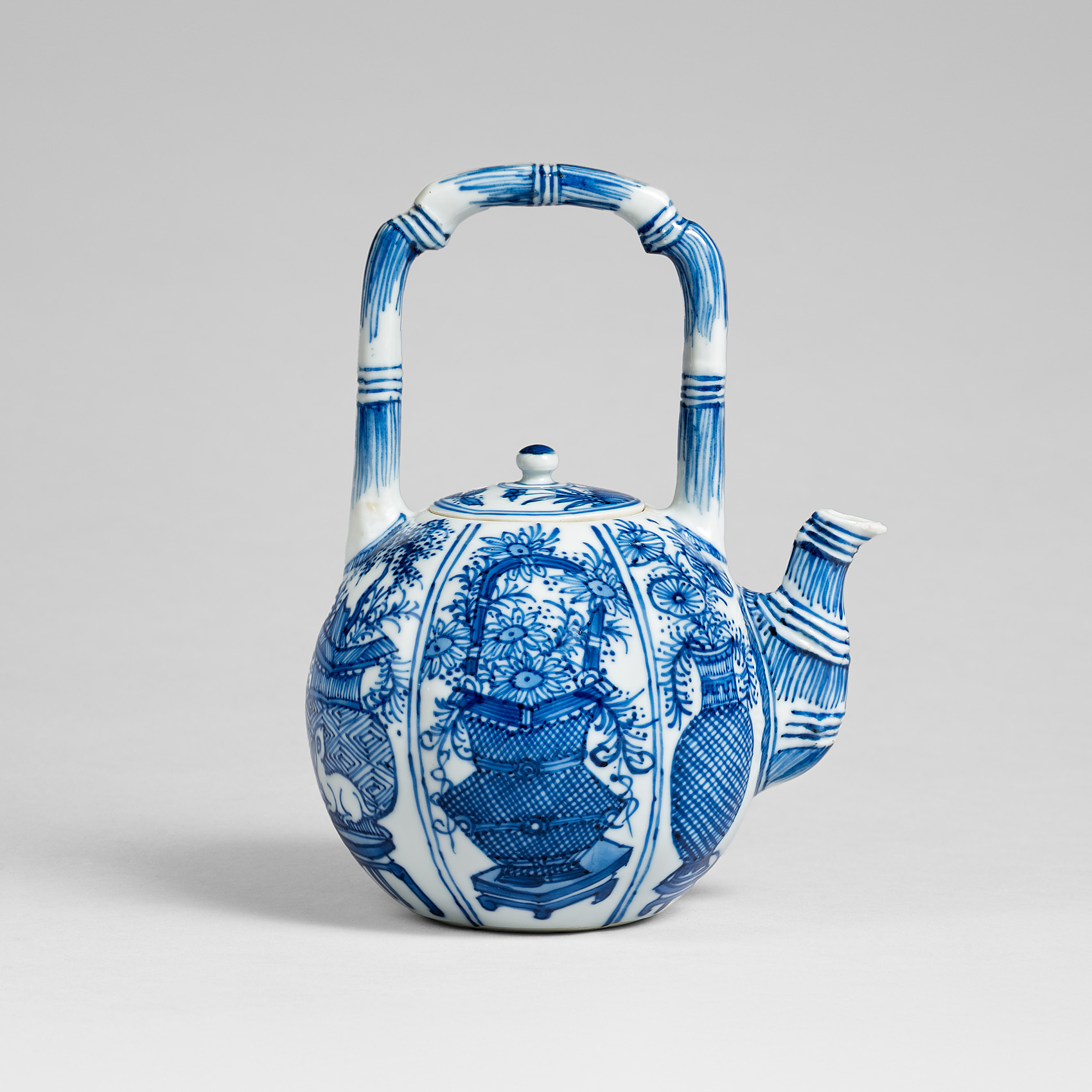
A Chinese blue and white “ball-form” teapot. Kangxi

The teapot is painted with six panels of vases and baskets of flowers holding lotus, prunus, morning glory and aster, with a large rabbit beneath a bamboo-form upright gate handle and bamboo-form spout, the cover with flower sprays and rockwork, executed in the same linear fashion.
COUNTRY : China
TIME: Kangxi (1662-1722)
MATERIAL : Porcelain
SIZE : 17 cm
REFERENCE : E981
STATUS : vendu
Related works.

An identical teapot, acquired by Charles Phelps Taft (1843-1929) and Anna Sinton Taft (1850-1931), is illustrated by Anthony du Boulay in The Taft Museum, Its History and Collections, Vol. II, p. 593 (inventory 1931.69a-b).

Additional information.

Forms inspired by nature flourished during the Kangxi period. The bamboo motif, long celebrated in Chinese painting and poetry, became a favoured subject in porcelain. Although bamboo was not used for teapots, it served many purposes. Young shoots were eaten, and leaves were used for wine, raincoats, thatch or packing material. Stems became pipes or furniture, while pulp was used for paper. Various parts of the plant also possessed medicinal properties. A cornerstone of Chinese poetry, bamboo embodies a profound range of symbolic meanings. Its swaying in the wind is described as “bending in laughter”. The word zhu (bamboo) is also a homonym for “to wish” or “to herald”. As it flourishes throughout winter, bamboo is an emblem of longevity. It is admired as one of the “Three Friends of Winter”—alongside pine and plum—for its ability to endure the cold.

See other items

Question about condition report

Question about condition report